
Birdr

Bisbita Liso vs Bisbita Roquero

Anthus leucophrys frente a Anthus crenatus

Juega un quiz con Bisbita Liso y Bisbita Roquero
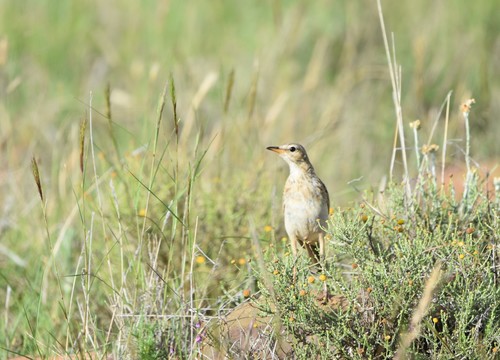
Bisbita Liso (Anthus leucophrys) Bisbita Liso
Bisbita Roquero (Anthus crenatus) Bisbita Roquero

Medios

Cargando…

En breve

El Bisbita Roquero se identifica mejor por su distintivo canto whee-prreuuu y su postura característica cuando está posado sobre rocas. En contraste, el Bisbita Liso carece de una vocalización y postura tan únicas, lo que dificulta su identificación solo por el sonido.

Consejos de identificación

  1. Escucha el fuerte canto whee-prreuuu del Bisbita Roquero. 2. Busca al Bisbita Roquero posado sobre rocas con una postura erguida. 3. Considera la ubicación geográfica; el Bisbita Roquero es endémico de regiones específicas en Sudáfrica y Lesoto.

Plumaje

Las características del plumaje no son fiables para distinguir estas dos especies.

Comportamiento

El Bisbita Roquero a menudo se posa sobre rocas con el cuerpo erguido y la cabeza inclinada, un comportamiento que no se ha notado en el Bisbita Liso.

Hábitat

El Bisbita Roquero es endémico de Sudáfrica y Lesoto, y se encuentra principalmente en áreas rocosas a lo largo del Gran Escarpe y mesetas adyacentes. Las preferencias de hábitat del Bisbita Liso no se detallan aquí.

Voz

El Bisbita Roquero tiene un canto distintivo y fuerte whee-prreuuu, que es un identificador clave. Las vocalizaciones del Bisbita Liso no se describen en estas notas.

Enviar una descripción mejor

Usa las mismas secciones que la comparación. El texto se publica al momento.

The Yellow-tufted Pipit is best identified by its distinctive whee-prreuuu call and characteristic posture when perched atop boulders. In contrast, the Plain-backed Pipit lacks such a unique vocalization and posture, making it harder to identify by sound alone.

  1. Listen for the Yellow-tufted Pipit's loud whee-prreuuu call. 2. Look for the Yellow-tufted Pipit perched on boulders with an upright posture. 3. Consider the geographic location; the Yellow-tufted Pipit is endemic to specific regions in South Africa and Lesotho.

Plumage features are not reliable for distinguishing these two species.

The Yellow-tufted Pipit often perches on boulders with an upright body and tilted head, a behavior not noted for the Plain-backed Pipit.

The Yellow-tufted Pipit is endemic to South Africa and Lesotho, primarily found in rocky areas along the Great Escarpment and adjacent plateaus. The Plain-backed Pipit's habitat preferences are not detailed here.

The Yellow-tufted Pipit has a distinctive, loud whee-prreuuu call, which is a key identifier. The Plain-backed Pipit's vocalizations are not described in these notes.

¿Descartar los cambios?

Tienes ediciones sin guardar. Si sales ahora, se perderán.

Bisbita Liso · Bisbita Roquero · Mis aves difíciles