
Akiapolaau d'Hawaï vs Amakihi d'Oahu
Hemignathus wilsoni contre Chlorodrepanis flava
Faire un quiz avec Akiapolaau d'Hawaï et Amakihi d'Oahu
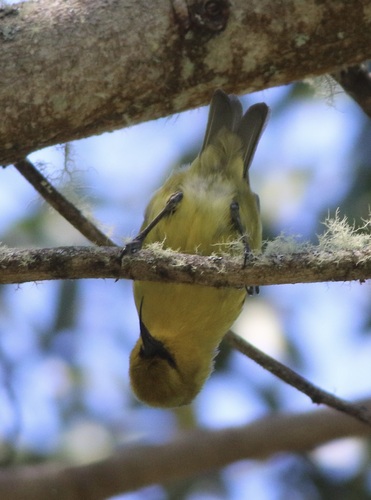 Akiapolaau d'Hawaï
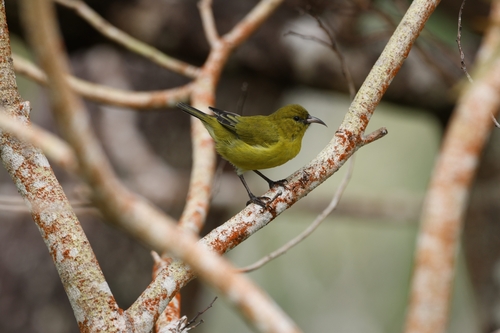 Amakihi d'Oahu
En bref
L'Akiapolaau d'Hawaï d'Hawaï d'Hawaï et l'Amakihi d'Oahu peuvent être distingués par la forme de leur bec et leur comportement alimentaire. L'Akiapolaau d'Hawaï d'Hawaï d'Hawaï a un bec unique et spécialisé avec une mandibule supérieure longue et courbée et une mandibule inférieure plus courte et droite, adaptée pour sonder et extraire des insectes de l'écorce des arbres. En revanche, l'Amakihi d'Oahu a un bec plus court et décourbé, adapté à l'alimentation en nectar.
Conseils d’identification
- Forme du bec : Recherchez la mandibule supérieure longue et courbée et la mandibule inférieure plus courte de l'Akiapolaau d'Hawaï d'Hawaï.
- Comportement de recherche de nourriture : Observez les habitudes alimentaires ; l'Akiapolaau d'Hawaï d'Hawaï sonde l'écorce, tandis que l'Amakihi d'Oahu se nourrit de nectar.
- Préférence d'habitat : L'Akiapolaau d'Hawaï d'Hawaï préfère les forêts natives avec de grands arbres, tandis que l'Amakihi d'Oahu est plus adaptable.
Plumage
Les deux espèces ont un plumage vert olive similaire, rendant la couleur un critère de distinction moins fiable.
Comportement
L'Akiapolaau d'Hawaï d'Hawaï d'Hawaï est connu pour son comportement de recherche de nourriture spécialisé, utilisant son bec unique pour sonder l'écorce des arbres à la recherche d'insectes. L'Amakihi d'Oahu, en revanche, est plus généraliste dans son alimentation, souvent observé en train de se nourrir de nectar et de petits insectes.
Habitat
Bien que les deux espèces habitent les forêts hawaïennes, l'Akiapolaau d'Hawaï d'Hawaï d'Hawaï est plus spécialisé dans sa préférence d'habitat, se trouvant souvent dans des forêts natives avec de grands arbres adaptés à son style de recherche de nourriture. L'Amakihi d'Oahu est plus adaptable, se trouvant dans une gamme de types de forêts, y compris les forêts xériques et mésiques.
Akiapolaau d'Hawaï · Amakihi d'Oahu · Mes oiseaux difficiles