
Gallinule africaine vs Gallinule poule-d'eau
Paragallinula angulata contre Gallinula chloropus
Faire un quiz avec Gallinule africaine et Gallinule poule-d'eau
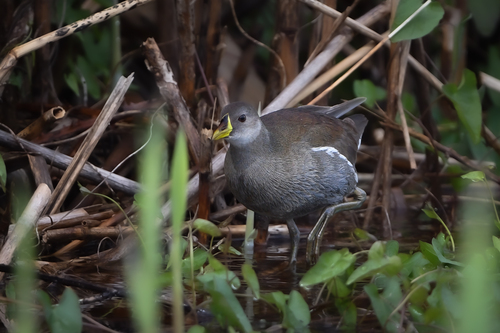 Gallinule africaine
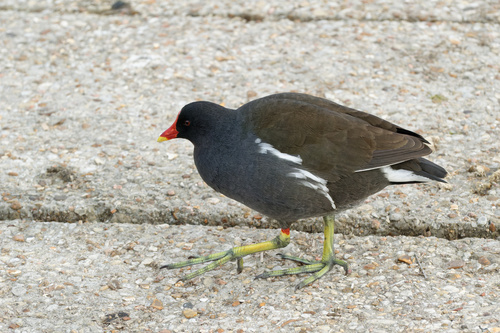 Gallinule poule-d'eau
En bref
La Gallinule africaine et la Gallinule poule-d'eau peuvent être distinguées par leur plumage et leur comportement. La Gallinule poule-d'eau a une bande blanche de flanc plus prononcée et un bec rouge avec une pointe jaune, tandis que la Gallinule africaine n'a pas ces caractéristiques. La Gallinule poule-d'eau présente également un comportement distinctif de mouvement de queue.
Conseils d’identification
Recherchez la bande blanche de flanc prononcée et le bec rouge avec une pointe jaune sur la Gallinule poule-d'eau. Observez le comportement de mouvement de queue sur le terrain, qui est caractéristique de la Gallinule poule-d'eau.
Plumage
La Gallinule poule-d'eau est distinctement noire suie avec des parties supérieures plus brunes, une bande blanche de flanc prononcée mais brisée, et des couvertures sous-caudales latérales blanches. Elle a un bec rouge avec une pointe jaune et un bouclier frontal rouge. La Gallinule africaine n'a pas ces bandes blanches de flanc prononcées ni le bec rouge avec une pointe jaune.
Comportement
La Gallinule poule-d'eau est connue pour son habitude distinctive de bouger constamment sa queue en cherchant de la nourriture sur terre, ce qui n'est pas noté pour la Gallinule africaine.
Voix
La Gallinule poule-d'eau émet une large gamme de vocalisations, y compris des cris, des gloussements et des notes de bavardage. Les détails spécifiques de vocalisation pour la Gallinule africaine ne sont pas fournis.
Gallinule africaine · Gallinule poule-d'eau · Mes oiseaux difficiles