Birdr

saíra-lagarta vs saíra-galega

Tangara desmaresti versus Hemithraupis flavicollis

Jogue um quiz com saíra-lagarta e saíra-galega
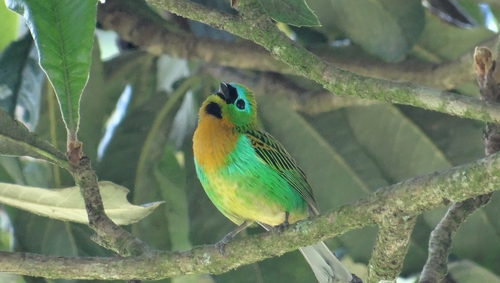
saíra-lagarta (Tangara desmaresti) saíra-lagarta
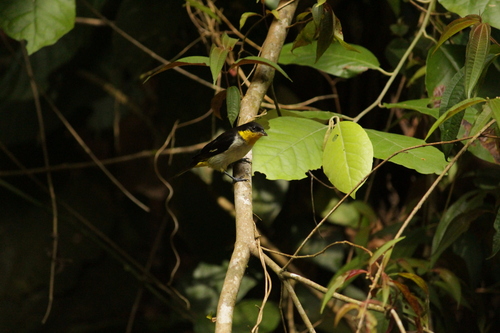
saíra-galega (Hemithraupis flavicollis) saíra-galega

Mídia

Carregando…

Em resumo

A saíra-lagarta é distinguida por seu padrão de peito laranja-amarelo e faixa azul-turquesa na cabeça, enquanto o macho da saíra-galega apresenta uma garganta amarela e parte inferior das costas e rabo amarelos com partes superiores predominantemente pretas. Ambas as espécies se juntam a bandos de espécies mistas, mas seus padrões de plumagem distintos são fundamentais para a identificação.

Dicas de identificação

Procure pelo padrão de peito laranja-amarelo e faixa azul-turquesa na saíra-lagarta. Para a saíra-galega, observe a garganta amarela e parte inferior das costas e rabo amarelos no macho. As fêmeas da saíra-galega são verde-oliva por cima e amarelas por baixo, o que pode ajudar a diferenciá-las da saíra-lagarta.

Plumagem

A saíra-lagarta tem uma plumagem predominantemente verde com um padrão de peito laranja-amarelo, faixa azul-turquesa nas laterais da cabeça e coroa, e uma coroa frontal e padrão de garganta pretos. Em contraste, o macho da saíra-galega é principalmente preto por cima, incluindo a coroa, com uma parte inferior das costas e rabo amarelos, e uma garganta amarela, enquanto o restante das partes inferiores é branco-acinzentado. As fêmeas da saíra-galega são principalmente verde-oliva por cima e amarelas por baixo.

Comportamento

Ambas as espécies são frequentemente observadas em bandos de espécies mistas.

Habitat

A saíra-lagarta habita bordas de florestas, crescimento secundário alto e plantações de 600 m a 2200 m, enquanto a saíra-galega é geralmente encontrada na copa de florestas razoavelmente altas.

Enviar uma descrição melhor

Use as mesmas seções da comparação. Seu texto é publicado na hora.

The Brassy-breasted Tanager is distinguished by its orange-yellow breast patch and turquoise blue band across the head, while the Yellow-backed Tanager male features a yellow throat and yellow lower back and rump with predominantly black upperparts. Both species join mixed-species flocks, but their distinct plumage patterns are key for identification.

Look for the orange-yellow breast patch and turquoise blue band on the Brassy-breasted Tanager. For the Yellow-backed Tanager, note the yellow throat and yellow lower back and rump on the male. Females of the Yellow-backed Tanager are olive-green above and yellow below, which can help differentiate them from the Brassy-breasted Tanager.

The Brassy-breasted Tanager has a mostly green plumage with an orange-yellow breast patch, turquoise blue band across the sides of the head and crown, and a black forecrown and throat patch. In contrast, the male Yellow-backed Tanager is principally black above, including the crown, with a yellow lower back and rump patch, and a yellow throat, while the rest of the underparts are off-white. Female Yellow-backed Tanagers are mainly olive-green above and yellow below.

Both species are frequently observed within mixed-species flocks.

The Brassy-breasted Tanager inhabits forest edges, tall second growth, and plantations from 600 m to 2200 m, while the Yellow-backed Tanager is usually found in the canopy of reasonably tall forests.

Descartar as alterações?

Você tem edições não salvas. Se sair agora, elas serão perdidas.

saíra-lagarta · saíra-galega · Minhas aves difíceis