
pomba-trocal vs juriti-vermelha
Patagioenas speciosa versus Geotrygon violacea
Jogue um quiz com pomba-trocal e juriti-vermelha
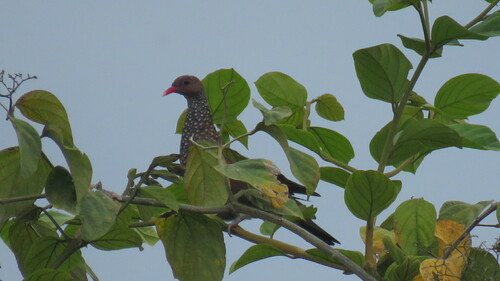 pomba-trocal
 juriti-vermelha
Em resumo
A marca de campo mais confiável para separar a pomba-trocal da juriti-vermelha é o tamanho e a estrutura: a pomba-trocal é muito maior e mais robusta, com uma aparência de pombo de cauda longa e ereta, enquanto a juriti-vermelha é uma pomba compacta, que vive no solo, com cauda curta e corpo arredondado. Em adultos, a pomba-trocal apresenta um padrão escamoso distinto no pescoço e nas partes inferiores, enquanto a juriti-vermelha tem um rosto e partes inferiores brancos contrastantes com iridescência roxa na nuca e nos ombros. Juvenis de juriti-vermelha não apresentam iridescência e mostram escamação avermelhada-canela acima, o que a pomba-trocal nunca mostra. A cor do bico e a cor dos olhos também diferem, mas cuidado com fêmeas e imaturos mais apagados. O habitat e o comportamento—arbóreo vs. terrestre—também são pistas fortes.
Dicas de identificação
- Size is the clearest separator: pomba-trocal is much larger and heavier than juriti-vermelha. If the bird looks pigeon-sized or larger, it's not a quail-dove.
- Structure and jizz: pomba-trocal is long-tailed, upright, and robust, often perching high; juriti-vermelha is short-tailed, round-bodied, and walks on the ground.
- Juvenile plumage: Juvenile juriti-vermelha is dark with reddish-cinnamon scalloping above and no iridescence—never shown by pomba-trocal at any age.
- Neck and underpart pattern: pomba-trocal (all ages/sexes) shows a scaly pattern on neck and underparts; juriti-vermelha (all ages/sexes) lacks this, instead showing clean white or pale underparts with purple tinge.
- Face pattern: juriti-vermelha has a grayish white face and throat (adult male) or pale gray face/throat (female), contrasting with the darker head; pomba-trocal has a uniform head with no pale face.
- Iridescence: juriti-vermelha (adults) shows purple/amethyst iridescence on hindneck and shoulders; pomba-trocal does not have this iridescence, but rather a uniform purplish or brownish tone.
- Bill color: pomba-trocal has a red bill with a white tip; juriti-vermelha has a dark bill.
- Eye color: pomba-trocal has a red eyering; juriti-vermelha's eye is yellow-brown to brown, never red.
- Sex differences: Female pomba-trocal is duller brown but still scaly; female juriti-vermelha is duller, with purple gloss only on hindneck/shoulders, but still has pale face and underparts.
- Flight behavior: pomba-trocal flies high and fast with regular wingbeats and sharp flicks; juriti-vermelha flushes low from the ground and rarely flies high.
- Perching behavior: pomba-trocal is usually seen perched in trees; juriti-vermelha is almost never seen perched high, usually on the ground or low branches.
- Habitat context: In semi-open or edge forest, especially in the canopy, expect pomba-trocal; in dense, shaded forest interior, especially on the ground, expect juriti-vermelha.
- Solitary habits: Both are solitary, but pomba-trocal is more likely to be seen alone in the open, while juriti-vermelha is secretive and skulking.
- Vocalization: If you hear deep, cooing cro ku-ks, it's pomba-trocal; juriti-vermelha's voice is not described here.
- Pitfalls: Dull females of both species can be confusing; rely on size, structure, and underpart pattern. Immature juriti-vermelha can look quite dark but always lacks scaly pattern and shows reddish scalloping above.
Tamanho
A pomba-trocal é dramaticamente maior, com cerca de 36 cm de comprimento e cerca de 290 g (segundo a Wikipedia), em comparação com os 20–24,5 cm e 93–150 g da juriti-vermelha [wikidata]. No campo, a pomba-trocal parece grande e robusta, com uma cauda longa e corpo pesado, enquanto a juriti-vermelha é visivelmente menor, compacta e de cauda curta. Essa diferença de tamanho é óbvia mesmo à distância ou em situações de espécies mistas.
Plumagem
- Juvenil/Imaturo: A juvenil juriti-vermelha é escura no geral, sem iridescência, e tem escamação avermelhada a canela nas partes superiores. Juvenis de pomba-trocal não são descritos em detalhes, mas nenhuma escamação semelhante ou falta de iridescência é notada; espera-se que se assemelhem a adultos mais apagados.
- Macho Adulto: Machos de pomba-trocal são principalmente roxo-acastanhados com um padrão escamoso pálido no pescoço e partes inferiores, e uma barriga esbranquiçada com bordas roxas. Machos de juriti-vermelha têm uma coroa roxa acinzentada, rosto branco acinzentado, nuca e ombros iridescentes roxos/ametistas, partes superiores marrons com um tom roxo, e um peito e barriga brancos a com um tom roxo.
- Fêmea Adulto: A fêmea da pomba-trocal é mais apagada e mais marrom, mas ainda mostra um padrão escamoso. A fêmea da juriti-vermelha é mais apagada que o macho, com brilho roxo limitado à nuca e ombros, rosto e garganta cinza pálido, e pescoço/peito acastanhados com um tom roxo. As fêmeas de ambas as espécies são menos coloridas, mas o padrão escamoso vs. rosto/partes inferiores brancas permanece uma diferença chave.
- Bico e Olho: A pomba-trocal tem um bico vermelho com ponta branca e anel ocular vermelho; a juriti-vermelha tem um bico escuro e olho amarelo-marrom a laranja-marrom (macho) ou marrom (fêmea).
Comportamento
A pomba-trocal é tipicamente vista sozinha ou em pares, frequentemente empoleirada alto em árvores ou voando com um voo forte, direto e alto. É cautelosa e geralmente evita aproximações próximas. A juriti-vermelha é uma espécie terrestre que forrageia no chão, geralmente caminhando silenciosamente no solo da floresta e raramente empoleirando-se em aberto. Seu voo é baixo e direto, e é mais provável que se levante do chão do que ser vista empoleirada alto.
Habitat
A pomba-trocal prefere florestas semi-abertas, bordas de florestas e clareiras, frequentemente no dossel ou subdossel, e raramente é vista no chão. A juriti-vermelha habita florestas densas e úmidas e é quase sempre encontrada no chão ou perto dele, em sombra profunda, frequentemente longe das bordas. Se você vê um grande pombo alto em uma árvore, é muito mais provável que seja a pomba-trocal; uma pequena pomba no chão da floresta indica a juriti-vermelha.
Voz
A pomba-trocal emite uma série de crocados profundos e cooantes cro ku-ks, que é marcadamente diferente de seus parentes. Nenhuma descrição vocal específica é dada para a juriti-vermelha nessas notas, então a voz não é um separador confiável aqui.