
American Moorhen vs Red-gartered Coot
Gallinula galeata versus Fulica armillata
Play a quiz with American Moorhen and Red-gartered Coot
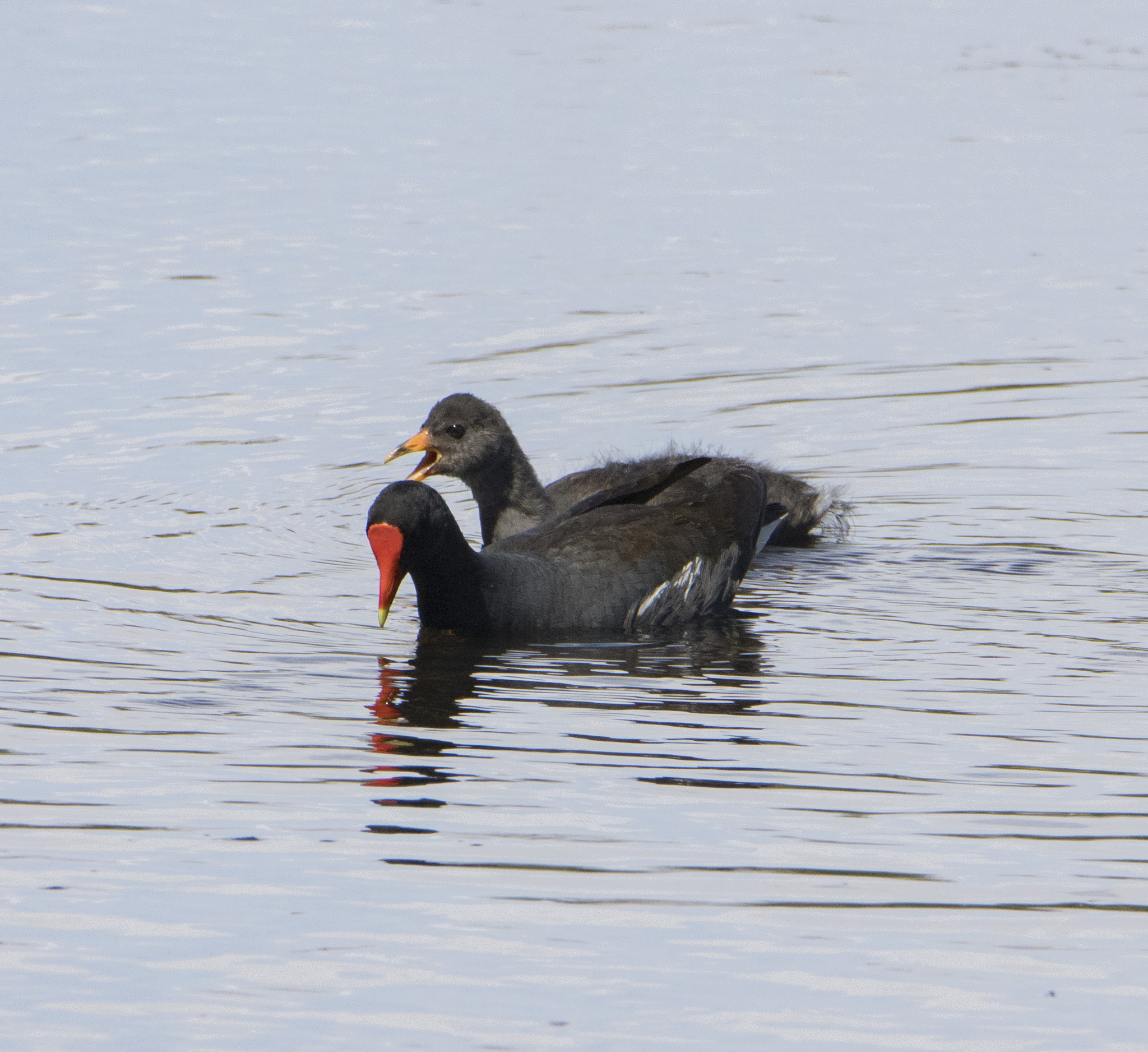 American Moorhen
 Red-gartered Coot
In short
The American Moorhen (Gallinula galeata) and Red-gartered Coot (Fulica armillata) are both waterbirds from the Rallidae family, but they can be distinguished by their bill and frontal shield coloration. The American Moorhen has a red bill with a yellow tip and a red frontal shield, while the Red-gartered Coot has a white bill and frontal shield with a distinctive red garter-like band on the legs.
Identification tips
- Bill and Shield Color: Look for the red bill with a yellow tip and red frontal shield on the American Moorhen versus the white bill and shield with a red leg band on the Red-gartered Coot. 2. Body Color: Note the brownish back of the American Moorhen compared to the uniform dark gray of the Red-gartered Coot. 3. Habitat: Consider the habitat; American Moorhens are more tied to emergent vegetation, while Red-gartered Coots are often in open water. 4. Behavior: Observe behavior; American Moorhens may be more solitary outside the breeding season compared to the social Red-gartered Coots.
Size
Both species are similar in size, but the Red-gartered Coot tends to be slightly bulkier.
Plumage
The American Moorhen has a dark gray body with a brownish back and white undertail coverts. The Red-gartered Coot is uniformly dark gray to black with no distinct brown tones.
Behaviour
American Moorhens are more likely to be seen foraging in emergent vegetation and are somewhat gregarious in winter. Red-gartered Coots are often seen in open water and can be quite social.
Habitat
American Moorhens are commonly found in marshes, ponds, and canals with emergent vegetation. Red-gartered Coots prefer larger bodies of open water but can also be found in similar wetland habitats.
Voice
The American Moorhen has a variety of calls, including clucks and squawks. The vocalizations of the Red-gartered Coot are less well-documented but are generally similar to other coots, with grunts and honks.