
Common Swift vs Scottish Crossbill
Apus apus versus Loxia scotica
Play a quiz with Common Swift and Scottish Crossbill
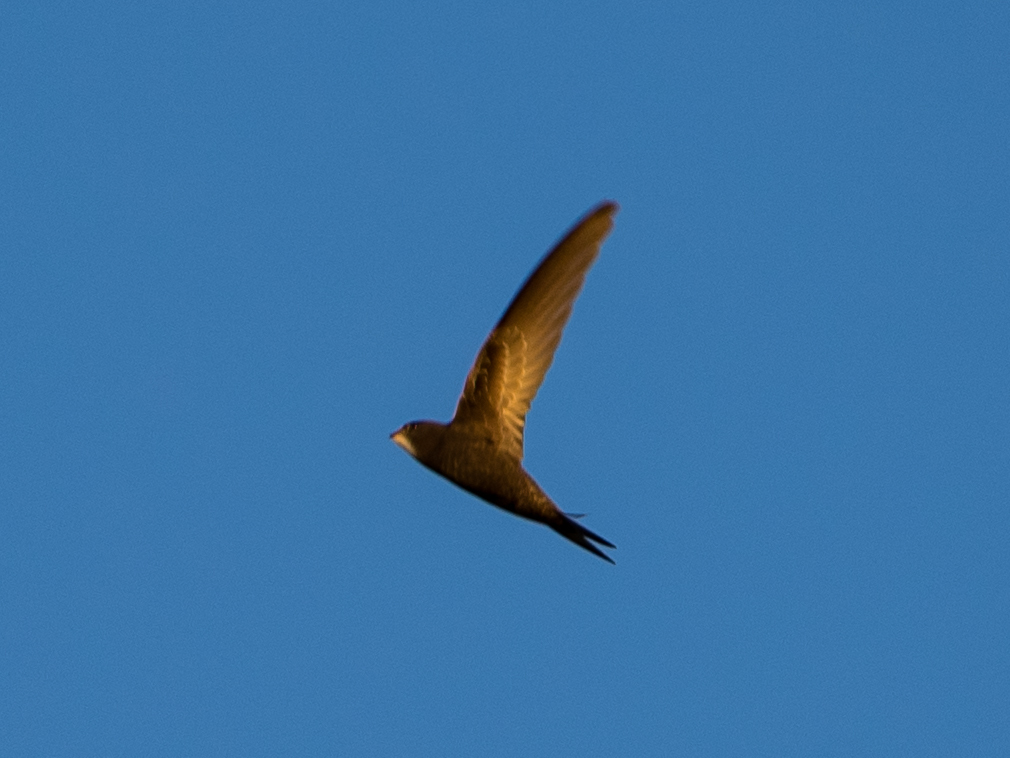 Common Swift
 Scottish Crossbill
In short
The Common Swift and Scottish Crossbill are easily distinguishable by their shape and behavior: the swift is a fast-flying aerial insectivore with a forked tail, while the crossbill is a finch with a distinctive crossed bill adapted for conifer seeds. The swift is uniformly dark with a small white throat patch, whereas the crossbill shows sexual dimorphism with males being brick-red and females olive-green. Vocalizations are crucial for identifying the Scottish Crossbill, as it is visually similar to other crossbills.
Identification tips
1. Shape and Flight: Common Swift has a forked tail and pointed wings, constantly in flight. Scottish Crossbill has a stout body and crossed bill, often perched in trees. 2. Plumage: Look for the swift's uniform dark plumage with a white throat patch versus the crossbill's red or green body. 3. Habitat: Swifts are seen in open skies, crossbills in Scottish pinewoods. 4. Vocalization: Listen for the crossbill's metallic calls, which are essential for distinguishing it from other crossbills.
Size
Common Swift is larger with a wingspan of 42–48 cm, compared to the Scottish Crossbill's 17 cm body length.
Plumage
Common Swift is mostly black-brown with a small white throat patch. Scottish Crossbill males are brick-red, females are olive-green, both with dark brown wings.
Behaviour
Common Swift is almost constantly airborne, while Scottish Crossbill is more sedentary, often seen in flocks within forests.
Habitat
Common Swift is found in a wide range of habitats, including urban areas, while Scottish Crossbill is restricted to the pinewoods of Scotland.
Voice
Scottish Crossbill identification relies heavily on its distinctive metallic flight call and excitement call, unlike the Common Swift.