Birdr

Common Waxbill vs Cape Verde Sparrow

Estrilda astrild versus Passer iagoensis

Play a quiz with Common Waxbill and Cape Verde Sparrow
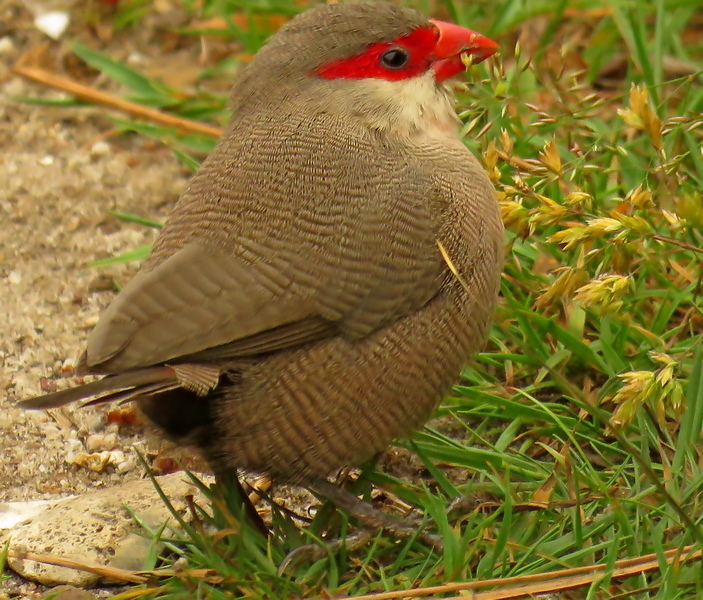
Common Waxbill (Estrilda astrild) Common Waxbill
Cape Verde Sparrow (Passer iagoensis) Cape Verde Sparrow

Media

Loading…

In short

The Common Waxbill and Cape Verde Sparrow are distinguishable primarily by their size and plumage. The Common Waxbill is smaller with a distinctive red eye-stripe, while the Cape Verde Sparrow is larger and lacks this feature. Both species have different habitat preferences, aiding in identification.

Identification tips

Look for the red eye-stripe on the Common Waxbill, a key distinguishing feature. Note the size difference, with the Cape Verde Sparrow being larger. Observe the habitat: Common Waxbills are more likely in wetter areas, while Cape Verde Sparrows are found in drier, more arid regions.

Size

The Common Waxbill is smaller, typically around 11-13 cm in length, whereas the Cape Verde Sparrow is larger, measuring about 13-14 cm.

Plumage

The Common Waxbill has a striking red eye-stripe and a generally greyish body with a pinkish wash on the underparts. In contrast, the Cape Verde Sparrow has a more uniform brownish-grey plumage without the red eye-stripe, and its underparts are paler.

Behaviour

Common Waxbills often move in flocks and are more active, while Cape Verde Sparrows are usually seen in pairs or small groups and may appear more solitary.

Habitat

Common Waxbills are typically found in grasslands and open areas with water, whereas Cape Verde Sparrows prefer arid and semi-arid environments, often near human habitation.

Voice

The Common Waxbill has a high-pitched, tinkling call, while the Cape Verde Sparrow's call is more sparrow-like, consisting of chirps and trills.

Submit a better description

Use the same sections as the comparison. Your text is published immediately.

The Common Waxbill and Cape Verde Sparrow are distinguishable primarily by their size and plumage. The Common Waxbill is smaller with a distinctive red eye-stripe, while the Cape Verde Sparrow is larger and lacks this feature. Both species have different habitat preferences, aiding in identification.

Look for the red eye-stripe on the Common Waxbill, a key distinguishing feature. Note the size difference, with the Cape Verde Sparrow being larger. Observe the habitat: Common Waxbills are more likely in wetter areas, while Cape Verde Sparrows are found in drier, more arid regions.

The Common Waxbill is smaller, typically around 11-13 cm in length, whereas the Cape Verde Sparrow is larger, measuring about 13-14 cm.

The Common Waxbill has a striking red eye-stripe and a generally greyish body with a pinkish wash on the underparts. In contrast, the Cape Verde Sparrow has a more uniform brownish-grey plumage without the red eye-stripe, and its underparts are paler.

Common Waxbills often move in flocks and are more active, while Cape Verde Sparrows are usually seen in pairs or small groups and may appear more solitary.

Common Waxbills are typically found in grasslands and open areas with water, whereas Cape Verde Sparrows prefer arid and semi-arid environments, often near human habitation.

The Common Waxbill has a high-pitched, tinkling call, while the Cape Verde Sparrow's call is more sparrow-like, consisting of chirps and trills.

Discard your changes?

You have unsaved edits. If you leave now, those changes will be lost.

Common Waxbill · Cape Verde Sparrow · My Tricky Birds