
Eurasian Treecreeper vs Short-toed Treecreeper
Certhia familiaris versus Certhia brachydactyla
Play a quiz with Eurasian Treecreeper and Short-toed Treecreeper
 Eurasian Treecreeper
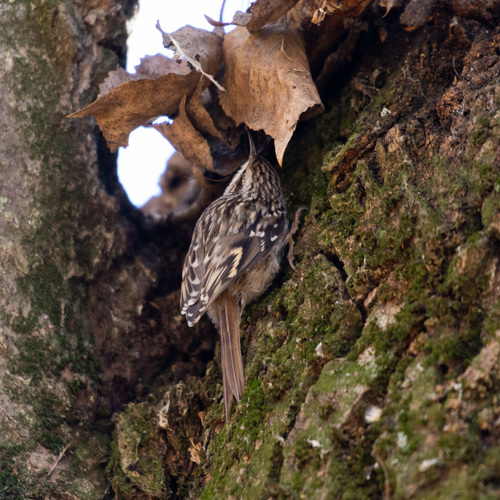 Short-toed Treecreeper
In short
The most reliable field mark between Eurasian Treecreeper and Short-toed Treecreeper is the wing pattern: on perched or spread-wing birds, look for the pale spot on the primaries—on Short-toed it forms a straight line, while on Eurasian it curves into a 'cup' shape near the wing base. Bill shape is also helpful: Eurasian's bill is slightly shorter and more decurved, while Short-toed's is longer and straighter. Plumage is very similar and often overlapping, but Eurasian tends to show a whiter, more distinct supercilium and warmer, more spotted upperparts. Habitat can offer clues, with Eurasian favoring conifers and Short-toed more often in deciduous woods, but both can overlap. Vocalizations are a strong separator if heard: Eurasian's song is more varied and complex, Short-toed's is simpler and more repetitive.
Identification tips
- Primary panel shape (all ages): On perched or spread-wing birds, check the pale spot on the primaries. Short-toed Treecreeper shows a straight pale line, while Eurasian's curves into a 'cup' shape against the black bar near the wing base. This is the most reliable field mark when visible.
- Bill shape (adults and juveniles): Eurasian Treecreeper has a slightly shorter, more decurved bill; Short-toed's is longer and straighter. This can be subtle and overlaps, but is useful in direct comparison.
- Supercilium (adults): Eurasian usually has a whiter, more distinct supercilium that connects to the bill; Short-toed's is weaker, off-white, and less sharply defined. Regional variation and individual overlap can make this unreliable alone.
- Upperparts color (adults): Eurasian is warmer brown and more heavily spotted above; Short-toed is duller grey-brown with less contrast. This is subtle and best used in combination with other marks.
- Underparts (adults): Eurasian is whiter below, especially on the belly and flanks; Short-toed is dingier, with a buffier or greyer wash. Not always obvious in poor light.
- Juvenile plumage: Eurasian juveniles have duller upperparts and fine dark spotting on the flanks; Short-toed juveniles may show a buff belly. Both are generally duller than adults and hard to separate without wing panel or bill clues.
- Tail pattern: Both species have plain brown tails, so this is not useful for separation.
- Vocalizations: Eurasian's song is more varied and complex, with twitters, ripples, and a final whistle; Short-toed's is simpler, more repetitive, and evenly spaced. Calls are similar, but careful listening can reveal differences. Use voice as a primary separator when birds are singing.
- Habitat: Eurasian favors coniferous forests, especially in the north and uplands; Short-toed prefers deciduous woods and lower altitudes. Use habitat only as a supporting clue, as both can occur together in mixed forests.
- Behavior: Both species behave similarly, creeping up trunks and branches with stiff tails for support. Behavior is not diagnostic.
- Size: Both are nearly identical in size and mass; do not use size for separation.
- Context and range: In southern Europe and North Africa, Short-toed is more likely; in northern and upland areas, Eurasian is more likely. In overlap zones, use plumage and voice.
- Pitfalls: Poorly marked individuals, especially juveniles, may be impossible to separate by sight alone. Even in the hand, 5% of birds are not safely identifiable. Use a combination of wing panel, bill shape, supercilium, and voice for best results.
- Season: Both species are resident, but vagrants can occur. Seasonal variation in plumage is minor; focus on structural and wing marks year-round.
- Sex: Sexes are similar in both species; do not use sex for identification.
Size
Both species are nearly identical in size and mass, with Eurasian Treecreeper averaging about 9.95 g and Short-toed Treecreeper about 8.4 g. Both are around 12.5 cm in length. These differences are not apparent in the field, and size should not be relied on for separation.
Plumage
The most diagnostic plumage feature is the wing pattern, visible on perched birds or in good flight views. On Short-toed Treecreeper of all ages, the pale spot on the primaries forms a straight line; on Eurasian Treecreeper, it curves inwards, creating a 'cup' shape next to the black bar at the wing base. Juveniles of both species are duller than adults, but Eurasian juveniles have duller upperparts and fine dark spotting on the flanks, while Short-toed juveniles may show a buff belly. Eurasian adults are warmer brown and more heavily spotted above, with a whiter, more distinct supercilium that connects to the bill; Short-toed is duller grey-brown above, with a weaker, off-white supercilium and dingier underparts (though both have white throats). Both have streaked brown upperparts, rufous rumps, and whitish underparts, making overall plumage a poor separator except for the wing panel and subtle supercilium differences.
Behaviour
Both species behave almost identically: they creep up tree trunks and branches in short hops, using their stiff tails and splayed feet for support. Their foraging style is mouse-like, and both are inconspicuous and unwary. In flight, both show erratic, undulating movement with fluttering wingbeats and side-slips. Behavior is not a reliable separator.
Habitat
Habitat can provide supporting evidence but is not definitive. Eurasian Treecreeper is more likely in coniferous forests, especially in northern and upland areas, while Short-toed Treecreeper prefers deciduous woods and lower altitudes, particularly in southern Europe and North Africa. However, both species can overlap in mixed or transitional woodlands, so habitat should only be used as a secondary clue.
Voice
Vocalizations are among the best field separators. Eurasian Treecreeper has a more varied and complex song, often beginning with 'srrih, srrih' followed by twitters, a descending ripple, and a rising-falling whistle. Its main call is a thin, high-pitched 'sit' or a vibrato 'tsree.' Short-toed Treecreeper's song is simpler and more repetitive, typically an evenly spaced sequence of notes like 'teet-teet-teet-e-roi-tiit,' and its call is a repeated shrill 'tyt...tyt tyt-tyt.' Calls can be similar, but with practice, the more complex Eurasian song stands out. Note that both species can occasionally mimic each other's songs, so use voice in combination with other marks.
Eurasian Treecreeper · Short-toed Treecreeper · My Tricky Birds