Birdr

Himalayan Rubythroat vs Chinese Rubythroat

Calliope pectoralis versus Calliope tschebaiewi

Play a quiz with Himalayan Rubythroat and Chinese Rubythroat
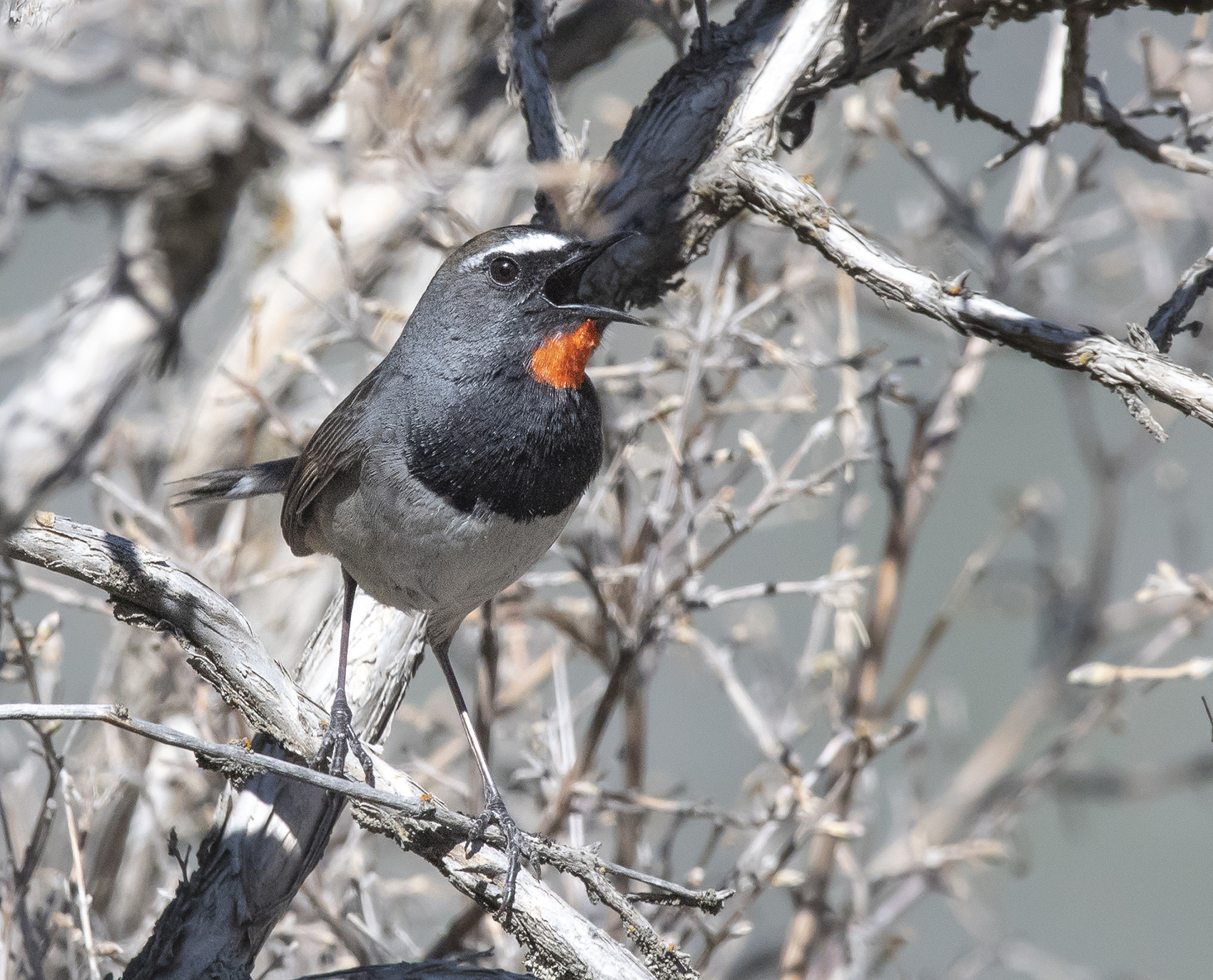
Himalayan Rubythroat (Calliope pectoralis) Himalayan Rubythroat
Chinese Rubythroat (Calliope tschebaiewi) Chinese Rubythroat

Media

Loading…

In short

The Himalayan Rubythroat and Chinese Rubythroat are closely related and can be challenging to differentiate. The most reliable field mark is the extent of the red throat patch: the Himalayan Rubythroat typically has a more extensive and vibrant red throat patch than the Chinese Rubythroat. Both species share similar habitats and behaviors, making plumage details crucial for identification.

Identification tips

  1. Focus on the extent and vibrancy of the red throat patch; the Himalayan Rubythroat usually has a more pronounced patch. 2. Observe the white supercilium, though it is similar in both species. 3. Consider the habitat and behavior, but rely on plumage for accurate identification. 4. If possible, listen for differences in song, though these are not well-documented.

Size

Both species are similar in size, typical of small passerines in the Old World Flycatchers family.

Plumage

The Himalayan Rubythroat generally has a more extensive and vibrant red throat patch compared to the Chinese Rubythroat. The Chinese Rubythroat may have a slightly duller red and less extensive throat patch. Both species have a white supercilium, but this feature is not a reliable differentiator.

Behaviour

Both species exhibit similar behaviors typical of rubythroats, such as skulking in dense undergrowth and foraging close to the ground.

Habitat

Both species inhabit similar environments, often found in shrubby areas and forest edges at high altitudes. Habitat alone is not a reliable differentiator.

Voice

Vocalizations are not well-documented in the sources, but both species are known for their melodious songs. Differences in song may exist but are not clearly defined in the available data.

Submit a better description

Use the same sections as the comparison. Your text is published immediately.

The Himalayan Rubythroat and Chinese Rubythroat are closely related and can be challenging to differentiate. The most reliable field mark is the extent of the red throat patch: the Himalayan Rubythroat typically has a more extensive and vibrant red throat patch than the Chinese Rubythroat. Both species share similar habitats and behaviors, making plumage details crucial for identification.

  1. Focus on the extent and vibrancy of the red throat patch; the Himalayan Rubythroat usually has a more pronounced patch. 2. Observe the white supercilium, though it is similar in both species. 3. Consider the habitat and behavior, but rely on plumage for accurate identification. 4. If possible, listen for differences in song, though these are not well-documented.

Both species are similar in size, typical of small passerines in the Old World Flycatchers family.

The Himalayan Rubythroat generally has a more extensive and vibrant red throat patch compared to the Chinese Rubythroat. The Chinese Rubythroat may have a slightly duller red and less extensive throat patch. Both species have a white supercilium, but this feature is not a reliable differentiator.

Both species exhibit similar behaviors typical of rubythroats, such as skulking in dense undergrowth and foraging close to the ground.

Both species inhabit similar environments, often found in shrubby areas and forest edges at high altitudes. Habitat alone is not a reliable differentiator.

Vocalizations are not well-documented in the sources, but both species are known for their melodious songs. Differences in song may exist but are not clearly defined in the available data.

Discard your changes?

You have unsaved edits. If you leave now, those changes will be lost.

Himalayan Rubythroat · Chinese Rubythroat · My Tricky Birds