
Leach's Storm-Petrel vs White-chinned Petrel
Hydrobates leucorhous versus Procellaria aequinoctialis
Play a quiz with Leach's Storm-Petrel and White-chinned Petrel
 Leach's Storm-Petrel
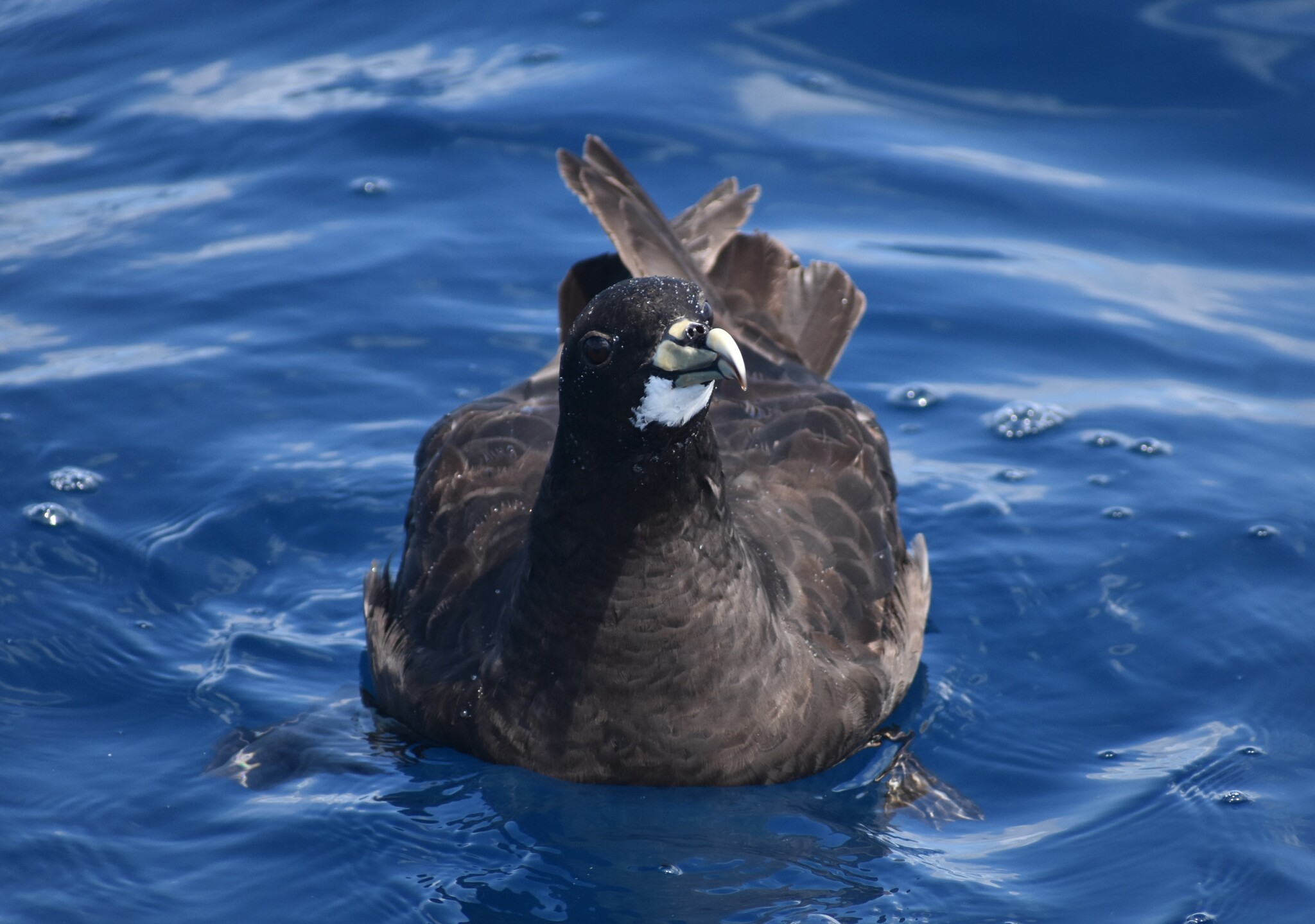 White-chinned Petrel
In short
Leach's Storm-Petrel is a small, dark seabird with a distinctive forked tail and a bounding flight pattern, while the White-chinned Petrel is much larger, with a prominent white chin and a heavy, pale bill. These species are not closely related, and their size and structural differences are the most reliable field marks.
Identification tips
- Size: Note the significant size difference; White-chinned Petrel is much larger. 2. Tail Shape: Look for the forked tail of the Leach's Storm-Petrel. 3. Bill and Chin: The White-chinned Petrel has a large, pale bill and a white chin patch. 4. Flight Pattern: Observe the flight; Leach's Storm-Petrel has a fluttering, bounding flight, while the White-chinned Petrel glides powerfully. 5. Geographic Location: Consider the location; Leach's Storm-Petrel is more northern, while the White-chinned Petrel is found in the Southern Ocean.
Size
Leach's Storm-Petrel is significantly smaller than the White-chinned Petrel, which is a large petrel with a robust build.
Plumage
Leach's Storm-Petrel is mostly dark with a forked tail, whereas the White-chinned Petrel has a distinctive white chin and a large, pale bill. The White-chinned Petrel's plumage is otherwise dark, similar to the storm-petrel.
Behaviour
Leach's Storm-Petrel exhibits a distinctive bounding flight pattern, often seen fluttering low over the water. In contrast, the White-chinned Petrel has a more powerful, gliding flight and often follows ships.
Habitat
Leach's Storm-Petrel is typically found in northern oceans, while the White-chinned Petrel is associated with subantarctic islands and the Southern Ocean, often moving north to the Humboldt Current.
Voice
Vocalizations are not a primary field mark for these species in typical birdwatching scenarios.
Leach's Storm-Petrel · White-chinned Petrel · My Tricky Birds