Birdr

Masked Bowerbird vs Flame Bowerbird

Sericulus aureus versus Sericulus ardens

Play a quiz with Masked Bowerbird and Flame Bowerbird

Masked Bowerbird (Sericulus aureus) Masked Bowerbird
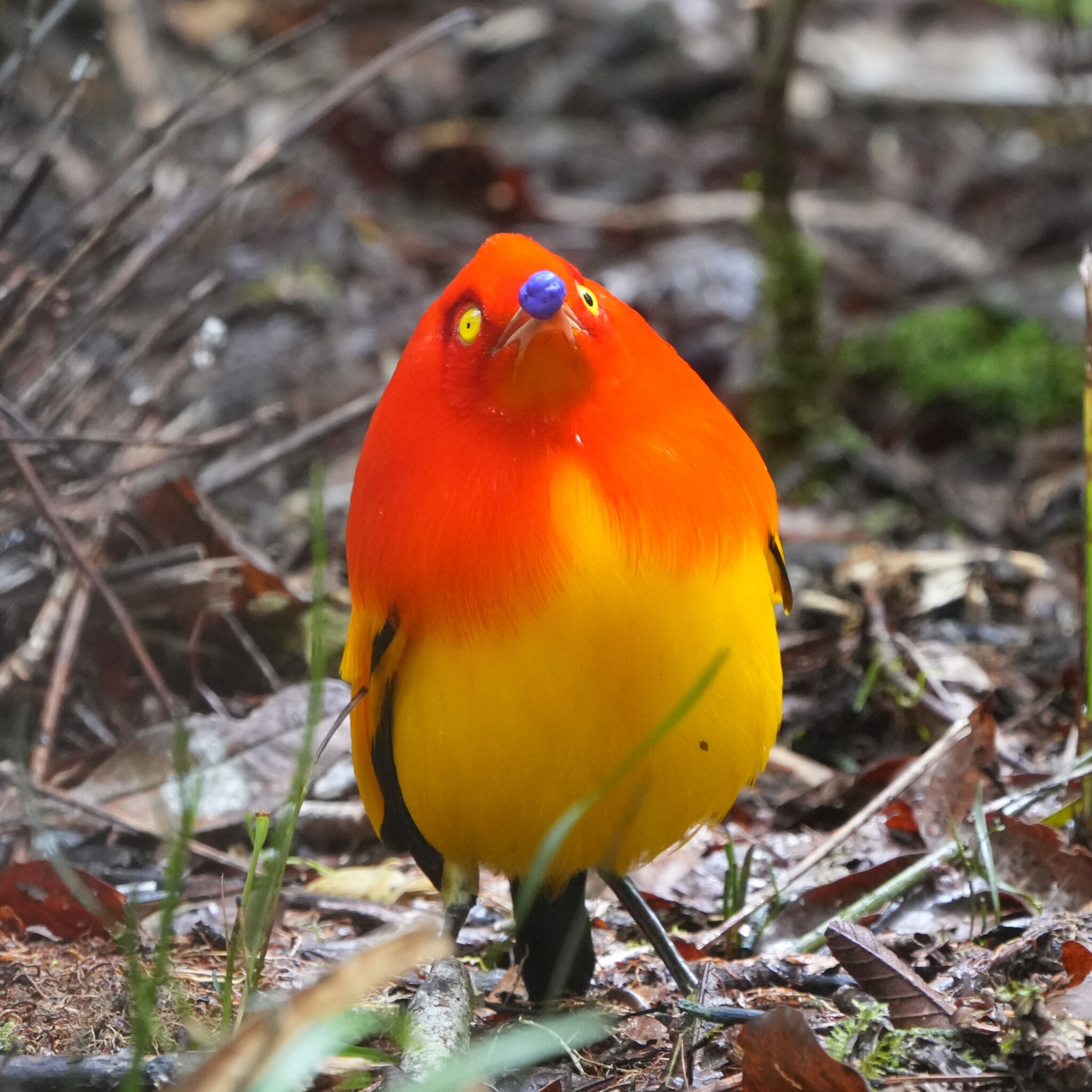
Flame Bowerbird (Sericulus ardens) Flame Bowerbird

Media

Loading…

In short

The Masked Bowerbird and Flame Bowerbird are closely related and can be challenging to distinguish in the field. The most reliable field mark is the facial mask: the Masked Bowerbird has a distinctive black mask around its eyes, while the Flame Bowerbird lacks this feature. Both species share similar habitats and behaviors, making visual identification key.

Identification tips

  1. Look for the black facial mask on the Masked Bowerbird, absent in the Flame Bowerbird. 2. Observe the overall plumage color: Masked Bowerbird is golden-orange with a mask, while the Flame Bowerbird is fiery orange-red without a mask. 3. Note that both species are found in similar habitats, so focus on visual cues. 4. Use binoculars to get a clear view of the head and face for accurate identification.

Size

Both species are similar in size, typical of bowerbirds, with no significant differences in structure.

Plumage

The Masked Bowerbird is noted for its black facial mask contrasting with its golden-orange body. In contrast, the Flame Bowerbird is entirely fiery orange-red without a mask. Both species have vibrant plumage, but the presence or absence of the mask is crucial.

Behaviour

Both species exhibit similar bower-building behavior, constructing elaborate structures to attract mates. Their behaviors are typical of bowerbirds, focusing on display and courtship.

Habitat

Both species inhabit lowland rainforests of New Guinea, often in similar ecological niches, making habitat a less reliable distinguishing factor.

Voice

Vocalizations are not well-documented for distinguishing these species, and they are generally similar, focusing on mechanical sounds and calls typical of bowerbirds.

Submit a better description

Use the same sections as the comparison. Your text is published immediately.

The Masked Bowerbird and Flame Bowerbird are closely related and can be challenging to distinguish in the field. The most reliable field mark is the facial mask: the Masked Bowerbird has a distinctive black mask around its eyes, while the Flame Bowerbird lacks this feature. Both species share similar habitats and behaviors, making visual identification key.

  1. Look for the black facial mask on the Masked Bowerbird, absent in the Flame Bowerbird. 2. Observe the overall plumage color: Masked Bowerbird is golden-orange with a mask, while the Flame Bowerbird is fiery orange-red without a mask. 3. Note that both species are found in similar habitats, so focus on visual cues. 4. Use binoculars to get a clear view of the head and face for accurate identification.

Both species are similar in size, typical of bowerbirds, with no significant differences in structure.

The Masked Bowerbird is noted for its black facial mask contrasting with its golden-orange body. In contrast, the Flame Bowerbird is entirely fiery orange-red without a mask. Both species have vibrant plumage, but the presence or absence of the mask is crucial.

Both species exhibit similar bower-building behavior, constructing elaborate structures to attract mates. Their behaviors are typical of bowerbirds, focusing on display and courtship.

Both species inhabit lowland rainforests of New Guinea, often in similar ecological niches, making habitat a less reliable distinguishing factor.

Vocalizations are not well-documented for distinguishing these species, and they are generally similar, focusing on mechanical sounds and calls typical of bowerbirds.

Discard your changes?

You have unsaved edits. If you leave now, those changes will be lost.

Masked Bowerbird · Flame Bowerbird · My Tricky Birds