
Birdr

Sula Cicadabird vs Grey-headed Cicadabird

Edolisoma sula versus Edolisoma schisticeps

Play a quiz with Sula Cicadabird and Grey-headed Cicadabird
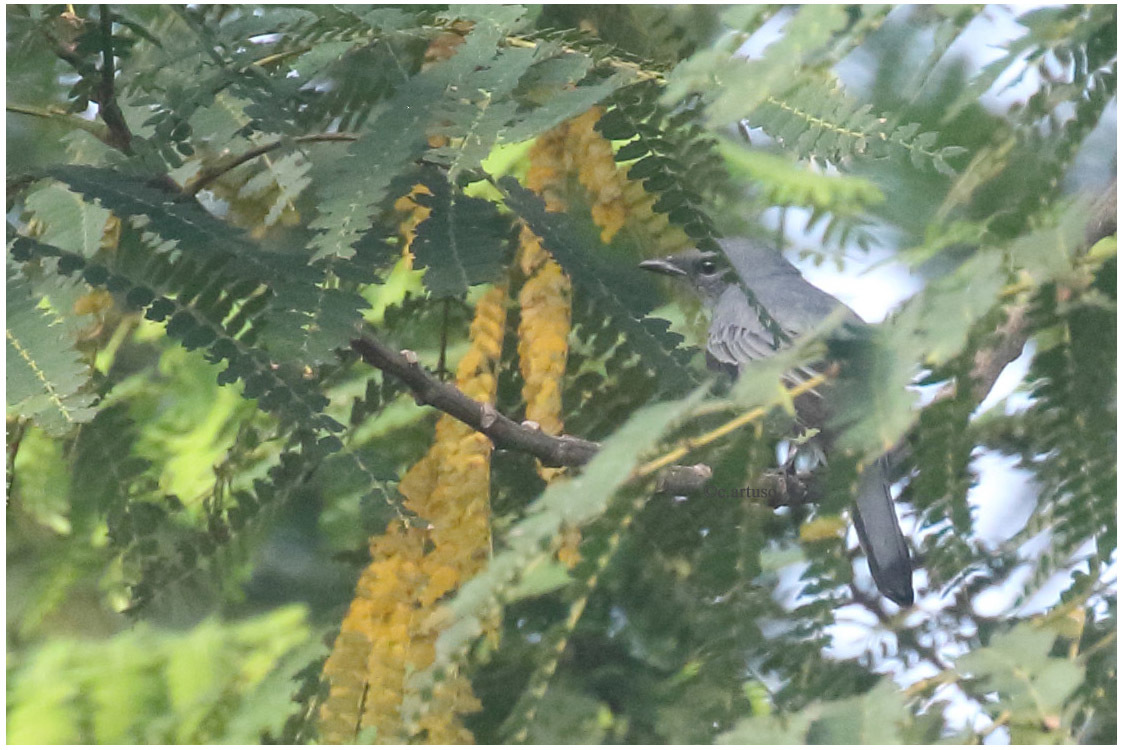
Sula Cicadabird (Edolisoma sula) Sula Cicadabird
Grey-headed Cicadabird (Edolisoma schisticeps) Grey-headed Cicadabird

Media

Loading…

In short

The Sula Cicadabird and Grey-headed Cicadabird are similar in appearance, but the Grey-headed Cicadabird typically has a more distinct grey head and a slightly different vocalization pattern. Both species belong to the Cuckooshrikes family and share similar habitats, making them challenging to differentiate without careful observation.

Identification tips

  1. Look for the grey head of the Grey-headed Cicadabird, which is more distinct than the Sula Cicadabird. 2. Pay attention to vocalizations, noting any differences in pitch or pattern. 3. Observe in good light to discern subtle plumage differences. 4. Consider habitat overlap and focus on visual and auditory cues.

Size

Both species are similar in size, typical of the Cuckooshrikes, with no notable size difference to aid in identification.

Plumage

The Grey-headed Cicadabird usually has a more pronounced grey head compared to the Sula Cicadabird, which may appear more uniformly colored. This distinction can be subtle and may require close observation.

Behaviour

Both species exhibit typical Cuckooshrike behavior, often seen foraging in the canopy. There are no significant behavioral differences noted between these species.

Habitat

Both species inhabit similar environments, often found in forested areas. The overlap in habitat can make visual identification more challenging.

Voice

The vocalizations of the Grey-headed Cicadabird may differ slightly, but specific differences are not well-documented. Birdwatchers should listen for variations in pitch or pattern.

Submit a better description

Use the same sections as the comparison. Your text is published immediately.

The Sula Cicadabird and Grey-headed Cicadabird are similar in appearance, but the Grey-headed Cicadabird typically has a more distinct grey head and a slightly different vocalization pattern. Both species belong to the Cuckooshrikes family and share similar habitats, making them challenging to differentiate without careful observation.

  1. Look for the grey head of the Grey-headed Cicadabird, which is more distinct than the Sula Cicadabird. 2. Pay attention to vocalizations, noting any differences in pitch or pattern. 3. Observe in good light to discern subtle plumage differences. 4. Consider habitat overlap and focus on visual and auditory cues.

Both species are similar in size, typical of the Cuckooshrikes, with no notable size difference to aid in identification.

The Grey-headed Cicadabird usually has a more pronounced grey head compared to the Sula Cicadabird, which may appear more uniformly colored. This distinction can be subtle and may require close observation.

Both species exhibit typical Cuckooshrike behavior, often seen foraging in the canopy. There are no significant behavioral differences noted between these species.

Both species inhabit similar environments, often found in forested areas. The overlap in habitat can make visual identification more challenging.

The vocalizations of the Grey-headed Cicadabird may differ slightly, but specific differences are not well-documented. Birdwatchers should listen for variations in pitch or pattern.

Discard your changes?

You have unsaved edits. If you leave now, those changes will be lost.

Sula Cicadabird · Grey-headed Cicadabird · My Tricky Birds