
White-shouldered Ibis vs Giant Ibis
Pseudibis davisoni versus Pseudibis gigantea
Play a quiz with White-shouldered Ibis and Giant Ibis
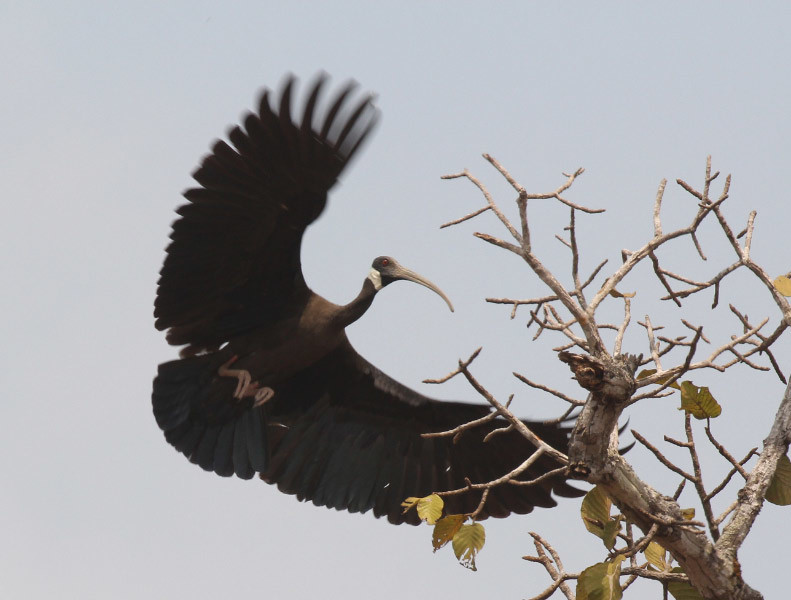 White-shouldered Ibis
 Giant Ibis
In short
The Giant Ibis is significantly larger than the White-shouldered Ibis, making size the most reliable field mark. In terms of plumage, the Giant Ibis has a more uniformly dark appearance, while the White-shouldered Ibis features distinctive white patches on its shoulders. Both species are found in similar habitats, but their size difference is a key identifier.
Identification tips
- Size: Look for the larger size of the Giant Ibis.
- Plumage: Check for white shoulder patches on the White-shouldered Ibis.
- Habitat: Consider the remoteness of the location; Giant Ibis may prefer less disturbed areas.
- Group Size: Giant Ibis may be more solitary compared to the smaller White-shouldered Ibis.
Size
The Giant Ibis is considerably larger than the White-shouldered Ibis, making size a primary distinguishing feature.
Plumage
The White-shouldered Ibis has white patches on its shoulders, which are absent in the Giant Ibis. The Giant Ibis appears more uniformly dark overall.
Behaviour
Both species exhibit similar foraging behaviors typical of ibises, probing in mud and shallow water, but the Giant Ibis may appear more solitary due to its larger size.
Habitat
Both species inhabit similar wetland and forested areas, but the Giant Ibis may be found in more remote, undisturbed locations.
Voice
Vocalizations are not well-documented for field identification, but any differences are subtle and not a primary distinguishing feature.