Birdr

Oedicnème criard vs Huîtrier pie

Burhinus oedicnemus contre Haematopus ostralegus

Faire un quiz avec Oedicnème criard et Huîtrier pie
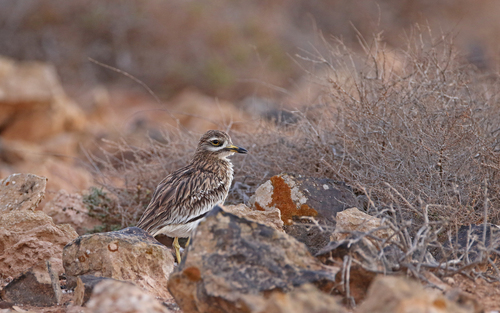
Oedicnème criard (Burhinus oedicnemus) Oedicnème criard
Huîtrier pie (Haematopus ostralegus) Huîtrier pie

Médias

Chargement…

En bref

L'Oedicnème criard et l'Huîtrier pie sont distincts en structure et en habitat. L'Oedicnème criard a une apparence plus cryptique avec une silhouette trapue, tandis que l'Huîtrier pie est plus grand et plus frappant avec un long bec orange vif. Ils occupent des habitats différents, l'Oedicnème criard préférant les zones sèches et ouvertes, tandis que l'Huîtrier pie se trouve le long des côtes et des zones humides.

Conseils d’identification

1. Bec : L'Huîtrier pie a un long bec orange vif, qui est une caractéristique clé de distinction. 2. Plumage : Recherchez le plumage cryptique et brunâtre de l'Oedicnème criard par rapport au noir et blanc de l'Huîtrier pie. 3. Habitat : Considérez l'habitat ; les Oedicnèmes criards préfèrent les zones sèches et ouvertes, tandis que les Huîtriers pies se trouvent près de l'eau.

Taille

L'Huîtrier pie est généralement plus grand que l'Oedicnème criard.

Plumage

L'Oedicnème criard a un plumage cryptique et brunâtre adapté au camouflage, tandis que l'Huîtrier pie est noir et blanc avec un bec orange vif distinctif.

Habitat

Les Oedicnèmes criards se trouvent généralement dans des habitats secs et ouverts tels que les prairies et les semi-déserts, tandis que les Huîtriers pies sont associés aux zones côtières et aux zones humides.

Envoyer une meilleure description

Utilise les mêmes sections que la comparaison. Ton texte est publié tout de suite.

The Stone-curlew and Eurasian Oystercatcher are distinct in structure and habitat. The Stone-curlew has a more cryptic appearance with a stocky build, while the Eurasian Oystercatcher is larger and more striking with a long, bright orange bill. They occupy different habitats, with the Stone-curlew favoring dry, open areas and the Oystercatcher found along coastlines and wetlands.

1. Bill: The Eurasian Oystercatcher has a long, bright orange bill, which is a key distinguishing feature. 2. Plumage: Look for the cryptic, brownish plumage of the Stone-curlew versus the black and white of the Oystercatcher. 3. Habitat: Consider the habitat; Stone-curlews prefer dry, open areas, while Oystercatchers are found near water.

The Eurasian Oystercatcher is generally larger than the Stone-curlew.

The Stone-curlew has a cryptic, brownish plumage suited for camouflage, whereas the Eurasian Oystercatcher is black and white with a distinctive bright orange bill.

Stone-curlews are typically found in dry, open habitats such as grasslands and semi-deserts, while Eurasian Oystercatchers are associated with coastal areas and wetlands.

Abandonner tes modifications ?

Tu as des modifications non enregistrées. Si tu pars maintenant, elles seront perdues.

Oedicnème criard · Huîtrier pie · Mes oiseaux difficiles