Birdr

Stone-curlew vs Eurasian Oystercatcher

Burhinus oedicnemus versus Haematopus ostralegus

Play a quiz with Stone-curlew and Eurasian Oystercatcher
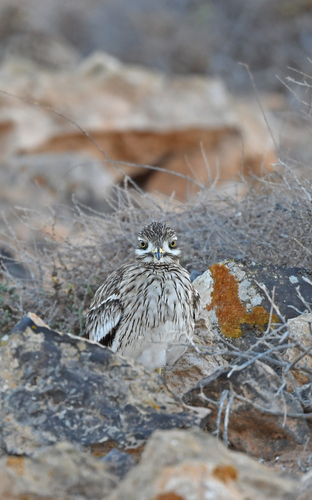
Stone-curlew (Burhinus oedicnemus) Stone-curlew
Eurasian Oystercatcher (Haematopus ostralegus) Eurasian Oystercatcher

Media

Loading…

In short

The Stone-curlew and Eurasian Oystercatcher are both ground-dwelling birds but differ significantly in appearance and habitat. The Stone-curlew is cryptically colored with a mottled brown plumage, while the Eurasian Oystercatcher is strikingly black and white with a long, bright orange bill. These differences are key in distinguishing them in the field.

Identification tips

Size

The Eurasian Oystercatcher is generally larger and more robust than the Stone-curlew, with a longer wingspan and a more prominent bill.

Plumage

The Stone-curlew has a mottled brown and buff plumage, which provides camouflage in its dry, open habitats. In contrast, the Eurasian Oystercatcher is unmistakable with its black upperparts and white underparts, along with a conspicuous orange bill and eye.

Behaviour

Stone-curlews are often seen standing still, relying on their camouflage, while Eurasian Oystercatchers are more active, often seen probing mudflats and sandy shores for food.

Habitat

Stone-curlews prefer dry, open habitats like grasslands and semi-deserts, whereas Eurasian Oystercatchers are typically found along coastlines, estuaries, and mudflats.

Voice

The Stone-curlew has a distinctive, eerie wailing call often heard at night, while the Eurasian Oystercatcher produces loud, piping calls, especially when in flight or alarmed.

Submit a better description

Use the same sections as the comparison. Your text is published immediately.

The Stone-curlew and Eurasian Oystercatcher are both ground-dwelling birds but differ significantly in appearance and habitat. The Stone-curlew is cryptically colored with a mottled brown plumage, while the Eurasian Oystercatcher is strikingly black and white with a long, bright orange bill. These differences are key in distinguishing them in the field.

  • Plumage: Look for the Stone-curlew's cryptic brown plumage versus the Oystercatcher's stark black and white contrast.
  • Bill: The Oystercatcher's long, bright orange bill is a key feature, unlike the more subdued bill of the Stone-curlew.
  • Habitat: Consider the habitat; Stone-curlews in dry, open areas, Oystercatchers near water.
  • Behavior: Note behavior; Stone-curlews are more stationary, Oystercatchers are active foragers.
  • Vocalization: Listen for the Stone-curlew's wailing call at night versus the Oystercatcher's loud piping.

The Eurasian Oystercatcher is generally larger and more robust than the Stone-curlew, with a longer wingspan and a more prominent bill.

The Stone-curlew has a mottled brown and buff plumage, which provides camouflage in its dry, open habitats. In contrast, the Eurasian Oystercatcher is unmistakable with its black upperparts and white underparts, along with a conspicuous orange bill and eye.

Stone-curlews are often seen standing still, relying on their camouflage, while Eurasian Oystercatchers are more active, often seen probing mudflats and sandy shores for food.

Stone-curlews prefer dry, open habitats like grasslands and semi-deserts, whereas Eurasian Oystercatchers are typically found along coastlines, estuaries, and mudflats.

The Stone-curlew has a distinctive, eerie wailing call often heard at night, while the Eurasian Oystercatcher produces loud, piping calls, especially when in flight or alarmed.

Discard your changes?

You have unsaved edits. If you leave now, those changes will be lost.

Stone-curlew · Eurasian Oystercatcher · My Tricky Birds