
Acadian Flycatcher vs Eastern Kingbird
Empidonax virescens versus Tyrannus tyrannus
Play a quiz with Acadian Flycatcher and Eastern Kingbird
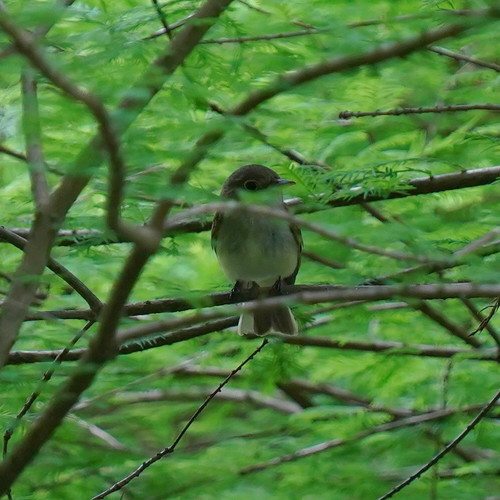 Acadian Flycatcher
 Eastern Kingbird
In short
The most reliable field mark to separate Acadian Flycatcher from Eastern Kingbird is overall size and structure: Eastern Kingbird is much larger, with a thick, long tail ending in a crisp white tip, while Acadian Flycatcher is a small, delicate Empidonax with a short, square tail and two pale wingbars. In flight or perched, Kingbird’s dark upperparts and bold white tail tip stand out, versus the Acadian’s olive-green tones and faint eye ring. If you see a flycatcher with a broad bill and subtle olive wash on the chest, it’s likely Acadian; if it’s big, bold, and blackish above with a white belly and tail tip, it’s Kingbird. Both can be found perched in open areas, but their size and tail patterns are unmistakable when seen well.
Identification tips
- Size and Structure: Eastern Kingbird is much larger and bulkier than Acadian Flycatcher. If the bird looks robin-sized or bigger than a sparrow, it’s a Kingbird.
- Tail Pattern: Kingbird’s long, black tail with a bold white tip is unique and visible in both perched and flying birds of all ages. Acadian Flycatcher has a short, square, dark tail with no white tip.
- Wingbars and Eye Ring: Acadian Flycatcher always shows two pale wingbars and a distinct white eye ring; Kingbird lacks both, presenting plain dark wings and face.
- Bill Shape and Color: Acadian Flycatcher has a broad, flat bill with a yellowish lower mandible; Kingbird’s bill is stout, all dark, and proportionally larger relative to the head.
- Upperpart Color: Acadian Flycatcher is olive-green above, blending into the forest; Kingbird is dark gray-black, often appearing nearly black in strong light.
- Underparts: Acadian Flycatcher’s underparts are whitish with an olive wash on the breast; Kingbird’s underparts are sharply white, with a crisp contrast to the dark upperparts.
- Crown Patch: Kingbird has a concealed red crown patch, but this is rarely visible and not a reliable field mark.
- Posture and Behavior: Kingbird sits upright and boldly on exposed perches, often sallying out after insects; Acadian Flycatcher is more likely to perch lower, flicking its tail and wings, and makes shorter, more delicate sallies.
- Habitat: Acadian Flycatcher is usually found in mature, shaded forests; Kingbird prefers open country, field edges, and water margins.
- Voice: Acadian’s explosive 'ka-zeep' or 'peet-sa' is distinctive; Kingbird’s call is a harsh, buzzing chirp. If you hear a sharp, two-note song, suspect Acadian.
- Wing Shape: Kingbird’s wings are long and pointed, suited for strong, direct flight; Acadian’s wings are shorter and more rounded.
- Seasonal Context: Both species are migratory, but Kingbird is more likely in open habitats during migration; Acadian is rarely seen outside forested areas.
- Flock Size: Kingbirds may be seen in small groups, especially on migration; Acadian Flycatchers are typically solitary or in loose pairs.
- Pitfalls: Distant perched Kingbirds can appear smaller, and Acadian Flycatchers can look darker in poor light, but the tail pattern and wingbars remain reliable. Always check for the white tail tip and absence of wingbars to rule out Kingbird.
- Juvenile Confusion: No juvenile plumage marks override the adult differences; the Kingbird’s tail tip and size are always diagnostic.
Size
Eastern Kingbird is dramatically larger: 19–23 cm long, 33–38 cm wingspan, and weighing 33–55 g [wikipedia][avonet]. Acadian Flycatcher is much smaller and lighter: 14–15 cm long, 22–23 cm wingspan, and 11–14 g. Even at a distance, Kingbird’s bulk and long tail are obvious compared to the dainty, compact Acadian Flycatcher.
Plumage
-
Adults: Acadian Flycatcher shows olive upperparts, darker wings and tail, two pale wingbars, a white eye ring, and whitish underparts with an olive wash on the breast. The bill is broad, with a dark upper mandible and yellowish lower. Eastern Kingbird is dark gray-black above, with a sharp white underbelly, long black tail with a bright white terminal band, and long, pointed wings. It lacks wingbars and eye ring. The red crown patch on Kingbird is rarely visible.
-
Juveniles/Immatures: No specific juvenile wing pattern is described for either species in the notes, but the Kingbird’s tail tip remains diagnostic at all ages. Acadian Flycatcher’s wingbars and eye ring are present in all plumages, while Kingbird never shows these Empidonax marks.
Behaviour
Eastern Kingbird is conspicuous, often sallying out from exposed perches to catch insects, and is aggressive in defending territory, sometimes mobbing much larger birds. Acadian Flycatcher is more retiring, typically found in shaded woodland, often making short sallies from lower perches. Kingbird’s upright, bold posture and willingness to perch in the open contrast with the more subtle, flicking movements of Acadian Flycatcher.
Habitat
Eastern Kingbird favors open habitats with scattered trees and bushes, such as fields, edges, and water margins, and is often seen out in the open. Acadian Flycatcher prefers mature, shaded forests and wooded ravines, usually away from open fields. If you see a flycatcher in deep woods, it’s more likely Acadian; in open country, Kingbird is expected.
Voice
Acadian Flycatcher gives a sharp, explosive two-note song ('ka-zeep' or 'peet-sa'), and soft 'peet' calls. Eastern Kingbird’s call is a high-pitched, buzzing, unmusical chirp, often compared to the sound of an electric fence. The difference is clear if you hear the full song, but single calls can be confusing at a distance.