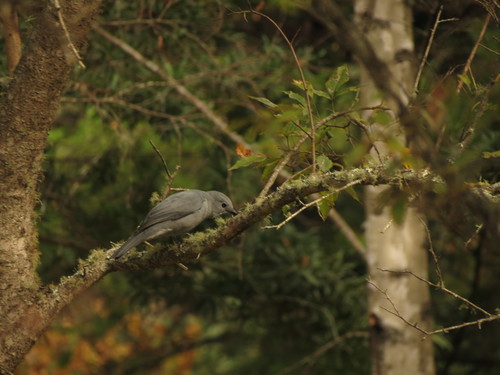
African Broadbill vs Grey Cuckooshrike
Smithornis capensis versus Ceblepyris caesius
Play a quiz with African Broadbill and Grey Cuckooshrike

African Broadbill
Grey Cuckooshrike
In short
The African Broadbill and Grey Cuckooshrike can be distinguished by their size and structure: the broadbill is smaller with a stout bill, while the cuckooshrike is larger with a slender, longer bill. Plumage also differs, with the broadbill having a more patterned appearance compared to the uniform grey of the cuckooshrike.
Identification tips
- Size and structure: Look for the smaller, more compact African Broadbill with a stout bill versus the larger, slender Grey Cuckooshrike.
- Plumage: Note the patterned appearance of the broadbill compared to the uniform grey of the cuckooshrike.
- Behavior: Watch for the broadbill's hovering display flight.
- Vocalizations: Listen for the mechanical display call of the broadbill, contrasting with the cuckooshrike's soft whistles.
Size
The African Broadbill is smaller and more compact than the Grey Cuckooshrike, which is larger and more elongated.
Plumage
The African Broadbill has a more patterned plumage with a mix of browns and greens, while the Grey Cuckooshrike is predominantly grey with a more uniform appearance.
Behaviour
The African Broadbill often displays a unique hovering behavior during its display flight, which is not seen in the Grey Cuckooshrike.
Habitat
Both species can be found in forested habitats, but the African Broadbill is more often associated with dense undergrowth, whereas the Grey Cuckooshrike is more likely to be seen in the canopy or at mid-levels.
Voice
The African Broadbill has a distinctive mechanical-sounding display call, while the Grey Cuckooshrike's vocalizations are more typical of songbirds, with a series of soft whistles.