Birdr

African Palm Swift vs Lesser Striped Swallow

Cypsiurus parvus versus Cecropis abyssinica

Play a quiz with African Palm Swift and Lesser Striped Swallow
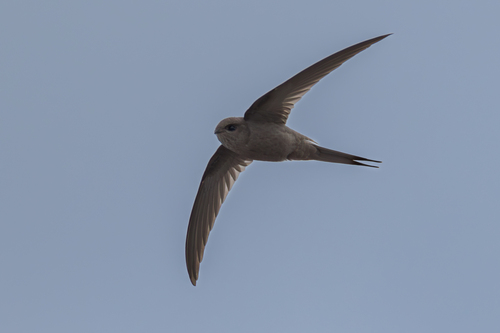
African Palm Swift (Cypsiurus parvus) African Palm Swift
Lesser Striped Swallow (Cecropis abyssinica) Lesser Striped Swallow

Media

Loading…

In short

The African Palm Swift (Cypsiurus parvus) and the Lesser Striped Swallow (Cecropis abyssinica) are easily distinguished by their flight patterns and tail shapes. The swift has a slender, sickle-shaped body and long, deeply forked tail, while the swallow has a more robust body and a shorter, less forked tail. Both species are aerial insectivores but differ significantly in their flight style and habitat preferences.

Identification tips

1. Tail shape: Look for the deeply forked tail of the African Palm Swift compared to the less forked tail of the Lesser Striped Swallow. 2. Flight style: Observe the swift's rapid, agile flight versus the swallow's more leisurely gliding. 3. Perching behavior: Swallows often perch visibly, while swifts are almost always in flight. 4. Plumage: Note the swallow's rufous crown and striped underparts, which contrast with the swift's uniform coloration.

Size

The African Palm Swift is smaller and more slender than the Lesser Striped Swallow.

Plumage

The African Palm Swift has a uniformly brownish-grey plumage, while the Lesser Striped Swallow features a striking rufous crown and nape, with bold black and white stripes on its underparts.

Behaviour

African Palm Swifts are almost always seen in flight, rarely perching, and exhibit rapid, agile flight. Lesser Striped Swallows are often seen perched on wires or branches and have a more leisurely flight style.

Habitat

African Palm Swifts are commonly found near palm trees and open areas, while Lesser Striped Swallows prefer open woodlands and savannas, often near water.

Voice

The vocalizations of these species are not well-documented for field differentiation, but swifts generally have high-pitched calls, whereas swallows have more melodic and varied vocalizations.

Submit a better description

Use the same sections as the comparison. Your text is published immediately.

The African Palm Swift (Cypsiurus parvus) and the Lesser Striped Swallow (Cecropis abyssinica) are easily distinguished by their flight patterns and tail shapes. The swift has a slender, sickle-shaped body and long, deeply forked tail, while the swallow has a more robust body and a shorter, less forked tail. Both species are aerial insectivores but differ significantly in their flight style and habitat preferences.

1. Tail shape: Look for the deeply forked tail of the African Palm Swift compared to the less forked tail of the Lesser Striped Swallow. 2. Flight style: Observe the swift's rapid, agile flight versus the swallow's more leisurely gliding. 3. Perching behavior: Swallows often perch visibly, while swifts are almost always in flight. 4. Plumage: Note the swallow's rufous crown and striped underparts, which contrast with the swift's uniform coloration.

The African Palm Swift is smaller and more slender than the Lesser Striped Swallow.

The African Palm Swift has a uniformly brownish-grey plumage, while the Lesser Striped Swallow features a striking rufous crown and nape, with bold black and white stripes on its underparts.

African Palm Swifts are almost always seen in flight, rarely perching, and exhibit rapid, agile flight. Lesser Striped Swallows are often seen perched on wires or branches and have a more leisurely flight style.

African Palm Swifts are commonly found near palm trees and open areas, while Lesser Striped Swallows prefer open woodlands and savannas, often near water.

The vocalizations of these species are not well-documented for field differentiation, but swifts generally have high-pitched calls, whereas swallows have more melodic and varied vocalizations.

Discard your changes?

You have unsaved edits. If you leave now, those changes will be lost.

African Palm Swift · Lesser Striped Swallow · My Tricky Birds