Birdr

Allen's Gallinule vs Baillon's Crake

Porphyrio alleni versus Zapornia pusilla

Play a quiz with Allen's Gallinule and Baillon's Crake
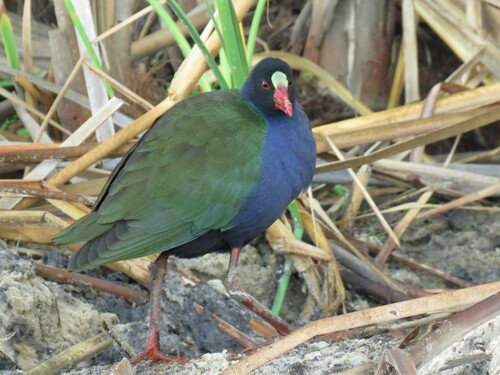
Allen's Gallinule (Porphyrio alleni) Allen's Gallinule
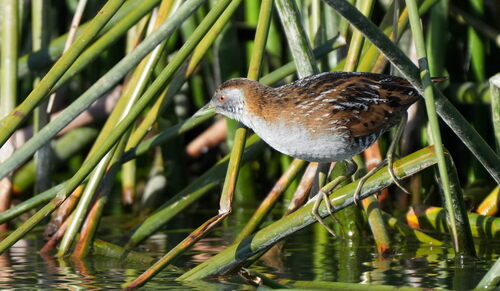
Baillon's Crake (Zapornia pusilla) Baillon's Crake

Media

Loading…

In short

Allen's Gallinule and Baillon's Crake can be distinguished by size and plumage. Allen's Gallinule is larger and more colorful, while Baillon's Crake is smaller and more cryptically colored. Observing their behavior and preferred habitats can also aid in identification.

Identification tips

Size

Allen's Gallinule is larger than Baillon's Crake.

Plumage

Allen's Gallinule has a striking purple-blue body with a greenish back and a red bill, while Baillon's Crake is more subdued with brown and buff tones, featuring white spots on the flanks.

Behaviour

Allen's Gallinule is more likely to be seen walking on floating vegetation or swimming, while Baillon's Crake tends to be more secretive, often skulking in dense reeds.

Habitat

Allen's Gallinule prefers wetlands with abundant floating vegetation, whereas Baillon's Crake is found in marshes and reed beds, often in more concealed areas.

Voice

Vocalizations differ, but specifics are not well-documented here; generally, crakes have a variety of calls that can be distinctive.

Submit a better description

Use the same sections as the comparison. Your text is published immediately.

Allen's Gallinule and Baillon's Crake can be distinguished by size and plumage. Allen's Gallinule is larger and more colorful, while Baillon's Crake is smaller and more cryptically colored. Observing their behavior and preferred habitats can also aid in identification.

  • Size: Allen's Gallinule is noticeably larger.
  • Plumage: Look for the vibrant purple-blue and greenish back of Allen's Gallinule versus the more camouflaged brown and buff of Baillon's Crake.
  • Behavior: Allen's Gallinule is more visible on open water, while Baillon's Crake is often hidden in reeds.
  • Habitat: Note the preference for floating vegetation by Allen's Gallinule compared to the dense reed beds favored by Baillon's Crake.

Allen's Gallinule is larger than Baillon's Crake.

Allen's Gallinule has a striking purple-blue body with a greenish back and a red bill, while Baillon's Crake is more subdued with brown and buff tones, featuring white spots on the flanks.

Allen's Gallinule is more likely to be seen walking on floating vegetation or swimming, while Baillon's Crake tends to be more secretive, often skulking in dense reeds.

Allen's Gallinule prefers wetlands with abundant floating vegetation, whereas Baillon's Crake is found in marshes and reed beds, often in more concealed areas.

Vocalizations differ, but specifics are not well-documented here; generally, crakes have a variety of calls that can be distinctive.

Discard your changes?

You have unsaved edits. If you leave now, those changes will be lost.

Allen's Gallinule · Baillon's Crake · My Tricky Birds