
Allen's Gallinule vs Grey-headed Swamphen
Porphyrio alleni versus Porphyrio poliocephalus
Play a quiz with Allen's Gallinule and Grey-headed Swamphen
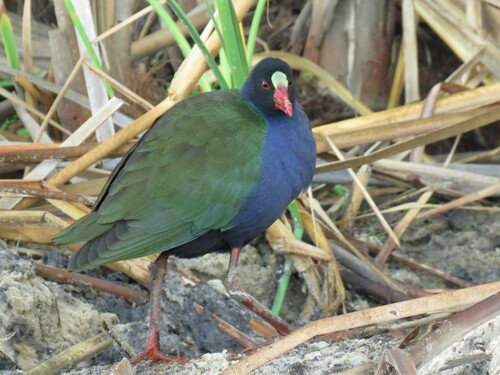 Allen's Gallinule
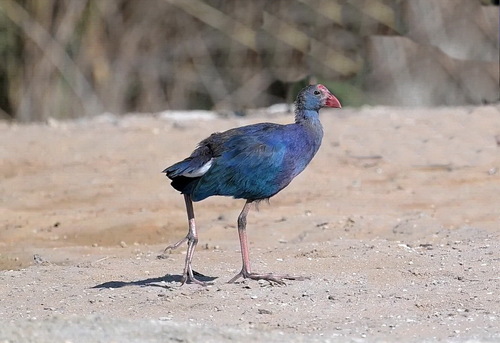 Grey-headed Swamphen
In short
The most reliable field mark between Allen's Gallinule and Grey-headed Swamphen is size: Grey-headed Swamphen is much larger and bulkier, with a longer body and stouter bill. Allen's Gallinule is compact, with a short tail and a more delicate build. In adults, Allen's Gallinule shows a greenish back and purple upperparts, while Grey-headed Swamphen is greyish-blue to purple with a distinctive pale grey head. Immature Allen's Gallinule is sandy brown with a buff undertail, never showing the pale grey head of the swamphen. Both have red bills and legs, but the swamphen's bill is much thicker. In flight or at rest, focus on size, head color, and overall structure.
Identification tips
- Size is the quickest separator: Grey-headed Swamphen is much larger and bulkier than Allen's Gallinule. If you see a Porphyrio that looks small and delicate, it's likely Allen's Gallinule.
- Head color in adults: Grey-headed Swamphen has a pale grey head, easily seen even at a distance. Allen's Gallinule never shows a pale head; males have a blue frontal shield, females a green one, but the rest of the head is dark.
- Back and upperparts: Adult Allen's Gallinule has a greenish back and purple upperparts, while Grey-headed Swamphen is more uniformly greyish-blue to purple, lacking the green back.
- Bill structure: Both species have red bills, but the swamphen's is much thicker and stouter, matching its larger head. Allen's Gallinule's bill is shorter and more delicate.
- Legs and toes: Both have red legs, but Allen's Gallinule's are finer and more spindly, with especially long toes relative to its small size.
- Tail pattern: Allen's Gallinule has a short tail with a white underside and a dark central bar, often flicked and visible when swimming or walking. Swamphen's tail is less contrasting and not as short.
- Juvenile/immature plumage: Immature Allen's Gallinule is sandy brown with a buff undertail, never blue or grey. Juvenile swamphens are always some shade of blue-grey or purple, never sandy brown.
- Behavior: Allen's Gallinule is shy and secretive, often swimming with a distinctive head-nodding motion. Swamphens are bolder, often seen walking in the open and performing elaborate courtship displays.
- Flight jizz: Swamphens are heavy and slow in flight, with broad wings and dangling legs. Allen's Gallinule is more agile and quick, with a compact outline.
- Habitat context: If you find a small Porphyrio in dense, reedy swamps, especially skulking, suspect Allen's Gallinule. In open marshes or jheels, especially in South Asia, swamphen is more likely.
- Sex differences: In Allen's Gallinule, males have a blue frontal shield, females green. Swamphens show little sexual dimorphism in the field, but always have the pale grey head.
- Seasonal context: Allen's Gallinule is more likely to be seen on migration or in winter, as it is very secretive during breeding. Swamphens are resident and visible year-round.
- Vocalizations: Allen's Gallinule gives a sharp, nasal 'pruk'; swamphen calls are louder and more varied, with chuckles and grunts. Use voice only if you are familiar with both.
- Pitfalls: Do not rely on leg color or bill color alone, as both are red. Always check size, head color, and back color first.
- Chick plumage: Downy chicks of both are black, so not separable at this age.
Size
Grey-headed Swamphen is a large wetland bird, reaching about 43 cm in length [wikipedia], making it noticeably bigger than Allen's Gallinule, which is only slightly larger than a Water Rail and much smaller than the swamphen. The swamphen appears heavy-bodied with a long neck and large head, while Allen's Gallinule is compact and lightly built. The difference is obvious even at a distance: swamphens dwarf gallinules.
Plumage
Immature Allen's Gallinule is sandy brown overall with a buff undertail, lacking any grey or blue tones; this is very different from the consistently blue-grey or purple tones of Grey-headed Swamphen of any age. Adult Allen's Gallinule has a greenish back and purple upperparts, with a short tail that is white underneath with a dark central bar. In contrast, Grey-headed Swamphen adults are greyish-blue to purple with a pale grey head and greenish wings, lacking the gallinule's green back and purple upperparts. The swamphen's head is always pale grey in adults, while Allen's Gallinule has a blue (male) or green (female) frontal shield but not a pale head. Both have red legs, but Allen's Gallinule's are more delicate. Juvenile and immature swamphens do not show the sandy brown of young gallinules.
Behaviour
Allen's Gallinule is secretive, often skulking in dense vegetation and more likely to be seen swimming with head-nodding movements. It is especially elusive during the breeding season, when it is mostly heard. Grey-headed Swamphen is bolder, often seen in the open, walking with a slow, deliberate gait, and sometimes performing courtship displays with water weeds in the bill. In flight, the swamphen appears heavy and slow, while Allen's Gallinule is quicker and more agile.
Habitat
Both species inhabit marshes and wetlands, but Allen's Gallinule prefers dense swamps and is more secretive, often hidden in thick vegetation. Grey-headed Swamphen is more likely to be seen in open wetlands, marshes, and jheels, often feeding in the open. If you see a Porphyrio out in the open for long periods, especially in South Asia, it is far more likely to be a swamphen.
Voice
Allen's Gallinule gives a sharp, nasal 'pruk' call and is generally noisy during the breeding season, though often heard rather than seen. Grey-headed Swamphen is also vocal, with loud chuckles, especially during courtship. The calls are different, but unless you are familiar with both, voice is less reliable than visual marks.