
Birdr

Amazonian Black-throated Trogon vs Collared Trogon

Trogon rufus versus Trogon collaris

Play a quiz with Amazonian Black-throated Trogon and Collared Trogon
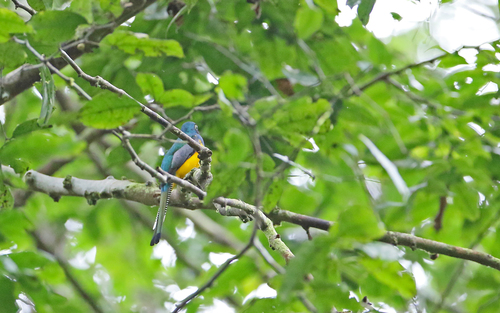
Amazonian Black-throated Trogon (Trogon rufus) Amazonian Black-throated Trogon
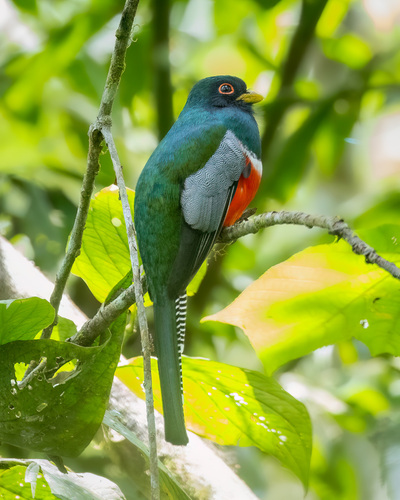
Collared Trogon (Trogon collaris) Collared Trogon

Media

Loading…

In short

The Amazonian Black-throated Trogon and the Collared Trogon are both small, yellow-bellied trogons with similar overall structure, making them challenging to distinguish. Key differences lie in the color of the male's upper tail and the undertail barring of both sexes. Vocalizations also differ, but are less reliable in the field.

Identification tips

1. Look for the black upper tail in males of the Amazonian Black-throated Trogon. 2. Check the density of barring on the undertail; it varies between species. 3. Note the habitat: Amazonian Black-throated Trogon is more restricted to the Amazon basin. 4. Use vocalizations cautiously as they can be unreliable for field identification.

Size

Both species are similar in size, typical of small trogons.

Plumage

Males of both species have green hoods and yellow bellies, but the Amazonian Black-throated Trogon has a more uniform black upper tail, while the Collared Trogon may show more variation. Females have brown hoods, and both species exhibit differences in the density of barring on the undertail.

Behaviour

Both species are typically found in the understory and midstory of forests, where they feed primarily on insects.

Habitat

The Amazonian Black-throated Trogon is found in the humid lowland forests of the Amazon, while the Collared Trogon has a broader range, often found in montane and lowland forests across Central and South America.

Voice

Vocalizations differ in pitch, duration, and number of notes, but these differences are subtle and may not be easily discernible in the field.

Submit a better description

Use the same sections as the comparison. Your text is published immediately.

The Amazonian Black-throated Trogon and the Collared Trogon are both small, yellow-bellied trogons with similar overall structure, making them challenging to distinguish. Key differences lie in the color of the male's upper tail and the undertail barring of both sexes. Vocalizations also differ, but are less reliable in the field.

1. Look for the black upper tail in males of the Amazonian Black-throated Trogon. 2. Check the density of barring on the undertail; it varies between species. 3. Note the habitat: Amazonian Black-throated Trogon is more restricted to the Amazon basin. 4. Use vocalizations cautiously as they can be unreliable for field identification.

Both species are similar in size, typical of small trogons.

Males of both species have green hoods and yellow bellies, but the Amazonian Black-throated Trogon has a more uniform black upper tail, while the Collared Trogon may show more variation. Females have brown hoods, and both species exhibit differences in the density of barring on the undertail.

Both species are typically found in the understory and midstory of forests, where they feed primarily on insects.

The Amazonian Black-throated Trogon is found in the humid lowland forests of the Amazon, while the Collared Trogon has a broader range, often found in montane and lowland forests across Central and South America.

Vocalizations differ in pitch, duration, and number of notes, but these differences are subtle and may not be easily discernible in the field.

Discard your changes?

You have unsaved edits. If you leave now, those changes will be lost.

Amazonian Black-throated Trogon · Collared Trogon · My Tricky Birds