
American Barn Owl vs Snowy Owl
Tyto furcata versus Bubo scandiacus
Play a quiz with American Barn Owl and Snowy Owl
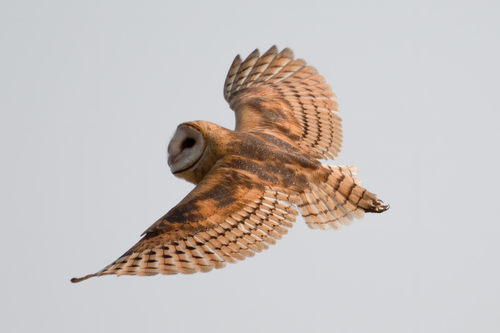 American Barn Owl
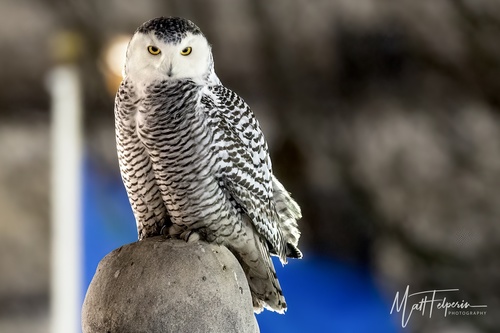 Snowy Owl
In short
The most reliable field mark to separate American Barn Owl from Snowy Owl is overall color and facial structure: Barn Owls have a distinctive heart-shaped, pale (often white) face and a pale, lightly speckled body, while Snowy Owls are bulkier, mostly white, and have a rounded head with bright yellow eyes. In flight, Barn Owls show long, broad wings and a short, squarish tail, often with dangling feathered legs, while Snowy Owls appear heavier with broad wings and a rounded, short tail. Juvenile and female Snowy Owls can be heavily barred or spotted, but never show the heart-shaped facial disk of Barn Owl. Both species can appear pale at a distance, but structure and facial features are decisive.
Identification tips
- Heart-shaped face (Barn Owl only): Barn Owls have a distinctive, flat, heart-shaped facial disk that is bright white or buff, with black eyes. Snowy Owls have a rounded head, no heart-shaped disk, and yellow eyes.
- Overall color: Snowy Owls are mostly white, sometimes with heavy brown barring or spots (especially females and juveniles), but never show the fine speckling or pale brown/gray tones of Barn Owl. Barn Owls are pale but never pure white, and always show some pale brown or gray on the upperparts.
- Wing and tail pattern (all ages): Barn Owls have long, broad wings and a short, squarish tail with light brown and darker bands but no bold barring. Snowy Owls have broad wings and a short, rounded tail; females and juveniles show brown barring on wings and tail, males are nearly unmarked.
- Eye color: Barn Owls have black eyes; Snowy Owls have bright yellow eyes. This is diagnostic at close range.
- Perched posture: Snowy Owls perch upright, appearing bulky and rounded, often on the ground or low posts. Barn Owls are slimmer, often perched in cavities or on rafters.
- Flight style: Barn Owls fly with buoyant, undulating, silent flight, often with legs dangling. Snowy Owls fly with strong, direct wingbeats and appear heavier in the air.
- Legs and toes: Barn Owls have long, feathered legs that may dangle in flight. Snowy Owls also have feathered legs, but their legs are shorter and less likely to dangle.
- Habitat context: Barn Owls are associated with human structures, farmland, and open country; Snowy Owls are birds of the tundra, open fields, and rarely near buildings.
- Sex and age confusion: Female and juvenile Snowy Owls can be heavily barred and appear darker, but never have the heart-shaped face or fine speckling of Barn Owl. Barn Owl females are more spotted below, but always show the characteristic facial disk.
- Head shape: Barn Owls have a flat, broad face; Snowy Owls have a rounded, compact head.
- Facial markings: Snowy Owls may show faint dark spots on the crown or around the face, but never the even, heart-shaped outline of Barn Owl.
- Bill and talon color: Barn Owl bills are pale horn to dark buff; Snowy Owl bills are less visible but are dark. Talon color is not a reliable field mark.
- Voice: Not diagnostic in the field for separation; both can be silent and their calls are very different, but rarely heard in direct comparison.
- Molt and feather wear: Not useful for separation in the field.
- Seasonal context: Snowy Owls are only likely in southern areas during irruptions in winter; Barn Owls are resident year-round in suitable habitat.
Size
Snowy Owl is distinctly larger and bulkier than American Barn Owl. While precise measurements are not provided here, Snowy Owls are described as large owls, with a powerful, heavy build typical of Bubo owls. Barn Owls are medium-sized, with a more slender, elongated appearance and a noticeably smaller head and body compared to Snowy Owl. In the field, Snowy Owl often appears as a large, rounded lump when perched, while Barn Owl is slimmer and more delicate.
Plumage
-
Juveniles and immatures: Juvenile Snowy Owls are dark gray-brown above with white eyebrows and facial areas, and develop dark barring on white as they age. They can be heavily mottled or blotched, especially on the back and wings. American Barn Owl juveniles are covered in white down, quickly developing the heart-shaped facial disk; their flight feathers are pale brown with darker bands, and the underparts are white to buff with fine speckling.
-
Adults: Adult Barn Owls are pale overall, with a white or buff unpatterned or finely speckled underside, pale brown to gray upperparts with fine speckles, and a bright white (sometimes brownish) heart-shaped face. The remiges and rectrices are light brown with darker bands, but never show bold barring or heavy spots. Adult Snowy Owls are mostly white, with males being purer white and females more heavily barred or spotted with brown, especially on the crown, flanks, and upper breast. Snowy Owl flight and tail feathers are faintly barred brown in females, and more sparsely marked in males. Snowy Owls lack the heart-shaped facial disk and have yellow eyes, while Barn Owls have black eyes.
-
Sex and age variation: Barn Owl females are larger and more heavily spotted below than males, but both sexes are paler and less marked than even the palest Snowy Owl females. Snowy Owl males can be nearly pure white, but most have some dark spots; females are always more marked, but rarely as pale as the whitest males. Some Snowy Owls grow paler with age, but this is variable.
Behaviour
Barn Owls have a distinctive undulating flight with long, broad wings and often dangle their feathered legs in flight. Their flight is silent and buoyant, and they are most often seen hunting at dusk or night. Snowy Owls are more likely to be seen perched in the open during the day, often sitting on the ground or low perches, appearing as a white lump. Their flight is powerful and direct, with broad wings and a heavy, rounded body. Snowy Owls are diurnal or crepuscular, especially in the Arctic summer, and are less likely to be seen flying low and erratically like Barn Owls.
Habitat
American Barn Owls are found in a wide range of open habitats, often near farmland, grasslands, or marshes, and frequently roost or nest in barns or other human structures. Snowy Owls are birds of the open Arctic tundra, rarely venturing into forests, and in winter may be found in open fields, coastal dunes, or airports far south of their breeding range. If you see a pale owl in a barn, it is almost certainly a Barn Owl; a pale owl on the tundra or sitting in an open field in winter is likely a Snowy Owl.