
American Bittern vs Least Bittern
Botaurus lentiginosus versus Botaurus exilis
Play a quiz with American Bittern and Least Bittern
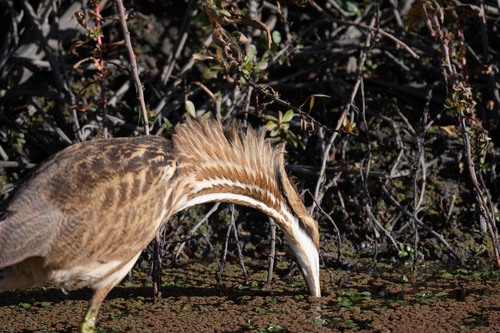 American Bittern
 Least Bittern
In short
The most reliable field mark to separate American Bittern from Least Bittern is size: American Bittern is a large, chunky heron, while Least Bittern is tiny and slender, barely half the length and a fraction of the weight. In flight or perched, American Bittern shows a heavily streaked, brown-and-buff plumage with a robust build, whereas Least Bittern is much more delicate, with a contrasting pattern of white underparts and dark upperparts, and a noticeably smaller, thinner bill. Both species can freeze with their bills pointed upward, blending into marsh vegetation, but Least Bittern often perches among reeds rather than wading. If you see a bittern straddling reeds or moving nimbly through dense vegetation, it's almost certainly a Least Bittern.
Identification tips
- Size is the most immediate clue: American Bittern is much larger and bulkier; Least Bittern is tiny and slender. If you see a heron-sized bird, it's not a Least Bittern.
- Bill structure: American Bittern has a long, robust, dagger-like bill; Least Bittern's bill is noticeably shorter, thinner, and more delicate.
- Plumage above: American Bittern is brown and buff with heavy black speckling and barring, especially on the mantle and scapulars. Least Bittern males are glossy greenish-black above (females glossy brown), with white shoulder lines and pale brown wing coverts.
- Plumage below: American Bittern has buff and rust underparts with fine black streaking, creating a striped effect. Least Bittern has white underparts with light brown streaks, much cleaner and more contrasting.
- Neck sides: American Bittern shows a bluish-black patch on the side of the neck (larger in males), while Least Bittern's neck sides are plain light brown.
- Crown color: American Bittern's crown is chestnut brown with black centers; Least Bittern males have a glossy dark crown, females brown.
- Facial pattern: American Bittern has a buff superciliary (eyebrow) and mustachial stripe on a brown cheek; Least Bittern's face is light brown with yellow eyes and bill, lacking strong facial stripes.
- Wing pattern in flight: Least Bittern shows pale brown wing coverts contrasting with dark upperparts and white underparts; American Bittern's flight feathers are blackish-brown with buff or chestnut tips but lack the sharp contrast of Least Bittern.
- Leg and foot color: Both species have yellowish-green legs, but this is not a strong separator.
- Behavior: Least Bittern often perches or straddles reeds, sometimes swaying to mimic vegetation; American Bittern is more likely to be seen wading or standing motionless in open water.
- Habitat use: If you see a bittern in dense reeds above deep water, especially perching or climbing, it's likely a Least Bittern. In more open marshes or standing in water, American Bittern is more probable.
- Voice: A deep, booming, pump-like call is diagnostic of American Bittern. Least Bittern's calls are quieter and less distinctive.
- Seasonal timing: Least Bittern arrives on breeding grounds later and leaves earlier than American Bittern, but overlap is extensive.
- Juvenile confusion: Juvenile American Bitterns look like adults but with less olive on the neck; Least Bittern juveniles are not described in detail but are likely to show the same size and structure differences as adults.
- When in doubt: Use a combination of size, structure, and overall pattern—American Bittern is large, streaky, and robust; Least Bittern is tiny, contrasting, and agile among reeds.
Size
American Bittern is dramatically larger: 58–85 cm (23–33 in) long with a 92–115 cm (36–45 in) wingspan and a mass of 370–1,072 g. Least Bittern is only 28–36 cm (11–14 in) long, with a 41–46 cm (16–18 in) wingspan and a mean mass around 80 g. In the field, American Bittern appears as a large, robust heron, while Least Bittern is tiny, about the size of a Green Heron or even smaller, and can compress its body to slip between reeds. If you see both together, the size difference is unmistakable.
Plumage
No age-specific upperwing or flight pattern is described for either species that is unique to juveniles or immatures, but overall plumage is distinctive. American Bittern (adult and juvenile) is brown and buff above, heavily speckled and streaked, with a chestnut crown, black feather centers, and a striped effect on the underparts. The side of the neck has a bluish-black patch, more prominent in males. Juveniles are similar but with less olive on the neck. Least Bittern (adult male) has glossy greenish-black on the back and crown, with white lines on the shoulders and light brown on the face and neck; females are glossy brown above. Both sexes have white underparts with light brown streaks and show pale brown wing coverts in flight. The contrast between dark upperparts and white underparts is much stronger in Least Bittern. The bill and legs are yellowish-green in American Bittern, and yellow in Least Bittern; both have yellow eyes.
Behaviour
Both species are elusive and rely on camouflage, often freezing with their bills pointed skyward. American Bittern typically stalks or stands motionless in shallow water, blending into cattails and bulrushes. Least Bittern, due to its small size, often perches or straddles reeds above deeper water, moving nimbly through dense vegetation. Least Bittern is more likely to be seen climbing among stems rather than wading. When alarmed, Least Bittern may sway to mimic wind-blown reeds.
Habitat
Both species occupy marshes with dense vegetation, often in the same wetlands. American Bittern prefers larger, more open marshes with extensive stands of cattails or bulrushes, and is more likely to be found in northern and central U.S. and Canada during breeding. Least Bittern favors dense, reedy edges and can exploit narrower patches of vegetation, often arriving on breeding grounds later and departing earlier than American Bittern. Least Bittern's ability to perch among reeds allows it to use habitat that is too deep for American Bittern's wading style.
Voice
American Bittern is famous for its loud, booming call, often described as 'oong, kach, oonk,' which carries over long distances and is usually heard at dusk or night. Least Bittern is more often heard than seen, but its calls are not described in detail in the sources provided; they are generally quieter and less resonant than American Bittern's. If you hear a deep, pump-like boom, it's American Bittern.