Birdr

American Crow vs Common Raven

Corvus brachyrhynchos versus Corvus corax

Play a quiz with American Crow and Common Raven
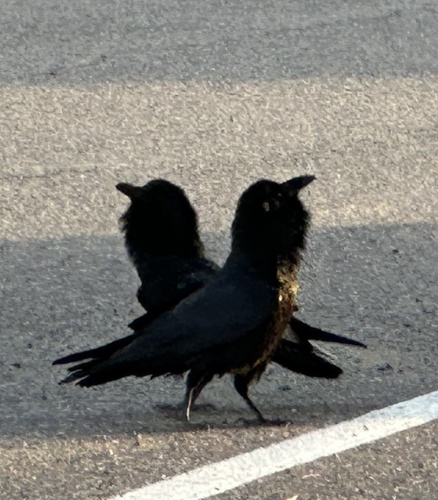
American Crow (Corvus brachyrhynchos) American Crow
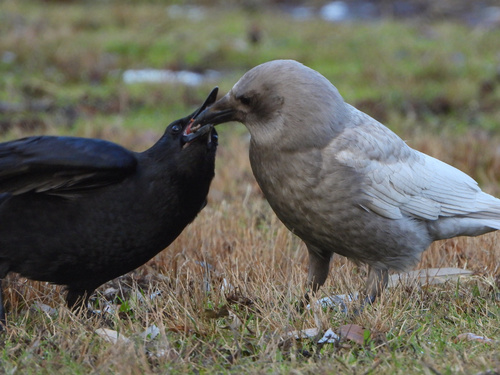
Common Raven (Corvus corax) Common Raven

Media

Loading…

In short

The American Crow and Common Raven are both large, black corvids, but the raven is notably larger with a heavier bill and wedge-shaped tail. Crows have a more uniform wing shape and a fan-shaped tail. Vocalizations are distinct, with crows having a cawing call and ravens producing a deeper, croaking sound.

Identification tips

  1. Tail Shape: Look for the wedge-shaped tail of the raven in flight, compared to the fan-shaped tail of the crow. 2. Bill Size: Ravens have a noticeably thicker and more curved bill. 3. Vocalizations: Listen for the deeper croak of the raven versus the caw of the crow. 4. Size and Structure: Note the larger size and bulkier build of the raven. 5. Behavior: Observe group size; crows are often in larger groups, while ravens are more solitary.

Size

The Common Raven is significantly larger than the American Crow, with a wingspan reaching up to 4 feet, compared to the crow's 3 feet. Ravens also have a more robust and thicker bill.

Plumage

Both species have glossy black plumage, but the raven's feathers often have a more iridescent sheen, particularly in sunlight.

Behaviour

American Crows are more likely to be seen in groups, especially outside the breeding season, while ravens are often solitary or in pairs. Ravens are also known for their aerial acrobatics.

Habitat

American Crows are more adaptable to urban and suburban environments, often seen in open landscapes with scattered trees. Common Ravens prefer more remote areas, including forests, mountains, and deserts.

Voice

American Crows have a distinctive cawing call, while Common Ravens produce a deeper, more resonant croak. Ravens also have a wider variety of vocalizations.

Submit a better description

Use the same sections as the comparison. Your text is published immediately.

The American Crow and Common Raven are both large, black corvids, but the raven is notably larger with a heavier bill and wedge-shaped tail. Crows have a more uniform wing shape and a fan-shaped tail. Vocalizations are distinct, with crows having a cawing call and ravens producing a deeper, croaking sound.

  1. Tail Shape: Look for the wedge-shaped tail of the raven in flight, compared to the fan-shaped tail of the crow. 2. Bill Size: Ravens have a noticeably thicker and more curved bill. 3. Vocalizations: Listen for the deeper croak of the raven versus the caw of the crow. 4. Size and Structure: Note the larger size and bulkier build of the raven. 5. Behavior: Observe group size; crows are often in larger groups, while ravens are more solitary.

The Common Raven is significantly larger than the American Crow, with a wingspan reaching up to 4 feet, compared to the crow's 3 feet. Ravens also have a more robust and thicker bill.

Both species have glossy black plumage, but the raven's feathers often have a more iridescent sheen, particularly in sunlight.

American Crows are more likely to be seen in groups, especially outside the breeding season, while ravens are often solitary or in pairs. Ravens are also known for their aerial acrobatics.

American Crows are more adaptable to urban and suburban environments, often seen in open landscapes with scattered trees. Common Ravens prefer more remote areas, including forests, mountains, and deserts.

American Crows have a distinctive cawing call, while Common Ravens produce a deeper, more resonant croak. Ravens also have a wider variety of vocalizations.

Discard your changes?

You have unsaved edits. If you leave now, those changes will be lost.

American Crow · Common Raven · My Tricky Birds