Birdr

American Flamingo vs Greater Flamingo

Phoenicopterus ruber versus Phoenicopterus roseus

Play a quiz with American Flamingo and Greater Flamingo
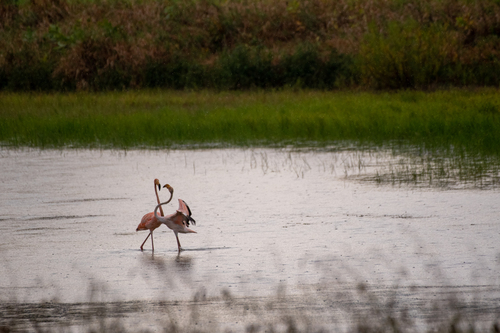
American Flamingo (Phoenicopterus ruber) American Flamingo
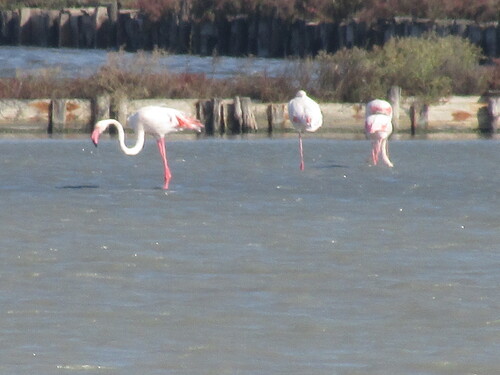
Greater Flamingo (Phoenicopterus roseus) Greater Flamingo

Media

Loading…

In short

The most reliable field mark to separate American Flamingo from Greater Flamingo is the overall intensity of pink in adult plumage: American Flamingo adults are a much deeper, more saturated pink, while Greater Flamingos are distinctly paler, often appearing pinkish-white. Both species have red wing coverts and black flight feathers, but the American Flamingo's body and legs are a richer pink. Subadults and juveniles of both species are duller, but Greater Flamingo immatures are especially pale with dark legs, which can help in tricky age classes. Structurally, Greater Flamingo is slightly larger and heavier, but this is subtle and unreliable at a distance. Both species share similar calls and feeding behaviors, so focus on coloration and leg color for the best field separation.

Identification tips

  1. Adult body color: American Flamingo adults are a much deeper, richer pink overall than Greater Flamingo adults, which are pale pinkish-white. This is the single most reliable field mark in good light.
  2. Leg color in immatures: Subadult and immature Greater Flamingos have notably dark legs, while American Flamingo immatures do not show this feature. This is especially useful when adult coloration is lacking.
  3. Bill pattern: Both species have a pink bill with a black tip, but the black is more extensive on American Flamingo, while Greater Flamingo's black is more restricted to the tip. This is subtle and best used at close range.
  4. Wing pattern in flight: Both species show red wing coverts and black primaries/secondaries in flight, so this is not a reliable separation point. Do not rely on wing pattern alone.
  5. Leg color in adults: Both adults have entirely pink legs, so this is not useful for separating them at this age.
  6. Overall size: Greater Flamingo averages slightly larger and heavier, but the overlap is considerable. Use only as a supporting clue, not a primary mark.
  7. Juvenile plumage: Both species' chicks are grey and downy; this is not useful for separation.
  8. Breeding season color enhancement: Greater Flamingos can appear slightly more colorful during the breeding season due to uropygial 'make-up,' but even then, they rarely reach the intensity of American Flamingo.
  9. Habitat and range: Use location as a strong clue—American Flamingo in the Americas, Greater Flamingo in the Old World. Out-of-range records should be scrutinized and supported by strong plumage evidence.
  10. Courtship and flocking behavior: Both species display similar group courtship and social behaviors; these are not helpful for identification.
  11. Voice: Both have a similar honking call; do not use voice for separation.
  12. Sex and age effects: Both species show some variation in color intensity with age and breeding status, but the difference in adult body color remains the most reliable mark.
  13. Feeding behavior: Both species feed in the same manner and habitats; this does not aid identification.
  14. Potential pitfalls: Faded or worn American Flamingos may appear paler, and breeding Greater Flamingos may appear slightly more colorful, but the overall pink intensity difference usually holds. Always check multiple features.
  15. Vagrant/escapee caution: In regions where both could theoretically occur (e.g., zoos, escapes, rare vagrants), rely on plumage and leg color, not just range.

Size

Greater Flamingo is the largest flamingo species worldwide, with adults averaging 110–150 cm tall and weighing 2–4 kg. American Flamingo is slightly smaller on average (120–145 cm tall, males ~2.8 kg, females ~2.2 kg), but this overlap means size alone is rarely diagnostic unless both species are seen side by side. In practice, both appear as very large, long-legged waders, and field separation by size is unreliable.

Plumage

Adult American Flamingos are a vivid, saturated pink across the body and legs, with red wing coverts and black primaries/secondaries. Their bill is pink with a large black tip, and the legs are entirely pink. In contrast, adult Greater Flamingos are much paler overall—pinkish-white rather than deep pink—with the same red wing coverts and black flight feathers, but their bill has a more restricted black tip. Greater Flamingo adults also have entirely pink legs, but subadults and immatures are paler still, with notably dark legs (unlike American Flamingo immatures, which are less well described but do not show such dark legs). Both species' chicks are grey and downy. During the breeding season, Greater Flamingos may enhance their pink coloration by spreading uropygial secretions, but even then, they rarely match the intensity of American Flamingos. In flight, both show the same striking black-and-red wing pattern, so body and leg color are more useful for separation, especially at rest.

Behaviour

Both species feed in shallow lagoons and mudflats, stirring up food with their feet and filtering it through their specialized bills. Their feeding posture and movements are essentially identical. Both species are highly social, forming large flocks, and both perform elaborate group courtship displays. There are no behavioral differences that are reliably diagnostic in the field.

Habitat

Habitat is a strong clue: American Flamingo is native to the West Indies, northern South America, the Galápagos, and the Yucatán Peninsula, while Greater Flamingo is found in the Old World—Africa, southern Europe, the Middle East, and South Asia. Vagrants do occur, but in their normal ranges, a flamingo seen in the Americas is almost certainly American Flamingo, and one in Europe, Africa, or Asia is almost certainly Greater Flamingo. Overlap is extremely rare and usually involves escapees or rare vagrants.

Voice

Both species give a similar goose-like honking call. There are no field-diagnostic differences in voice described in the sources.

Submit a better description

Use the same sections as the comparison. Your text is published immediately.

The most reliable field mark to separate American Flamingo from Greater Flamingo is the overall intensity of pink in adult plumage: American Flamingo adults are a much deeper, more saturated pink, while Greater Flamingos are distinctly paler, often appearing pinkish-white. Both species have red wing coverts and black flight feathers, but the American Flamingo's body and legs are a richer pink. Subadults and juveniles of both species are duller, but Greater Flamingo immatures are especially pale with dark legs, which can help in tricky age classes. Structurally, Greater Flamingo is slightly larger and heavier, but this is subtle and unreliable at a distance. Both species share similar calls and feeding behaviors, so focus on coloration and leg color for the best field separation.

  1. Adult body color: American Flamingo adults are a much deeper, richer pink overall than Greater Flamingo adults, which are pale pinkish-white. This is the single most reliable field mark in good light.
  2. Leg color in immatures: Subadult and immature Greater Flamingos have notably dark legs, while American Flamingo immatures do not show this feature. This is especially useful when adult coloration is lacking.
  3. Bill pattern: Both species have a pink bill with a black tip, but the black is more extensive on American Flamingo, while Greater Flamingo's black is more restricted to the tip. This is subtle and best used at close range.
  4. Wing pattern in flight: Both species show red wing coverts and black primaries/secondaries in flight, so this is not a reliable separation point. Do not rely on wing pattern alone.
  5. Leg color in adults: Both adults have entirely pink legs, so this is not useful for separating them at this age.
  6. Overall size: Greater Flamingo averages slightly larger and heavier, but the overlap is considerable. Use only as a supporting clue, not a primary mark.
  7. Juvenile plumage: Both species' chicks are grey and downy; this is not useful for separation.
  8. Breeding season color enhancement: Greater Flamingos can appear slightly more colorful during the breeding season due to uropygial 'make-up,' but even then, they rarely reach the intensity of American Flamingo.
  9. Habitat and range: Use location as a strong clue—American Flamingo in the Americas, Greater Flamingo in the Old World. Out-of-range records should be scrutinized and supported by strong plumage evidence.
  10. Courtship and flocking behavior: Both species display similar group courtship and social behaviors; these are not helpful for identification.
  11. Voice: Both have a similar honking call; do not use voice for separation.
  12. Sex and age effects: Both species show some variation in color intensity with age and breeding status, but the difference in adult body color remains the most reliable mark.
  13. Feeding behavior: Both species feed in the same manner and habitats; this does not aid identification.
  14. Potential pitfalls: Faded or worn American Flamingos may appear paler, and breeding Greater Flamingos may appear slightly more colorful, but the overall pink intensity difference usually holds. Always check multiple features.
  15. Vagrant/escapee caution: In regions where both could theoretically occur (e.g., zoos, escapes, rare vagrants), rely on plumage and leg color, not just range.

Greater Flamingo is the largest flamingo species worldwide, with adults averaging 110–150 cm tall and weighing 2–4 kg. American Flamingo is slightly smaller on average (120–145 cm tall, males ~2.8 kg, females ~2.2 kg), but this overlap means size alone is rarely diagnostic unless both species are seen side by side. In practice, both appear as very large, long-legged waders, and field separation by size is unreliable.

Adult American Flamingos are a vivid, saturated pink across the body and legs, with red wing coverts and black primaries/secondaries. Their bill is pink with a large black tip, and the legs are entirely pink. In contrast, adult Greater Flamingos are much paler overall—pinkish-white rather than deep pink—with the same red wing coverts and black flight feathers, but their bill has a more restricted black tip. Greater Flamingo adults also have entirely pink legs, but subadults and immatures are paler still, with notably dark legs (unlike American Flamingo immatures, which are less well described but do not show such dark legs). Both species' chicks are grey and downy. During the breeding season, Greater Flamingos may enhance their pink coloration by spreading uropygial secretions, but even then, they rarely match the intensity of American Flamingos. In flight, both show the same striking black-and-red wing pattern, so body and leg color are more useful for separation, especially at rest.

Both species feed in shallow lagoons and mudflats, stirring up food with their feet and filtering it through their specialized bills. Their feeding posture and movements are essentially identical. Both species are highly social, forming large flocks, and both perform elaborate group courtship displays. There are no behavioral differences that are reliably diagnostic in the field.

Habitat is a strong clue: American Flamingo is native to the West Indies, northern South America, the Galápagos, and the Yucatán Peninsula, while Greater Flamingo is found in the Old World—Africa, southern Europe, the Middle East, and South Asia. Vagrants do occur, but in their normal ranges, a flamingo seen in the Americas is almost certainly American Flamingo, and one in Europe, Africa, or Asia is almost certainly Greater Flamingo. Overlap is extremely rare and usually involves escapees or rare vagrants.

Both species give a similar goose-like honking call. There are no field-diagnostic differences in voice described in the sources.

Discard your changes?

You have unsaved edits. If you leave now, those changes will be lost.

American Flamingo · Greater Flamingo · My Tricky Birds