
American Herring Gull vs Vega Gull
Larus smithsonianus versus Larus vegae
Play a quiz with American Herring Gull and Vega Gull
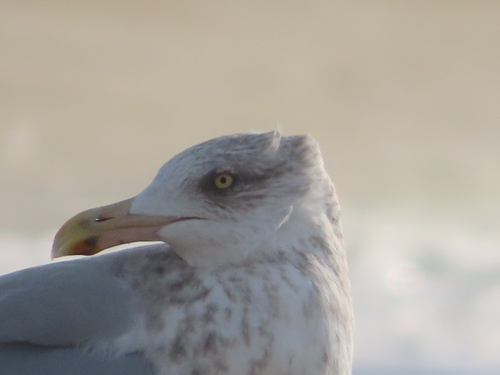 American Herring Gull
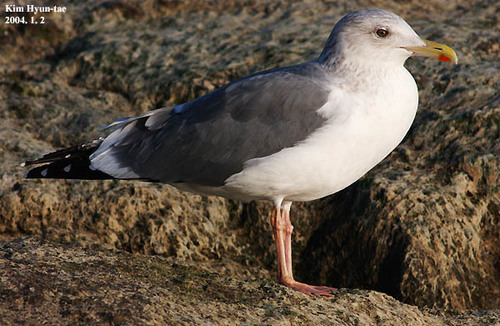 Vega Gull
In short
The most reliable field mark for separating American Herring Gull and Vega Gull is the pattern and tone of the head and neck in winter: Vega Gull shows heavy brown streaking and a distinct collar, while American Herring Gull has lighter, more diffuse streaking. For immature birds, focus on the darkness and uniformity of the body and tail: American Herring Gull immatures are more uniformly gray-brown and have a darker tail, while Vega Gull immatures show heavier brown flecking and streaking, especially on the head and body. Adults are very similar, but Vega Gull is slightly darker gray above and typically has brighter pink legs. Eye color and orbital ring also differ, with Vega tending toward a darker eye and red orbital ring. In flight, subtle differences in wing pattern may be visible, but are not well detailed in available sources.
Identification tips
- Head and neck streaking in winter (adults): Vega Gull shows heavy brown streaking and a distinct collar on the head and neck in winter, especially on the back and sides of the neck. American Herring Gull has lighter, more diffuse brown streaking, often limited to the crown and nape.
- Head pattern in immatures: First- and second-winter Vega Gulls have a notably darker, more heavily streaked crown and neck than American Herring Gull of the same age, which tends to have a paler head relative to the body.
- Body and tail in immatures: American Herring Gull immatures are more uniformly gray-brown with a distinctly darker tail, while Vega Gull immatures show extensive brown flecking and streaking over most of the body, with less contrast between tail and body.
- Upperwing and flight pattern (immatures): No detailed, diagnostic differences are described in the sources for these two species, so rely on overall darkness and uniformity for American Herring Gull versus more mottled, streaked appearance for Vega Gull.
- Mantle/upperpart gray tone (adults): Vega Gull is slightly darker gray above than American Herring Gull, but this is subtle and best judged in direct comparison or good light.
- Leg color: Both species typically have pink legs, but Vega Gull's are often described as brighter pink. Leg color is variable and not always reliable.
- Bill color and pattern: Adult bills are yellow with a red spot in both species. In first- and second-winter birds, Vega Gull's bill is almost entirely dark gray to black, with the dark area shrinking as the bird matures. American Herring Gull immatures have a dark bill that becomes paler at the base through winter.
- Eye color and orbital ring: Vega Gull tends to have a darker eye with a red orbital ring, while American Herring Gull usually has a pale yellow eye with a yellow or orange ring. This is most useful in adults.
- Overall structure and size: Both are large, robust gulls with overlapping measurements; size and shape are not reliable for separation.
- Habitat and range: If seen in North America outside western Alaska, the bird is almost certainly American Herring Gull. In western Alaska, both may occur, so habitat is not diagnostic.
- Seasonal context: In winter, focus on head streaking and collar for Vega Gull. In summer, both species have clean white heads, making separation more challenging.
- Plumage molt timing: Not detailed in sources, but be aware that molt timing may affect head streaking and bill color, especially in transitional seasons.
- Pitfalls: Do not rely on a single mark; use a combination of head streaking, body pattern, and eye color/orbital ring for best results. Be cautious with birds in molt or poor light.
- Sex and age: Both species show similar sexual dimorphism (males larger), but this is not useful in the field. Age-related plumage changes are key for immatures.
- Flight views: In the absence of strong wing pattern differences, rely on overall darkness and uniformity (American Herring Gull) versus heavier streaking and mottling (Vega Gull) in immatures.
Size
Both species are large, heavily built gulls with similar structure. The Vega Gull has an average body mass around 1100 g [wikidata], which is within the range of American Herring Gull (males 1050–1650 g, females 600–900 g [wikipedia]). Overall length and wingspan overlap extensively, so size is not a reliable field mark between these two. Both have long, powerful bills and a full-chested, robust appearance.
Plumage
- First-winter/immature birds: American Herring Gull immatures are more uniformly gray-brown overall, with a distinctly darker tail and a paler head compared to the body. Vega Gull immatures (first- and second-winter) are darker overall, with heavy brown flecking and streaking across nearly the entire body, especially on the crown and neck, creating a more mottled appearance. Vega's head is notably darker and more heavily streaked than American Herring Gull at the same age.
- Second-winter: American Herring Gull begins to show pale eyes, a pale bill with a black tip, and a paler head, with some gray feathers appearing on the back. Vega Gull at this age still shows extensive dark streaking on the head and body, especially on the crown.
- Adults (breeding): Both species have white heads, gray backs and upperwings, black wingtips with white spots, and pink legs. Vega Gull is slightly darker gray above than American Herring Gull, but this is subtle and varies with light.
- Adults (non-breeding/winter): Vega Gull shows heavy brown streaking on the head and neck, often forming a pronounced collar, while American Herring Gull has lighter, more diffuse brown streaking on the head and neck.
- Bill and eye: Both have yellow bills with a red spot in adults, but Vega Gull's eye is often darker with a red orbital ring, while American Herring Gull's eye is pale yellow with a yellow or orange ring.
Behaviour
Both species are generalist gulls, often seen loafing, scavenging, or foraging near water or human activity. There are no strong behavioral differences noted in the sources that would reliably separate them in the field.
Habitat
American Herring Gull breeds and winters across North America in a wide range of habitats, including coasts, lakes, rivers, parking lots, and garbage dumps. Vega Gull breeds in northeastern Siberia and winters in East Asia, but is occasionally found in western Alaska and rarely farther south along the Pacific coast. In their respective ranges, both species use similar habitats: harbors, river mouths, rocky shores, and urban areas. Habitat is not a reliable separator where both may occur (e.g., western Alaska).
Voice
Both species have a variety of loud, harsh calls typical of large gulls. There is no detailed information in the sources about vocal differences between American Herring Gull and Vega Gull, so voice is not a reliable field mark for separation.