Birdr

American Kestrel vs Black-tailed Gnatcatcher

Falco sparverius versus Polioptila melanura

Play a quiz with American Kestrel and Black-tailed Gnatcatcher
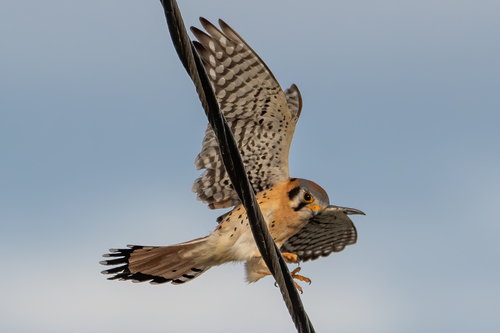
American Kestrel (Falco sparverius) American Kestrel
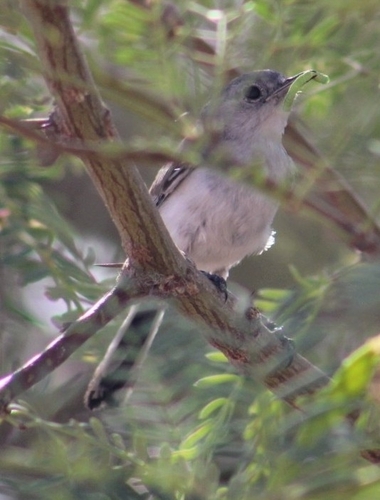
Black-tailed Gnatcatcher (Polioptila melanura) Black-tailed Gnatcatcher

Media

Loading…

In short

The American Kestrel is a small falcon with a distinctive rufous back and tail, often seen hovering or perched in open areas. The Black-tailed Gnatcatcher is a tiny, slender songbird with a constantly flicking tail, found in dense desert scrub. These species differ greatly in size, habitat, and behavior, making them unlikely to be confused in the field.

Identification tips

Size and shape: American Kestrel is much larger and more robust. Plumage: Look for the kestrel's rufous back and tail versus the gnatcatcher's gray body and black tail. Behavior: Kestrels hover and perch high, gnatcatchers flick tails and stay low in scrub. Habitat: Note the open areas for kestrels and dense desert scrub for gnatcatchers. Vocalization: Listen for the kestrel's 'klee' and the gnatcatcher's 'zhee-zhee-zhee'.

Size

The American Kestrel is much larger, about the size of a small hawk, whereas the Black-tailed Gnatcatcher is one of the smallest North American songbirds.

Plumage

American Kestrels have a rufous back and tail with a blue-gray head in males, while Black-tailed Gnatcatchers are gray with a distinctive black tail. The kestrel's plumage is more vibrant and patterned compared to the gnatcatcher's more uniform gray.

Behaviour

American Kestrels are often seen hovering or perched on utility wires, hunting from above. In contrast, Black-tailed Gnatcatchers flit through dense scrub, constantly flicking their tails as they forage.

Habitat

American Kestrels prefer open areas with short vegetation, often near human activity, while Black-tailed Gnatcatchers are found in dense thorn scrub and thickets in desert regions.

Voice

The American Kestrel's call is a series of sharp 'klee' sounds, while the Black-tailed Gnatcatcher has a taunting 'zhee-zhee-zhee' call.

Submit a better description

Use the same sections as the comparison. Your text is published immediately.

The American Kestrel is a small falcon with a distinctive rufous back and tail, often seen hovering or perched in open areas. The Black-tailed Gnatcatcher is a tiny, slender songbird with a constantly flicking tail, found in dense desert scrub. These species differ greatly in size, habitat, and behavior, making them unlikely to be confused in the field.

Size and shape: American Kestrel is much larger and more robust. Plumage: Look for the kestrel's rufous back and tail versus the gnatcatcher's gray body and black tail. Behavior: Kestrels hover and perch high, gnatcatchers flick tails and stay low in scrub. Habitat: Note the open areas for kestrels and dense desert scrub for gnatcatchers. Vocalization: Listen for the kestrel's 'klee' and the gnatcatcher's 'zhee-zhee-zhee'.

The American Kestrel is much larger, about the size of a small hawk, whereas the Black-tailed Gnatcatcher is one of the smallest North American songbirds.

American Kestrels have a rufous back and tail with a blue-gray head in males, while Black-tailed Gnatcatchers are gray with a distinctive black tail. The kestrel's plumage is more vibrant and patterned compared to the gnatcatcher's more uniform gray.

American Kestrels are often seen hovering or perched on utility wires, hunting from above. In contrast, Black-tailed Gnatcatchers flit through dense scrub, constantly flicking their tails as they forage.

American Kestrels prefer open areas with short vegetation, often near human activity, while Black-tailed Gnatcatchers are found in dense thorn scrub and thickets in desert regions.

The American Kestrel's call is a series of sharp 'klee' sounds, while the Black-tailed Gnatcatcher has a taunting 'zhee-zhee-zhee' call.

Discard your changes?

You have unsaved edits. If you leave now, those changes will be lost.

American Kestrel · Black-tailed Gnatcatcher · My Tricky Birds