
American Pygmy Kingfisher vs Green Kingfisher
Chloroceryle aenea versus Chloroceryle americana
Play a quiz with American Pygmy Kingfisher and Green Kingfisher
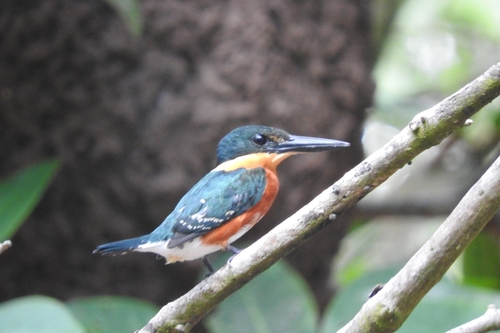 American Pygmy Kingfisher
 Green Kingfisher
In short
The most reliable way to separate American Pygmy Kingfisher from Green Kingfisher is by size: the pygmy is much smaller and more compact, even at a distance. For immature birds, look for buffy or white spotting on the wings—both species show it, but the pattern and extent differ. Adult plumage also offers clear contrasts: American Pygmy Kingfisher males are deep rufous below with a white belly patch, while Green Kingfisher males have a rufous breast but otherwise white underparts. Females of both species have a green breast band, but the pygmy’s is narrower and set against richer rufous. Structure is also helpful: the pygmy has a proportionally larger head and bill for its size, and a shaggier crest, while the Green Kingfisher is sleeker and lacks a crest. Both species overlap widely in range and habitat, so visual marks are essential.
Identification tips
- Size is the quickest check: American Pygmy Kingfisher is much smaller than Green Kingfisher—about two-thirds the length and less than half the mass. If you have any size context (e.g., nearby kingfishers, known perches), use it first.
- Juvenile wing spotting: Juvenile American Pygmy Kingfishers have buffy spots on the wings, and in the stictoptera subspecies, lines of white spots on the secondaries and some white on the rump. Juvenile Green Kingfishers have small buff spots on the crown and wing coverts, and two or more rows of white spots on the flight feathers, but also show much white on the outer tail in flight—use this to separate them when seen flying away.
- Tail pattern in flight: Green Kingfisher (all ages) shows much white on the outer tail feathers, especially obvious in flight. American Pygmy Kingfisher’s tail is bluer green and lacks extensive white.
- Crested vs. sleek head: American Pygmy Kingfisher has a shaggy crest, giving it a spiky-headed look, while Green Kingfisher lacks a crest and appears sleeker and flatter-headed.
- Bill and head proportions: The pygmy has a disproportionately large head and bill for its tiny body, making the bill look massive. Green Kingfisher’s bill is also long but fits its larger, more streamlined body.
- Adult male underparts: Male American Pygmy Kingfisher is deep rufous below except for a white belly patch, while male Green Kingfisher has a rufous breast band but otherwise white underparts.
- Adult female breast band: Female American Pygmy Kingfisher has a narrow, dark green band across rich rufous underparts. Female Green Kingfisher has a green-speckled band across a white and buffy breast.
- White collar: Green Kingfisher (both sexes) shows a distinct white collar, especially obvious from the side or back. American Pygmy Kingfisher’s rufous collar is narrower and less contrasting.
- Leg color: American Pygmy Kingfisher has pinkish to light gray legs and feet; Green Kingfisher’s are dark gray. This is subtle and only useful at close range.
- Perch height and behavior: Pygmy often perches very low, close to the water or even just above it, sometimes in dense cover. Green Kingfisher may perch higher and in more open spots.
- Habitat overlap: Both species can occur together in the same stream or pond. Do not rely on habitat alone for separation.
- Sex differences: Both species show sexual dimorphism, but the pattern differs—note the color and extent of the breast band and underparts.
- Subspecies variation: Some American Pygmy Kingfishers (stictoptera) show more white spotting on the wings and rump, which can be confused with Green Kingfisher’s wing and tail spots. Focus on size, tail pattern, and underparts color for confirmation.
- When in doubt, prioritize size and tail pattern: Even if plumage is confusing, the pygmy’s tiny size and lack of white in the tail are the most reliable separators.
- Voice is not a reliable separator: No distinctive vocal differences are described in the sources; rely on visual marks.
Size
American Pygmy Kingfisher is dramatically smaller, at about 13 cm long and weighing 10–16 g (males) or 12–16 g (females) [wikipedia], compared to the Green Kingfisher’s 20 cm length and 32–40 g weight [wikidata, wikipedia]. In the field, this makes the pygmy appear much more compact and toy-like, with a disproportionately large head and bill for its body. Green Kingfisher is closer in size to a sparrow or small thrush, while the pygmy is closer to a warbler or large hummingbird. If you see both together, the size gap is unmistakable.
Plumage
Juvenile and immature birds of both species show pale spotting on the wings, but the pattern differs: American Pygmy Kingfisher juveniles have buffy spots on the wings and, in the stictoptera subspecies, obvious lines of white spots on the secondaries and some white on the rump. Juvenile Green Kingfishers are duller overall, with small buff spots on the crown and wing coverts, and two or more rows of white spots on the flight feathers. In flight, Green Kingfisher shows much white on the outer tail feathers, which is visible and diagnostic; American Pygmy Kingfisher’s tail is a bluer green with less obvious white.
Adult males: American Pygmy Kingfisher males are dark glossy green above with a golden wash, a narrow rufous collar, and rich rufous underparts except for a white central belly and undertail. Green Kingfisher males are green above, with a white collar and mostly white underparts, but a rufous breast band.
Adult females: Both have a green breast band, but American Pygmy Kingfisher females have a dark green band over rich rufous underparts, while Green Kingfisher females have a green-speckled band over white underparts and a buffy throat and breast.
Both species have a long, heavy bill, but only the pygmy has a shaggy crest.
Behaviour
Both species hunt from low perches and dive for aquatic prey, but the American Pygmy Kingfisher often appears more furtive and is typically seen closer to water’s edge, sometimes in denser cover. Green Kingfisher is more likely to be seen perched in the open or flying low over streams. The pygmy’s flight is rapid and direct, often hugging the water, with a noticeably smaller, rounder profile. Green Kingfisher’s flight is more powerful and the bird appears longer and sleeker.
Habitat
Both species overlap widely in range, from southern Mexico through Central America and much of South America (excluding Chile and Uruguay). Both prefer slow-moving streams, ponds, and forested watercourses. American Pygmy Kingfisher is more likely to be found in dense, shaded riparian habitats, often perching low and close to water. Green Kingfisher uses similar habitats but is more often seen in slightly more open settings and can occur further from dense cover. Habitat alone is not diagnostic where both occur.
American Pygmy Kingfisher · Green Kingfisher · My Tricky Birds