
Birdr

American Tree Sparrow vs Dark-eyed Junco

Spizelloides arborea versus Junco hyemalis

Play a quiz with American Tree Sparrow and Dark-eyed Junco
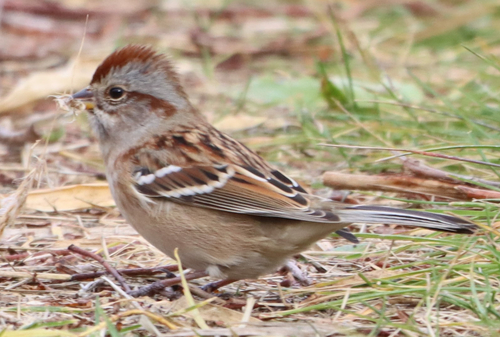
American Tree Sparrow (Spizelloides arborea) American Tree Sparrow
Dark-eyed Junco (Junco hyemalis) Dark-eyed Junco

Media

Loading…

In short

American Tree Sparrows and Dark-eyed Juncos can be distinguished by their plumage and behavior. The American Tree Sparrow has a distinctive bicolored bill and a rusty cap, while the Dark-eyed Junco is noted for its white outer tail feathers and contrasting hood. Both species are common in winter habitats, often seen foraging on the ground.

Identification tips

  1. Look for the American Tree Sparrow's rusty cap and bicolored bill. 2. Note the Dark-eyed Junco's white outer tail feathers and hood. 3. Observe behavior: juncos often hop and flick their tails. 4. Listen for vocal differences: American Tree Sparrows have a musical trill, while juncos have a simpler trill and sharp call.

Size

Both species are similar in size, though the Dark-eyed Junco may appear slightly bulkier due to its rounder body shape.

Plumage

The American Tree Sparrow features a rusty cap, gray face, and a bicolored bill (dark upper mandible, yellow lower mandible). In contrast, the Dark-eyed Junco has a gray or blackish hood, a dark back, and white outer tail feathers that are visible in flight.

Behaviour

Both species often forage on the ground, but the Dark-eyed Junco is known for its distinctive hopping motion and frequent tail flicking.

Habitat

Both species are found in open woodlands and fields during winter, but the American Tree Sparrow is more likely to be seen in shrubby areas, while the Dark-eyed Junco is often found in mixed or coniferous forests.

Voice

The American Tree Sparrow's song is a musical trill, while the Dark-eyed Junco's song is a simple, musical trill. Calls can be similar, but the junco's call is a sharp 'tick' or 'tchip'.

Submit a better description

Use the same sections as the comparison. Your text is published immediately.

American Tree Sparrows and Dark-eyed Juncos can be distinguished by their plumage and behavior. The American Tree Sparrow has a distinctive bicolored bill and a rusty cap, while the Dark-eyed Junco is noted for its white outer tail feathers and contrasting hood. Both species are common in winter habitats, often seen foraging on the ground.

  1. Look for the American Tree Sparrow's rusty cap and bicolored bill. 2. Note the Dark-eyed Junco's white outer tail feathers and hood. 3. Observe behavior: juncos often hop and flick their tails. 4. Listen for vocal differences: American Tree Sparrows have a musical trill, while juncos have a simpler trill and sharp call.

Both species are similar in size, though the Dark-eyed Junco may appear slightly bulkier due to its rounder body shape.

The American Tree Sparrow features a rusty cap, gray face, and a bicolored bill (dark upper mandible, yellow lower mandible). In contrast, the Dark-eyed Junco has a gray or blackish hood, a dark back, and white outer tail feathers that are visible in flight.

Both species often forage on the ground, but the Dark-eyed Junco is known for its distinctive hopping motion and frequent tail flicking.

Both species are found in open woodlands and fields during winter, but the American Tree Sparrow is more likely to be seen in shrubby areas, while the Dark-eyed Junco is often found in mixed or coniferous forests.

The American Tree Sparrow's song is a musical trill, while the Dark-eyed Junco's song is a simple, musical trill. Calls can be similar, but the junco's call is a sharp 'tick' or 'tchip'.

Discard your changes?

You have unsaved edits. If you leave now, those changes will be lost.

American Tree Sparrow · Dark-eyed Junco · My Tricky Birds