Birdr

Amethyst Woodstar vs Purple-collared Woodstar

Calliphlox amethystina versus Myrtis fanny

Play a quiz with Amethyst Woodstar and Purple-collared Woodstar
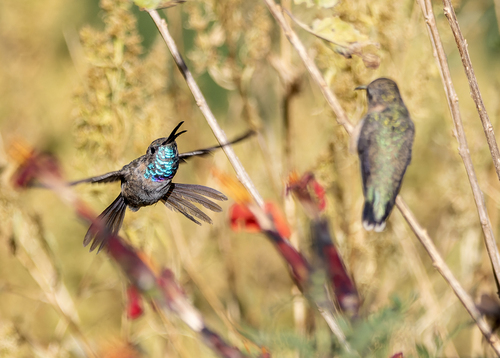
Amethyst Woodstar (Calliphlox amethystina) Amethyst Woodstar
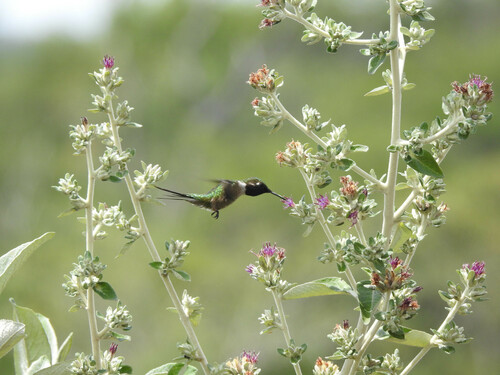
Purple-collared Woodstar (Myrtis fanny) Purple-collared Woodstar

Media

Loading…

In short

The Amethyst Woodstar and Purple-collared Woodstar are both small hummingbirds with distinctive throat colors, but differ in tail shape and plumage details. The Amethyst Woodstar has a prominently forked tail and a striking amethyst-colored throat, while the Purple-collared Woodstar features a less forked tail and a purple collar.

Identification tips

Size

Both species are small hummingbirds, but the Amethyst Woodstar typically appears slightly more compact due to its forked tail.

Plumage

The male Amethyst Woodstar has a bronzy green back, amethyst throat, and a white breast band, while the female has a green-spotted white throat and orange-rufous sides. The Purple-collared Woodstar male has a purple collar and green upperparts, with less pronounced tail fork. Females of both species are similar, with subtle differences in throat spotting.

Behaviour

Both species feed on nectar and may occasionally hawk insects. The Amethyst Woodstar is noted for its local movements, though these are not well-documented.

Habitat

The Amethyst Woodstar is found in circum-Amazonian regions, while the Purple-collared Woodstar is more associated with arid and semi-arid habitats.

Submit a better description

Use the same sections as the comparison. Your text is published immediately.

The Amethyst Woodstar and Purple-collared Woodstar are both small hummingbirds with distinctive throat colors, but differ in tail shape and plumage details. The Amethyst Woodstar has a prominently forked tail and a striking amethyst-colored throat, while the Purple-collared Woodstar features a less forked tail and a purple collar.

  • Look for the forked tail in the Amethyst Woodstar, which is more pronounced than in the Purple-collared Woodstar.
  • Note the amethyst throat in male Amethyst Woodstars versus the purple collar in male Purple-collared Woodstars.
  • Female Amethyst Woodstars have orange-rufous sides, which can help distinguish them from female Purple-collared Woodstars.
  • Consider habitat: Amethyst Woodstars are more likely in humid, forested areas, while Purple-collared Woodstars prefer drier environments.

Both species are small hummingbirds, but the Amethyst Woodstar typically appears slightly more compact due to its forked tail.

The male Amethyst Woodstar has a bronzy green back, amethyst throat, and a white breast band, while the female has a green-spotted white throat and orange-rufous sides. The Purple-collared Woodstar male has a purple collar and green upperparts, with less pronounced tail fork. Females of both species are similar, with subtle differences in throat spotting.

Both species feed on nectar and may occasionally hawk insects. The Amethyst Woodstar is noted for its local movements, though these are not well-documented.

The Amethyst Woodstar is found in circum-Amazonian regions, while the Purple-collared Woodstar is more associated with arid and semi-arid habitats.

Discard your changes?

You have unsaved edits. If you leave now, those changes will be lost.

Amethyst Woodstar · Purple-collared Woodstar · My Tricky Birds