Birdr

Amethyst Woodstar vs Swallow-tailed Hummingbird

Calliphlox amethystina versus Eupetomena macroura

Play a quiz with Amethyst Woodstar and Swallow-tailed Hummingbird
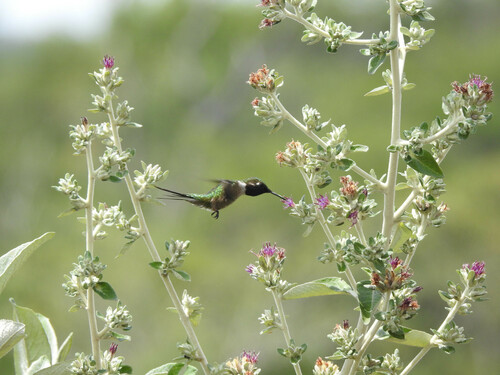
Amethyst Woodstar (Calliphlox amethystina) Amethyst Woodstar
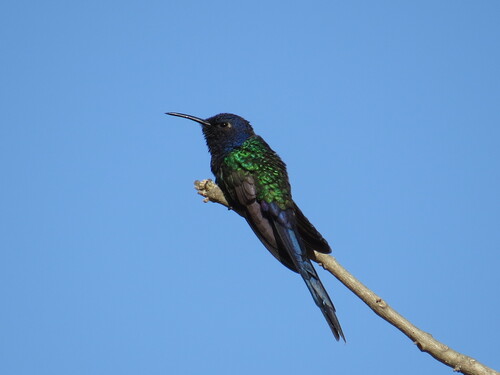
Swallow-tailed Hummingbird (Eupetomena macroura) Swallow-tailed Hummingbird

Media

Loading…

In short

The Amethyst Woodstar and Swallow-tailed Hummingbird are both small hummingbirds, but they can be distinguished by their tail shapes and throat colors. The Amethyst Woodstar has a prominently forked tail and a striking amethyst-colored throat, while the Swallow-tailed Hummingbird features a long, deeply forked tail and lacks the amethyst throat coloration.

Identification tips

1. Tail Shape: Look for the Amethyst Woodstar's prominently forked tail versus the Swallow-tailed Hummingbird's long, deeply forked tail. 2. Throat Color: The Amethyst Woodstar male has a distinctive amethyst-colored throat, which is absent in the Swallow-tailed Hummingbird. 3. Size and Structure: Note the smaller, more compact size of the Amethyst Woodstar compared to the larger Swallow-tailed Hummingbird. 4. Habitat: Consider the habitat; Amethyst Woodstars are more likely in denser, circum-Amazonian areas, while Swallow-tailed Hummingbirds frequent open areas.

Size

The Amethyst Woodstar is smaller and more compact compared to the larger and more elongated Swallow-tailed Hummingbird.

Plumage

The Amethyst Woodstar male has a bronzy green back, amethyst throat, and white breast band, while the female has a green-spotted white throat and orange-rufous sides. The Swallow-tailed Hummingbird is generally green with a blue throat and belly, and its long tail is a distinguishing feature.

Behaviour

Both species feed on nectar and may occasionally hawk insects, but the Amethyst Woodstar is noted for being more sedentary.

Habitat

The Amethyst Woodstar is found throughout its circum-Amazonian distribution, while the Swallow-tailed Hummingbird is more widespread in open and semi-open areas, often near water.

Submit a better description

Use the same sections as the comparison. Your text is published immediately.

The Amethyst Woodstar and Swallow-tailed Hummingbird are both small hummingbirds, but they can be distinguished by their tail shapes and throat colors. The Amethyst Woodstar has a prominently forked tail and a striking amethyst-colored throat, while the Swallow-tailed Hummingbird features a long, deeply forked tail and lacks the amethyst throat coloration.

1. Tail Shape: Look for the Amethyst Woodstar's prominently forked tail versus the Swallow-tailed Hummingbird's long, deeply forked tail. 2. Throat Color: The Amethyst Woodstar male has a distinctive amethyst-colored throat, which is absent in the Swallow-tailed Hummingbird. 3. Size and Structure: Note the smaller, more compact size of the Amethyst Woodstar compared to the larger Swallow-tailed Hummingbird. 4. Habitat: Consider the habitat; Amethyst Woodstars are more likely in denser, circum-Amazonian areas, while Swallow-tailed Hummingbirds frequent open areas.

The Amethyst Woodstar is smaller and more compact compared to the larger and more elongated Swallow-tailed Hummingbird.

The Amethyst Woodstar male has a bronzy green back, amethyst throat, and white breast band, while the female has a green-spotted white throat and orange-rufous sides. The Swallow-tailed Hummingbird is generally green with a blue throat and belly, and its long tail is a distinguishing feature.

Both species feed on nectar and may occasionally hawk insects, but the Amethyst Woodstar is noted for being more sedentary.

The Amethyst Woodstar is found throughout its circum-Amazonian distribution, while the Swallow-tailed Hummingbird is more widespread in open and semi-open areas, often near water.

Discard your changes?

You have unsaved edits. If you leave now, those changes will be lost.

Amethyst Woodstar · Swallow-tailed Hummingbird · My Tricky Birds