
Amur Paradise-Flycatcher vs Blyth's Paradise-Flycatcher
Terpsiphone incei versus Terpsiphone affinis
Play a quiz with Amur Paradise-Flycatcher and Blyth's Paradise-Flycatcher
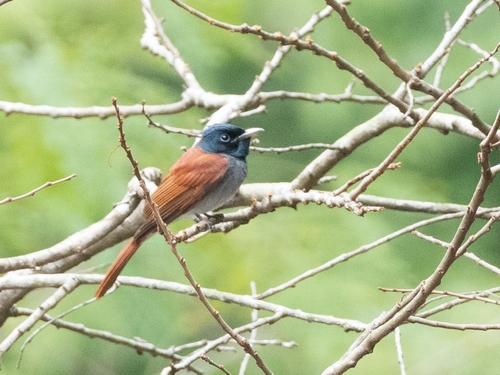 Amur Paradise-Flycatcher
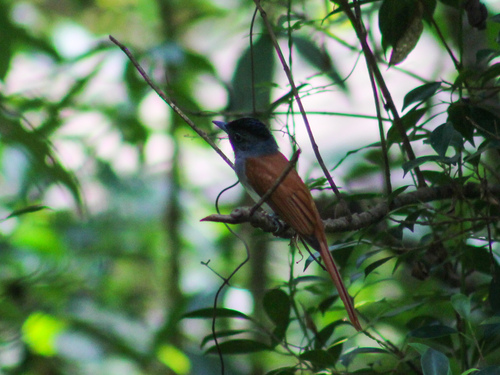 Blyth's Paradise-Flycatcher
In short
The most reliable field mark to separate Amur Paradise-Flycatcher from Blyth's Paradise-Flycatcher is the color of the undertail and the sharpness of contrast on the underparts in rufous morphs: Amur shows a white undertail and crisp black-and-white contrast, while Blyth's has a pale rufous undertail and a more gradual transition to grey below. Both species have dimorphic males (rufous and white morphs), black hoods, blue eye-rings, and long tail streamers in breeding males, making them very similar at a glance. Crest shape and eye-ring intensity can help, but are subtle. Females and non-breeding birds are especially tricky, so focus on undertail color and underpart contrast whenever possible.
Identification tips
- Undertail color is key: Amur shows a white undertail (all ages and sexes), while Blyth's has a pale rufous undertail in rufous morphs and females. This is the single most reliable field mark.
- Underpart contrast: Amur has a sharp contrast between the black hood and white underparts; Blyth's rufous morphs have a more gradual transition to greyish underparts, lacking a crisp divide.
- White morph marks: Blyth's white morph males show dark streaks on the wings and central tail feather shafts, which are not noted for Amur. Check for these subtle marks in good light.
- Crest shape: Blyth's has a short, rounded crest; Amur's is small but not specifically rounded. This is subtle and best used in direct comparison.
- Eye-ring color: Both have blue eye-rings, but Blyth's females and non-breeding birds have a less vibrant blue than Amur. This is a minor point and may be hard to judge in the field.
- Tail streamer length: Both males in breeding plumage have tail streamers nearly twice the body length, so this is not a separator.
- Female confusion: Females of both species are very similar; rely on undertail color and underpart contrast, as other features overlap.
- Habitat context: If seen in mature forest in China or the Russian Far East, Amur is more likely; in Southeast Asian gardens, plantations, or edge habitats, Blyth's is favored, but range overlap and migration can cause confusion.
- Voice: Only Blyth's has a described song/call in these notes. If you hear a ringing "wiwiwiwiwiwiwi" or nasal "ji-jeh", it supports Blyth's, but absence of song is not diagnostic.
- Rufous morph pitfalls: Both species have rufous morphs, so do not use overall rufous coloration alone. Focus on undertail and underpart contrast.
- White morph pitfalls: Both can show white morphs; look for the dark shaft streaks on Blyth's, which are not described for Amur.
- Crest and jizz: Crest shape is subtle and not always visible; do not rely on this alone.
- Immature/juvenile confusion: No distinctive immature wing or flight pattern marks are described, so focus on undertail and underpart contrast even in young birds.
- Seasonal context: Amur is a migrant in Southeast Asia, so timing may help, but overlap with Blyth's is possible in winter.
- When in doubt: If undertail color and underpart contrast are not visible, and habitat or voice do not help, it may not be possible to separate these species confidently in the field.
Size
No direct size differences are noted between Amur and Blyth's Paradise-Flycatchers in the available sources. Both are typical paradise-flycatchers, with males showing extremely long tails in breeding plumage. Structure (bill, wing, body) is not highlighted as a separator in these species.
Plumage
-
Juvenile/immature plumage: No specific juvenile or immature upperwing or flight pattern differences are described in the available notes for either species. If you encounter a bird in flight, focus on undertail color and underpart contrast if visible.
-
Adult males (breeding): Both species have two male morphs (rufous and white), with long tail streamers, black hoods, blue eye-rings, and small crests. Amur males have white underparts and a white undertail, with a sharp contrast between the black hood and white belly. Blyth's rufous morph males have a pale rufous undertail and a gradual transition from darker upperparts to greyish underparts, lacking the sharp contrast of Amur. White morph Blyth's males show dark streaks on the wing and central tail shaft, which are not mentioned for Amur.
-
Females and non-breeding birds: Females of both species resemble rufous males but Blyth's females have a paler head and a less vibrant blue eye-ring. The undertail remains a key separator: white in Amur, pale rufous in Blyth's. The underpart contrast is also less sharp in Blyth's.
-
Crest: Blyth's has a short, rounded crest; Amur's is described as small but not specifically shaped.
Behaviour
No distinctive behavioral differences are described between these two species in the available notes. Both are typical flycatchers, likely to be seen sallying for insects and perching in mid-story or canopy.
Habitat
Amur Paradise-Flycatcher is native to China and the Russian Far East, wintering in Southeast Asia. Blyth's Paradise-Flycatcher is more associated with evergreen broadleaf forests, forest edges, secondary growth, gardens, and plantations in lowland and foothill regions. While both can occur in overlapping wintering areas in Southeast Asia, Blyth's is more likely in disturbed or edge habitats, whereas Amur may prefer more mature forest (though this is not definitive).
Voice
Only Blyth's Paradise-Flycatcher has described vocalizations in the notes: a ringing series of "wiwiwiwiwiwiwi" notes and a nasal "ji-jeh" or "ji-jeh-jeh" call. No vocal description is provided for Amur in these notes, so voice is not a reliable separator unless you are familiar with Blyth's calls.
Amur Paradise-Flycatcher · Blyth's Paradise-Flycatcher · My Tricky Birds