Birdr

Aquatic Warbler vs Sedge Warbler

Acrocephalus paludicola versus Acrocephalus schoenobaenus

Play a quiz with Aquatic Warbler and Sedge Warbler
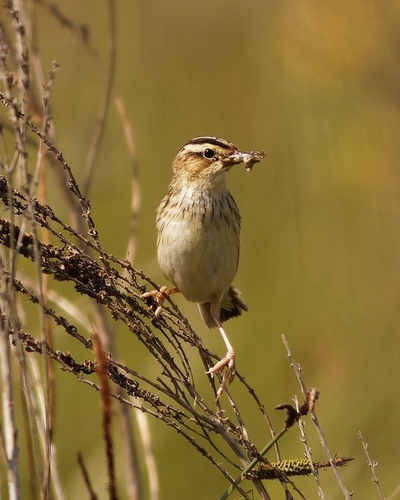
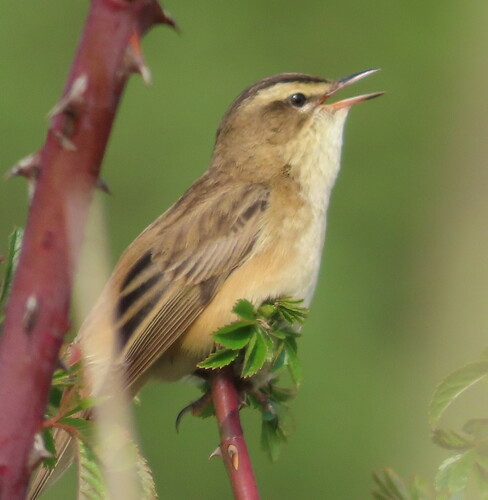
Aquatic Warbler (Acrocephalus paludicola) Aquatic Warbler
Sedge Warbler (Acrocephalus schoenobaenus) Sedge Warbler

Media

Loading…

In short

The Aquatic Warbler (Acrocephalus paludicola) and the Sedge Warbler (Acrocephalus schoenobaenus) are two closely related species that share similar habitats but can be distinguished through differences in size, plumage, vocalizations, and breeding behaviors. The Aquatic Warbler is slightly smaller and has a more muted coloration compared to the Sedge Warbler, which features distinctive streaking and a more vibrant appearance.

Identification tips

  1. Birds of the World Similar-Species Diagnostics:
  2. The Aquatic Warbler is described as having a more muted coloration with a less pronounced supercilium, while the Sedge Warbler features a more vibrant and heavily streaked plumage, notably with a prominent supercilium. The Sedge Warbler's vocalizations are also more varied and pronounced compared to the Aquatic Warbler's simpler calls.

  3. AI Field Diagnostics:

  4. Size and Shape: Look for the slightly larger size and more robust structure of the Sedge Warbler compared to the more slender Aquatic Warbler.
  5. Plumage Patterns: Pay attention to the plumage; if you observe a bird with rich brown streaks and a pronounced supercilium, it's likely a Sedge Warbler. In contrast, the Aquatic Warbler's more subtle coloration and less streaking can help in identification.
  6. Behavioral Cues: The Sedge Warbler's acrobatic and active foraging behavior can be a giveaway, whereas the Aquatic Warbler tends to be more secretive and close to the ground.
  7. Habitat Preference: Observing the habitat can assist; if you are in a denser, more specialized wetland, you may be encountering the Aquatic Warbler, while more open reedbeds may indicate the Sedge Warbler.
  8. Vocalization: Listen closely; if the bird is singing a complex and varied song, it’s likely a Sedge Warbler. If you hear a simpler, sharper call, you may be hearing the Aquatic Warbler.

By keeping these differences in mind, birdwatchers can enhance their ability to accurately identify these two closely related warbler species in the field.

Size

Plumage

Behaviour

Habitat

Voice

Submit a better description

Use the same sections as the comparison. Your text is published immediately.

The Aquatic Warbler (Acrocephalus paludicola) and the Sedge Warbler (Acrocephalus schoenobaenus) are two closely related species that share similar habitats but can be distinguished through differences in size, plumage, vocalizations, and breeding behaviors. The Aquatic Warbler is slightly smaller and has a more muted coloration compared to the Sedge Warbler, which features distinctive streaking and a more vibrant appearance.

  1. Birds of the World Similar-Species Diagnostics:
  2. The Aquatic Warbler is described as having a more muted coloration with a less pronounced supercilium, while the Sedge Warbler features a more vibrant and heavily streaked plumage, notably with a prominent supercilium. The Sedge Warbler's vocalizations are also more varied and pronounced compared to the Aquatic Warbler's simpler calls.

  3. AI Field Diagnostics:

  4. Size and Shape: Look for the slightly larger size and more robust structure of the Sedge Warbler compared to the more slender Aquatic Warbler.
  5. Plumage Patterns: Pay attention to the plumage; if you observe a bird with rich brown streaks and a pronounced supercilium, it's likely a Sedge Warbler. In contrast, the Aquatic Warbler's more subtle coloration and less streaking can help in identification.
  6. Behavioral Cues: The Sedge Warbler's acrobatic and active foraging behavior can be a giveaway, whereas the Aquatic Warbler tends to be more secretive and close to the ground.
  7. Habitat Preference: Observing the habitat can assist; if you are in a denser, more specialized wetland, you may be encountering the Aquatic Warbler, while more open reedbeds may indicate the Sedge Warbler.
  8. Vocalization: Listen closely; if the bird is singing a complex and varied song, it’s likely a Sedge Warbler. If you hear a simpler, sharper call, you may be hearing the Aquatic Warbler.

By keeping these differences in mind, birdwatchers can enhance their ability to accurately identify these two closely related warbler species in the field.

  • Aquatic Warbler: Typically measures about 12-13 cm in length with a wingspan of approximately 19-22 cm. It has a relatively slender body.
  • Sedge Warbler: Slightly larger, averaging around 12.5-14 cm in length and a wingspan of 20-23 cm. Its body is robust and more compact than that of the Aquatic Warbler.
  • Aquatic Warbler: Exhibits a more subdued plumage with olive-brown upperparts and pale underparts. It has a distinctive pale supercilium (eyebrow stripe) that is less pronounced than in the Sedge Warbler. The streaking on the flanks is also less prominent.
  • Sedge Warbler: Features a more vibrant and contrasting plumage, with rich brown upperparts and heavily streaked flanks. The supercilium is more prominent and extends further behind the eye, providing a striking contrast against its darker crown.
  • Aquatic Warbler: This species is often found in dense reedbeds and wet meadows where it forages primarily on insects and seeds. It is known for its low, fluttering flight, often close to the ground.
  • Sedge Warbler: More active and acrobatic, the Sedge Warbler is often seen darting about in vegetation and is known for its lively foraging behavior, primarily feeding on insects. Its flight is often characterized by sharp, agile movements.
  • Aquatic Warbler: Prefers wet, marshy habitats with stable hydrology, particularly in sedge fens. It has a highly fragmented breeding distribution in restricted areas of Eastern Europe.
  • Sedge Warbler: Commonly found in reedbeds, damp grasslands, and wet scrub, it has a broader distribution across Europe and parts of Asia, making it more adaptable to various wetland habitats.
  • Aquatic Warbler: The call is a series of short, sharp notes, often described as a "chack" sound. The song is less varied and more subdued than that of the Sedge Warbler.
  • Sedge Warbler: Known for its complex and varied song, which includes melodious phrases interspersed with mimicry of other bird species. Its vocalizations are often loud and can carry over long distances.

Discard your changes?

You have unsaved edits. If you leave now, those changes will be lost.

Aquatic Warbler · Sedge Warbler · My Tricky Birds