
Arabian Babbler vs Wattled Starling
Argya squamiceps versus Creatophora cinerea
Play a quiz with Arabian Babbler and Wattled Starling
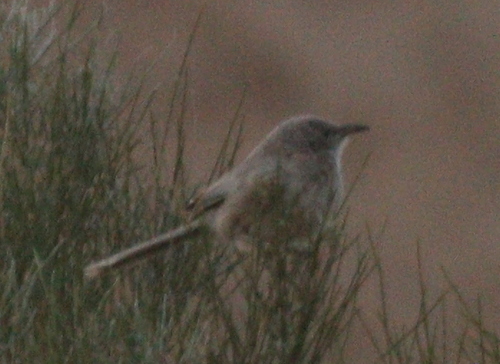 Arabian Babbler
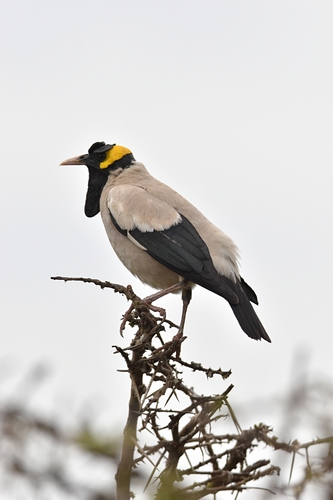 Wattled Starling
In short
The most reliable field mark to separate Arabian Babbler from Wattled Starling is the latter’s striking white rump and black flight feathers and tail, which are obvious in flight at all ages. Arabian Babblers are larger, longer-tailed, and uniformly grey-brown with dark streaks above and a whitish throat, lacking any white rump or black in the wings or tail. Wattled Starlings, especially breeding males, show a distinctive bare yellow face and black wattles, but even non-breeding and juvenile birds retain the white rump and contrasting dark wings in flight. Structure, tail length, and habitat also help: babblers are lanky, long-tailed, and terrestrial, while starlings are short-tailed, compact, and often flock in open country.
Identification tips
- White rump in flight (all ages, Wattled Starling only): If you see a bird with a bright white rump and black wings/tail in flight, it is a Wattled Starling. Arabian Babblers never show this pattern; their flight is uniformly brownish.
- Breeding male Wattled Starling’s bare yellow face and black wattles: Only breeding males show the full yellow facial skin and black wattles on the forehead and throat. No babbler ever shows bare facial skin or wattles.
- White shoulder patch (breeding male Wattled Starling): A bold white shoulder patch is present on breeding males, sometimes weakly on old females. Babblers never show this.
- Non-breeding/juvenile Wattled Starling’s yellow face patch: Non-breeding males, females, and juveniles have a small yellow patch behind the eye, never seen in babblers.
- Arabian Babbler’s plain, streaked brown plumage: Babblers are grey-brown above with dark streaks, paler below, and a whitish throat. No strong contrasts, no white rump, and no black in the wings or tail.
- Tail length and shape: Arabian Babblers have a long, rounded tail often held cocked or fanned. Wattled Starlings have a short tail, giving a compact look.
- Bill shape: Babblers have a fairly long, curved bill; Wattled Starlings have a shorter, straighter bill typical of starlings.
- Legs and stance: Babblers have strong legs and walk or run on the ground; starlings perch more and are less terrestrial.
- Group size and behavior: Babblers are in small, stable groups, often seen foraging together on the ground. Starlings form large, noisy flocks, often mixing with other species and perching in trees or on wires.
- Habitat: Babblers are in arid scrub/desert-edge; starlings are in open grassland, cultivation, or with livestock.
- Vocalizations: Listen for chattering and trills (babbler) versus harsh, wheezing 'ssreeeeo' (starling).
- Geographic range: Arabian Babblers are Middle Eastern; Wattled Starlings are African, but vagrants can occur.
- Size impression: Babblers are larger and lankier; starlings are smaller, more compact.
- Flight style: Babblers fly low and weakly, often only short distances; starlings have strong, direct flight with pointed wings.
- Plumage pitfalls: Juvenile and non-breeding Wattled Starlings may look plain when perched, but always show the white rump and dark wings/tail in flight — check birds in flight for this contrast.
Size
Arabian Babbler is the larger and longer bird, measuring 26–29 cm in length with a wingspan of 31–33.5 cm, and weighing 64–87.9 g. Wattled Starling is smaller and more compact at about 21 cm long and 73 g. The babbler’s long tail and overall lanky proportions contrast with the starling’s short tail and pointed wings. In the field, the babbler appears noticeably bigger and more elongated, especially when perched.
Plumage
-
Juvenile and non-breeding Wattled Starlings: Always show a white rump and contrasting dark (brown to black) flight feathers and tail, which are diagnostic in flight. The rest of the plumage is mainly grey, with a reduced or absent white shoulder patch, and the head is feathered except for a small yellow patch behind the eye. Juveniles and females resemble non-breeding males but always retain the white rump and dark wings/tail.
-
Breeding male Wattled Starlings: Add a striking bare yellow facial skin, black wattles on the forehead and throat, and a bold white shoulder patch. These features are unique and unmistakable when present.
-
Arabian Babblers (all ages and sexes): Uniformly grey-brown above with dark streaks on the back, paler below, and a whitish throat. No white rump, no black in the wings or tail, and no bare skin or wattles. The plumage is plain and lacks any strong contrast, even in flight.
-
In flight: Wattled Starling’s white rump and black wings/tail are always visible and diagnostic. Arabian Babbler shows no such contrast, appearing uniformly brownish.
Behaviour
Arabian Babblers are highly social but typically move in small, stable family groups, foraging mostly on the ground in arid scrub. They are terrestrial, often running or hopping with tails cocked and fanned. Wattled Starlings are much more gregarious, forming large flocks, often with other starlings, and are frequently seen flying in open country or perching conspicuously on wires and trees. Starlings are more aerial and less tied to the ground than babblers.
Habitat
Arabian Babblers are residents of arid scrub and desert-edge habitats in the Middle East, rarely venturing into open grassland or cultivation. Wattled Starlings prefer grassland, open woodland, and agricultural areas in eastern and southern Africa, and are rarely found in dense scrub. If you see a bird in dry, bushy habitat, babbler is more likely; in open fields or among livestock, starling is favored.
Voice
Arabian Babblers produce a variety of calls including whistles, trills, and chattering, often given in social groups. Wattled Starlings have a range of wheezing or grating calls, with the most familiar being a drawn-out 'ssreeeeo', reminiscent of other starlings. The starling’s calls are harsher and more mechanical compared to the babbler’s chattering.