Birdr

Arabian Wheatear vs Mourning Wheatear

Oenanthe lugentoides versus Oenanthe lugens

Play a quiz with Arabian Wheatear and Mourning Wheatear
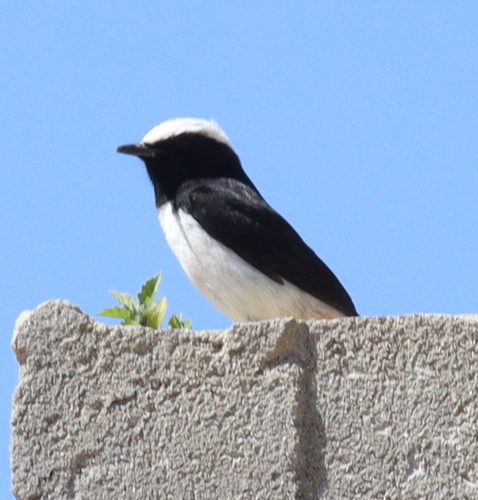
Arabian Wheatear (Oenanthe lugentoides) Arabian Wheatear
Mourning Wheatear (Oenanthe lugens) Mourning Wheatear

Media

Loading…

In short

The Arabian Wheatear and Mourning Wheatear are similar in appearance but can be distinguished by key plumage differences and habitat preferences. The Arabian Wheatear typically has a more uniform black appearance with less contrast, while the Mourning Wheatear often shows a distinct white rump and more contrasting plumage. Habitat can also provide clues, as the Arabian Wheatear is more often found in rocky, arid environments.

Identification tips

Size

Both species are similar in size, typical of wheatears, with no significant size differences noted.

Plumage

The Arabian Wheatear is predominantly black with a less contrasting appearance, lacking the white rump seen in the Mourning Wheatear. The Mourning Wheatear has a more contrasting plumage with a distinct white rump and often a paler belly.

Behaviour

Both species exhibit typical wheatear behaviors such as perching on rocks and making short flights to catch insects. No significant behavioral differences are noted.

Habitat

Arabian Wheatears are more commonly found in rocky, arid environments, whereas Mourning Wheatears can be found in a wider range of habitats including semi-deserts and open areas with sparse vegetation.

Voice

Vocalizations are not well-documented for these species in the provided sources, making it an unreliable field mark for differentiation.

Submit a better description

Use the same sections as the comparison. Your text is published immediately.

The Arabian Wheatear and Mourning Wheatear are similar in appearance but can be distinguished by key plumage differences and habitat preferences. The Arabian Wheatear typically has a more uniform black appearance with less contrast, while the Mourning Wheatear often shows a distinct white rump and more contrasting plumage. Habitat can also provide clues, as the Arabian Wheatear is more often found in rocky, arid environments.

  • Look for the white rump: Mourning Wheatears have a distinct white rump, unlike Arabian Wheatears.
  • Check the habitat: Arabian Wheatears are more likely in rocky, arid areas.
  • Observe plumage contrast: Mourning Wheatears show more contrast with a paler belly and black upperparts.
  • Consider the location: Geographic range may help, as Arabian Wheatears are more localized to the Arabian Peninsula.

Both species are similar in size, typical of wheatears, with no significant size differences noted.

The Arabian Wheatear is predominantly black with a less contrasting appearance, lacking the white rump seen in the Mourning Wheatear. The Mourning Wheatear has a more contrasting plumage with a distinct white rump and often a paler belly.

Both species exhibit typical wheatear behaviors such as perching on rocks and making short flights to catch insects. No significant behavioral differences are noted.

Arabian Wheatears are more commonly found in rocky, arid environments, whereas Mourning Wheatears can be found in a wider range of habitats including semi-deserts and open areas with sparse vegetation.

Vocalizations are not well-documented for these species in the provided sources, making it an unreliable field mark for differentiation.

Discard your changes?

You have unsaved edits. If you leave now, those changes will be lost.

Arabian Wheatear · Mourning Wheatear · My Tricky Birds