Birdr

Arctic Redpoll vs Two-barred Crossbill

Acanthis hornemanni versus Loxia leucoptera

Play a quiz with Arctic Redpoll and Two-barred Crossbill

Arctic Redpoll (Acanthis hornemanni) Arctic Redpoll
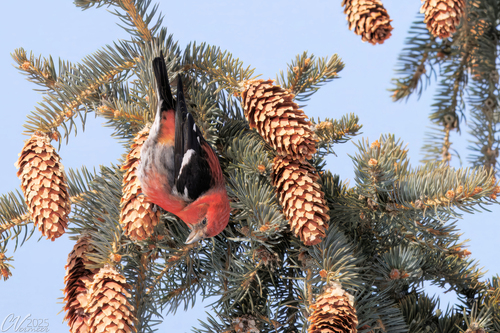
Two-barred Crossbill (Loxia leucoptera) Two-barred Crossbill

Media

Loading…

In short

The Arctic Redpoll and Two-barred Crossbill are both finches but differ significantly in bill structure and plumage. The Arctic Redpoll has a small, conical bill suited for seeds, while the Two-barred Crossbill features a distinctive crossed bill for extracting conifer seeds. Plumage differences include the redpoll's pale appearance with a red cap and the crossbill's more robust build with white wing bars.

Identification tips

Bill shape: Look for the distinctive crossed bill of the Two-barred Crossbill. Plumage: Note the Arctic Redpoll's red cap and frosty appearance versus the crossbill's white wing bars. Habitat: Consider the habitat; crossbills are more likely in coniferous forests. Behavior: Observe feeding behavior; crossbills are adept at extracting seeds from cones.

Size

The Two-barred Crossbill is generally larger and more robust than the Arctic Redpoll.

Plumage

Arctic Redpolls are pale with a red cap and often show a frosty appearance, while Two-barred Crossbills have a more robust body with prominent white wing bars and lack the redpoll's red cap.

Behaviour

Two-barred Crossbills are often seen in flocks, actively foraging in coniferous trees using their specialized bills. Arctic Redpolls also form flocks but are more likely to be seen foraging on the ground or in low vegetation.

Habitat

Arctic Redpolls are typically found in open tundra and birch forests, while Two-barred Crossbills inhabit coniferous forests, often following cone crops.

Voice

Two-barred Crossbills have distinctive calls often described as 'jip-jip,' while Arctic Redpolls produce a softer, more twittering call.

Submit a better description

Use the same sections as the comparison. Your text is published immediately.

The Arctic Redpoll and Two-barred Crossbill are both finches but differ significantly in bill structure and plumage. The Arctic Redpoll has a small, conical bill suited for seeds, while the Two-barred Crossbill features a distinctive crossed bill for extracting conifer seeds. Plumage differences include the redpoll's pale appearance with a red cap and the crossbill's more robust build with white wing bars.

Bill shape: Look for the distinctive crossed bill of the Two-barred Crossbill. Plumage: Note the Arctic Redpoll's red cap and frosty appearance versus the crossbill's white wing bars. Habitat: Consider the habitat; crossbills are more likely in coniferous forests. Behavior: Observe feeding behavior; crossbills are adept at extracting seeds from cones.

The Two-barred Crossbill is generally larger and more robust than the Arctic Redpoll.

Arctic Redpolls are pale with a red cap and often show a frosty appearance, while Two-barred Crossbills have a more robust body with prominent white wing bars and lack the redpoll's red cap.

Two-barred Crossbills are often seen in flocks, actively foraging in coniferous trees using their specialized bills. Arctic Redpolls also form flocks but are more likely to be seen foraging on the ground or in low vegetation.

Arctic Redpolls are typically found in open tundra and birch forests, while Two-barred Crossbills inhabit coniferous forests, often following cone crops.

Two-barred Crossbills have distinctive calls often described as 'jip-jip,' while Arctic Redpolls produce a softer, more twittering call.

Discard your changes?

You have unsaved edits. If you leave now, those changes will be lost.

Arctic Redpoll · Two-barred Crossbill · My Tricky Birds