
Arctic Skua vs Great Skua
Stercorarius parasiticus versus Stercorarius skua
Play a quiz with Arctic Skua and Great Skua
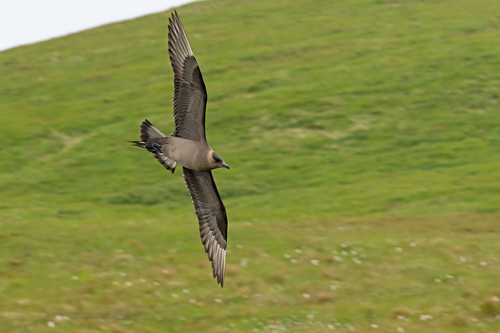 Arctic Skua
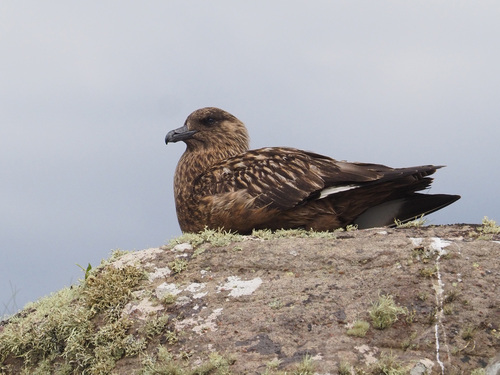 Great Skua
In short
The most reliable way to separate Arctic Skua (Parasitic Jaeger) from Great Skua is by overall size and structure: Great Skua is massive, herring gull-sized, with a heavy barrel chest and blunt tail, while Arctic Skua is much smaller and slimmer, with a pointed tail projection in adults. In flight, both show a white wing flash, but Great Skua’s bulk and broad wings contrast with the more falcon-like, agile flight of Arctic Skua. Juvenile plumages can be confusing, but Great Skua juveniles are unstreaked below and always look hefty; Arctic Skua juveniles are slimmer and warmer brown. If you see a skua from shore, Arctic Skua is more likely, but always check for size and structure first.
Identification tips
- Size is the first check: Great Skua is herring gull-sized and massively built; Arctic Skua is much smaller and slimmer. If the bird looks big and barrel-chested, it is almost certainly a Great Skua.
- Tail shape in adults: Breeding Arctic Skuas have a pointed central tail projection (streamer); Great Skuas always have a short, blunt tail. This is diagnostic in adults, especially in flight.
- Wing shape and flight style: Arctic Skua has narrower, more pointed wings and a falcon-like, agile flight. Great Skua’s wings are broad, and its flight is powerful but less agile, sometimes buzzard-like.
- White wing flash: Both species show a white flash in the primaries, but in Great Skua it is broader and set in a much larger wing. In Arctic Skua, the flash is present in all morphs and ages, but the wing is slimmer.
- Plumage tone and contrast: Light-morph Arctic Skuas show strong contrast between brown back and white underparts, with a pale head and black cap. Great Skua is streaked grey-brown overall, with less contrast and a more uniform appearance.
- Juvenile confusion: Juvenile Great Skuas are unstreaked below and always look heavy and blunt-tailed. Juvenile Arctic Skuas are slimmer, often warmer brown, and can be variable, but never as massive as Great Skua.
- Bill and head: Great Skua has a heavy, deep bill and a broad, powerful head. Arctic Skua’s bill is finer and the head is more delicate.
- Jizz at a distance: If the bird looks like a small, agile raptor or tern, suspect Arctic Skua. If it looks like a buzzard or a very large gull, suspect Great Skua.
- Habitat context: Arctic Skua is more likely to be seen from shore, especially during migration. Great Skua is more restricted to North Atlantic breeding areas and is less often seen from land.
- Behavior: Arctic Skua chases birds with agility and speed; Great Skua uses brute force and can attack very large seabirds. If you see a skua physically grappling a gannet, it is a Great Skua.
- Voice (rarely useful): Nasal mewing (Arctic Skua) vs. harsh 'hah-hah-hah-hah' (Great Skua) near nests.
- Morph confusion: Arctic Skua comes in three morphs (light, dark, intermediate), but all have the same structure. Great Skua is always streaked grey-brown as an adult.
- Seasonal context: Both species migrate, but Arctic Skua winters more widely in the southern hemisphere; Great Skua winters at sea in the Atlantic.
- Pitfalls: Do not rely on plumage alone, especially in juveniles—structure and size are more reliable. The white wing flash is not diagnostic by itself.
- When in doubt: If you cannot judge size, look for tail shape (pointed streamer = Arctic Skua adult), wing shape, and overall jizz. If still unsure, note behavior and context for later review.
Size
Great Skua is dramatically larger than Arctic Skua: it is herring gull-sized (body mass ~1835g), with a length of 50–58 cm and a wingspan of 125–140 cm. By contrast, Arctic Skua is much smaller (41–48 cm long, 107–125 cm wingspan, 300–650g). Even at a distance, Great Skua’s bulk, deep chest, and broad wings are obvious, while Arctic Skua appears lighter, more streamlined, and agile. The difference is especially clear when both species are seen together, but even singly, Great Skua’s size is usually unmistakable.
Plumage
- Juvenile/immature birds: Juvenile Great Skuas are a warm brown overall, unstreaked below, and always look hefty. Juvenile Arctic Skuas are slimmer, usually warmer brown than adults, but can be variable and are often browner (not grey) compared to Long-tailed Jaeger. Both species show a white wing flash, but Arctic Skua’s is set in a more pointed, narrower wing.
- Adults: Adult Arctic Skuas come in three morphs (light, dark, intermediate), but all have a pointed central tail projection in breeding plumage and a white wing flash. Light-morph adults have a brown back, white underparts, yellowish-white head/neck with a black cap. Dark morphs are all dark brown. Great Skuas are streaked greyish brown with a black cap, and have a short, blunt tail. Their white wing flash is broad and obvious, but the rest of the plumage is more uniform and lacks the sharply contrasting pale underparts of light-morph Arctic Skua. In all ages, Great Skua’s tail is blunt, never pointed.
Behaviour
Both species are aggressive kleptoparasites, but their behavior differs in style: Arctic Skua is more agile, often chasing terns and gulls with fast, acrobatic flight, while Great Skua uses brute force, even attacking large birds like gannets by grabbing them mid-air. Great Skua’s flight is powerful but less agile, sometimes likened to a buzzard, whereas Arctic Skua is more falcon-like. Both defend nests aggressively, but Great Skua’s size makes its attacks more intimidating.
Habitat
Both species breed in northern coastal regions, but Arctic Skua nests on dry tundra, fells, and islands, while Great Skua prefers coastal moorland and rocky islands. At sea, both can be seen offshore, but Arctic Skua is more commonly seen from shore, especially during migration. Great Skua is more likely to be encountered in the North Atlantic and breeds in more restricted areas (Iceland, Norway, Faroe Islands, Scottish islands).
Voice
Arctic Skua gives a nasal, mewing call repeated in display and a shorter alarm note, but is usually silent away from the breeding grounds. Great Skua has a harsh, repeated 'hah-hah-hah-hah' call, and can also produce quacking or croaking noises. Both are mostly silent at sea, so voice is rarely a primary field mark except near nests.