
Arctic Skua vs South Polar Skua
Stercorarius parasiticus versus Stercorarius maccormicki
Play a quiz with Arctic Skua and South Polar Skua
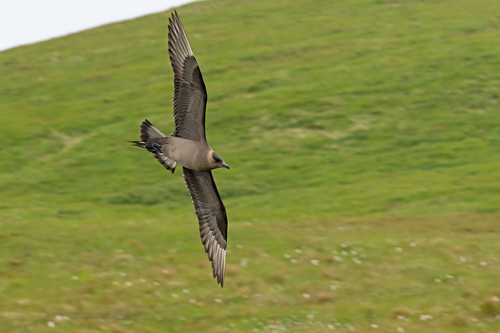 Arctic Skua
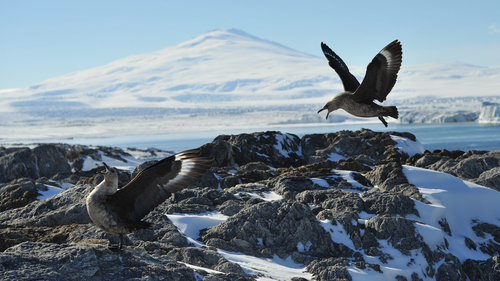 South Polar Skua
In short
The most reliable field mark between Arctic Skua and South Polar Skua is size and structure: South Polar Skua is much larger, with a massive barrel chest and heavy build, while Arctic Skua is noticeably smaller and slimmer. In flight, both show a white wing flash, but South Polar Skua's is set in a broader, more powerful wing. Adult Arctic Skuas (especially light morphs) have a distinctive pointed central tail projection, absent in South Polar Skua. Juvenile and dark morph birds are trickier, but South Polar Skua always looks bulkier and colder-toned. If you see a skua from shore and it seems small, agile, and tern-like, it's almost certainly an Arctic Skua.
Identification tips
- Size and structure are the most reliable field marks: South Polar Skua is much larger and bulkier, with a barrel chest and thick neck. Arctic Skua is smaller, slimmer, and more streamlined. This is true for all ages and morphs.
- Tail shape in adults: Adult Arctic Skua (especially light morphs) has a pointed central tail streamer, extending about 7 cm beyond the rest of the tail. South Polar Skua lacks this feature and has a more squared-off tail.
- Wing shape and flight style: Arctic Skua is more agile and falcon-like, with narrower wings and quick, acrobatic flight. South Polar Skua has broader wings and a slower, more powerful, and direct flight.
- White wing flash: Both species show a white wing flash, but in South Polar Skua it is set in a broader wing and may appear more prominent due to the bird's size. This mark alone is not diagnostic.
- Plumage tones: Arctic Skua (especially juveniles and intermediates) is generally warmer brown, while South Polar Skua is colder brown or greyish. This is subtle and best used in combination with structure.
- Head and neck contrast: Adult South Polar Skua (pale/intermediate morphs) shows a sharp contrast between a pale (whitish or straw-brown) head and darker body. Arctic Skua (light morph) has a yellowish-white head and neck with a black cap, but the contrast is less sharp.
- Juvenile confusion: Juvenile Arctic Skua is browner and slimmer, with a shorter but still pointed tail. Juvenile South Polar Skua is bulkier, colder brown, and lacks the pointed tail. Use structure and jizz over plumage in juveniles.
- Bill color: South Polar Skua may show a blue base to the bill (especially in juveniles and dark morphs), but this is subtle and hard to see at distance.
- Habitat and range: If you are in the northern hemisphere, especially near shore, a small skua is almost certainly Arctic Skua. South Polar Skua is a rare vagrant outside the southern oceans.
- Behavior: Arctic Skua is more likely to be seen performing agile chases of terns and gulls. South Polar Skua relies more on brute force and is less acrobatic.
- Perched posture: South Polar Skua appears massive and heavy-chested when perched; Arctic Skua is more compact and less imposing.
- Plumage morph pitfalls: Both species have light, intermediate, and dark morphs, so color alone is not a safe separator. Always use size and structure first.
- Voice: Not a reliable separator; Arctic Skua gives nasal mewing calls on breeding grounds, but both are usually silent away from nests.
- Season and context: Adult Arctic Skuas with tail streamers are only seen in breeding season; juveniles and non-breeding birds lack the long tail but retain slim structure. South Polar Skua is unlikely outside southern oceans except in migration.
- Relative abundance: Arctic Skua is the most common jaeger seen from shore in the north. South Polar Skua is rare or absent in most of the northern hemisphere.
Size
South Polar Skua is dramatically heavier (average adult mass ~1349 g) and longer (about 53 cm) than Arctic Skua (41–48 cm, mass 300–650 g). In the field, South Polar Skua appears much more robust, with a barrel-shaped chest and a thick neck, while Arctic Skua is compact and more streamlined. This size difference is usually obvious even at a distance, especially when seen alongside gulls or terns.
Plumage
Juvenile and immature plumages are the main source of confusion. Both species can show dark, intermediate, and pale morphs, and both have a white wing flash, but the context and structure help. Juvenile Arctic Skua is browner and warmer-toned, with a more falcon-like flight and a pointed central tail projection (though shorter than in adults). Juvenile South Polar Skua is colder brown, bulkier, and lacks the pointed tail. Adults of both species can show pale heads contrasting with darker bodies, but in South Polar Skua this contrast is sharper and the head is often straw-brown or whitish. Adult Arctic Skua (light morph) has a yellowish-white head and neck with a black cap, and a pointed central tail streamer. Dark morphs of both are mostly dark brown, but South Polar Skua's is colder and more uniform. In all ages, South Polar Skua's white wing flash is set in a broader, more powerful wing.
Behaviour
Both species are aggressive kleptoparasites, harassing gulls and terns for food. Arctic Skua is more agile and falcon-like in flight, often performing acrobatic chases. South Polar Skua is less agile but more forceful, relying on brute strength and direct flight. On the ground, South Polar Skua appears more imposing and dominant due to its size and posture.
Habitat
Arctic Skua breeds on tundra, high fells, and islands in the northern hemisphere, and is the most common jaeger seen from shore in its range. South Polar Skua breeds in the Antarctic and is rarely encountered outside the southern oceans, except as a rare vagrant. If you are in the northern hemisphere outside the Antarctic region, a small skua is almost certainly Arctic Skua. South Polar Skua is rarely, if ever, reliably recorded in the North Atlantic outside migration.
Voice
Arctic Skua is usually silent except on the breeding grounds, where it gives nasal mewing and wailing calls. South Polar Skua's vocalizations are not described in the provided notes, but both species are generally quiet at sea and rarely vocalize during migration. Voice is not a reliable field mark for separation.