
Arctic Tern vs Antarctic Tern
Sterna paradisaea versus Sterna vittata
Play a quiz with Arctic Tern and Antarctic Tern
 Arctic Tern
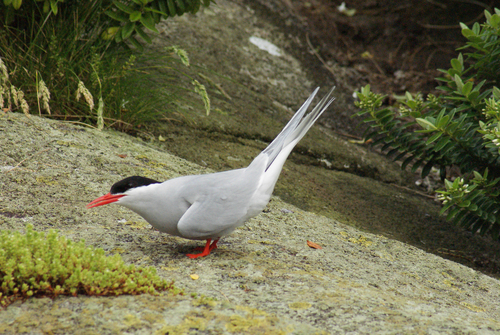 Antarctic Tern
In short
The most reliable field mark between Arctic Tern and Antarctic Tern is the upperwing pattern and bill color in adults and juveniles, but age and season must be considered. Juvenile Arctic Terns show a distinctive dark carpal bar and 'scaly' upperwing, while juvenile Antarctic Terns have yellowish-brown spotting and lack the strong carpal bar. In breeding adults, both species are similar, but Arctic Tern is slightly slimmer with a shorter bill and more translucent wingtips; Antarctic Tern is stockier with a heavier, longer bill. Non-breeding birds are best separated by context, as Antarctic Terns are in breeding plumage when Arctic Terns are in non-breeding plumage. Bill and leg color, tail length, and subtle differences in wing pattern are key, but beware overlap and the need for good views.
Identification tips
- Juvenile upperwing pattern: Arctic Tern juveniles show a strong dark carpal bar and scaly upperwing/mantle; Antarctic Tern juveniles are more mottled brownish, lacking the carpal bar, with yellowish-brown spotting.
- Bill color (adults): In breeding season, Arctic Tern has a shorter, slender, uniformly blood-red bill; Antarctic Tern's bill is heavier, longer, and bright red. In non-breeding, Arctic Tern's bill darkens to blackish, Antarctic Tern's becomes dull reddish-black.
- Leg color and length: Both have red legs in breeding plumage, but Arctic Tern's are shorter and darker; Antarctic Tern's are brighter and longer. In non-breeding, both species' legs darken, but Antarctic Tern's remain dull red.
- Tail shape and length: Arctic Tern's tail streamers are longer and more deeply forked, especially in adults. Antarctic Tern's tail is also deeply forked but appears shorter and less delicate.
- Wingtip pattern (adults): Arctic Tern shows more prominent black margins on the outer primaries and a more translucent area near the wingtip. Antarctic Tern's wingtips are less translucent and lack the strong black margin.
- Body structure: Arctic Tern is slimmer and more delicate; Antarctic Tern is stockier and heavier-bodied, with a more robust bill and head.
- Seasonal context: In the southern summer, Antarctic Tern is in full breeding plumage while Arctic Tern (if present) is in non-breeding plumage. Use this to your advantage if you know the time of year and location.
- Facial pattern (non-breeding): Arctic Tern loses most of its black cap, keeping a white forehead; Antarctic Tern's cap recedes to a black band behind the eye.
- Juvenile face and underparts: Arctic Tern juveniles have a whiter forecrown and pale grey underparts; Antarctic Tern juveniles have a yellowish-brown belly and breast.
- Habitat and range: Arctic Tern is found in the northern hemisphere during breeding, Antarctic Tern only in the southern oceans. If seen in the Arctic or subarctic, it's Arctic Tern; if on Antarctic islands, check plumage and season.
- Flight style: Arctic Tern appears more buoyant and fluttery, with longer tail streamers; Antarctic Tern is more robust in flight.
- Vocalizations: Arctic Tern's call is nasal and rasping; Antarctic Tern's is higher-pitched and trilling, but this is subtle and best used with experience.
- Colony size: Arctic Tern often nests in larger colonies; Antarctic Tern usually in smaller groups or pairs, though large colonies do occur.
- Pitfall: Non-breeding adults of both species can appear similar; use structure, bill/leg color, and context for separation.
- Subspecies variation: Antarctic Tern shows some variation in size and plumage tone by subspecies, but these are subtle and not usually diagnostic in the field.
Size
Antarctic Tern is consistently heavier (average 139 g) than Arctic Tern (average 114 g) [wikidata]. Antarctic Tern is also slightly longer (35–40 cm vs. 33–36 cm) but has a slightly shorter wingspan (74–79 cm vs. 76–85 cm). In the field, Antarctic Tern often appears stockier and more robust, especially in the body and bill, while Arctic Tern looks more slender and delicate. These differences are subtle and can be hard to judge unless both species are seen together.
Plumage
- Juveniles/immatures:
- Arctic Tern: Shows a distinctive dark carpal bar on the upperwing, 'scaly' appearance to the mantle and wings due to dark feather tips, black bill and legs, short tail streamers, and a whiter forecrown in first summer. The upperwing is pale grey with a translucent area near the tip.
- Antarctic Tern: Juveniles have yellowish-brown, grey, and white spots on the back, yellowish-brown belly and breast, dull black bill, and dull red legs. No mention of a strong carpal bar or scaly upperwing pattern. The overall impression is more mottled and brownish than Arctic Tern juveniles.
- Adults (breeding):
- Both have pale grey upperparts, white cheeks, black cap, and deeply forked white tail. Arctic Tern has a blood-red bill and feet, shorter legs, and a more translucent area near the wingtip; Antarctic Tern has a heavier, longer, bright red bill and legs, and is stockier overall. Arctic Tern's outer primaries have more prominent black margins.
- Adults (non-breeding):
- Arctic Tern: Crown becomes whiter, bill and legs darken to blackish.
- Antarctic Tern: Black cap reduced to a band behind the eye, bill becomes dull reddish-black, underparts paler.
- Key difference: Antarctic Tern is in breeding plumage during the southern summer when Arctic Tern is in non-breeding plumage, so context and season are important.
Behaviour
Both species are agile, buoyant fliers with graceful, tern-like flight. Arctic Tern is famous for its extreme long-distance migration, while Antarctic Tern is more sedentary, remaining near its breeding grounds year-round. Antarctic Tern is often seen in small, loose colonies or as isolated pairs, while Arctic Tern can form large colonies. In flight, Arctic Tern may appear more delicate and buoyant, with longer tail streamers and a more fluttery flight style, while Antarctic Tern may look more robust.
Habitat
Arctic Tern breeds in the high Arctic and subarctic, often on tundra, rocky coasts, or islands, and migrates to the Antarctic for the southern summer. Antarctic Tern is resident around the southern oceans, breeding on small islands and Antarctic mainland shores, often on cliffs, moraines, or beaches. If seen in the northern hemisphere outside the Antarctic, it is almost certainly Arctic Tern; in the far south, check plumage and season carefully.
Voice
Arctic Tern gives a nasal, rasping call, especially in alarm or display, which is distinct from the higher-pitched, trilling 'trr-trr-kriah' and 'chrrrr' calls of Antarctic Tern. However, calls are similar enough that they are not the most reliable field mark unless well known.