
Arctic Tern vs Common Tern
Sterna paradisaea versus Sterna hirundo
Play a quiz with Arctic Tern and Common Tern
 Arctic Tern
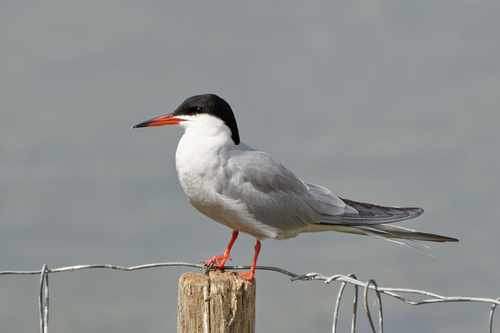 Common Tern
In short
The most reliable field mark for separating Arctic Tern from Common Tern is the pattern of the upperwing in flight, especially in juveniles and immatures: Arctic Tern shows a translucent quality across all flight feathers and a thin, sharp black trailing edge, while Common Tern has only the innermost primaries translucent and a broader, less defined dark trailing edge. Juvenile Arctic Terns have a distinctive dark carpal bar and 'scaly' upperwing, while juvenile Common Terns are paler with a different wing pattern. Structurally, Arctic Tern is more delicate with a shorter neck, smaller head, shorter legs, and longer tail streamers, giving it a more buoyant, graceful flight compared to the Common Tern's more powerful, direct flight. Bill color is also key: breeding Arctic Terns have a uniformly dark red bill, while Common Terns show an orange-red bill with a black tip (except in some subspecies). These differences are subtle and often require good light and close views, especially outside the breeding season or with immatures.
Identification tips
- Juvenile upperwing pattern: Look for a strong dark carpal bar and 'scaly' mantle in juvenile Arctic Tern; Common Tern juveniles lack the strong carpal bar and have a paler, less patterned wing.
- Translucency of flight feathers: In flight, Arctic Tern shows all flight feathers translucent against the sky, while Common Tern has this translucency only in the four innermost primaries. This is most reliable in good light.
- Trailing edge of wing: Arctic Tern has a thin, sharp black trailing edge on the outer primaries; Common Tern's trailing edge is broader and less sharply defined.
- Bill color (adults, breeding): Arctic Tern has a uniformly dark red bill; Common Tern has an orange-red bill with a black tip (except in some subspecies).
- Leg color: Arctic Tern's legs are dark red and shorter; Common Tern's legs are brighter red and longer, making it look taller when perched.
- Tail length and shape: Arctic Tern's tail streamers are longer and extend well beyond the wing tips when perched; Common Tern's tail is shorter and may not extend past the wing tips.
- Head and neck structure: Common Tern has a larger head and thicker neck, giving it a more robust look; Arctic Tern appears more delicate and small-headed.
- Flight style: Arctic Tern is buoyant and graceful in flight, with long, narrow wings; Common Tern is more direct and powerful, with stiffer, more triangular wings.
- Cheek and underparts: Arctic Tern has whiter cheeks and slightly greyer underparts than Common Tern, making the cheek patch stand out more.
- Rump color (non-breeding): Arctic Tern's rump remains white; Common Tern's rump can become greyish in non-breeding plumage.
- Seasonal changes: In winter, Arctic Tern's crown becomes whiter and the bill/legs darken; Common Tern retains more black on the head and may keep some black on the bill.
- Voice: Arctic Tern's call is more nasal and rasping; Common Tern's is more musical. Use with caution unless you are familiar with both.
- Habitat context: If you are at a high-Arctic breeding site, Arctic Tern is more likely; in temperate regions, especially inland, Common Tern is usually the default.
- Pitfalls: Immature birds are often misidentified—prioritize wing translucency and carpal bar for juveniles, and bill/tail/leg structure for adults. Beware of overlap in non-breeding plumage, where differences are subtle.
- Direct comparison: When possible, compare birds side by side for structure and flight style, as these differences are more apparent in direct comparison than in isolation.
Size
Both species are similar in length and wingspan, but Arctic Tern is slightly lighter and more delicate overall (body mass ~114 g). Common Tern tends to have a slightly larger head, thicker neck, and longer legs, making it appear a bit more robust and less dainty than Arctic Tern. In the field, these differences are subtle and best appreciated when both species are side by side.
Plumage
- Juveniles/immatures: Arctic Tern juveniles have a black bill and legs, a 'scaly' appearance to the upperwing and mantle due to dark feather tips, a dark carpal bar, and short tail streamers. Their forecrown is whiter in the first summer. Common Tern juveniles are paler, lack the strong dark carpal bar, and have a different wing pattern; they are easily separated from Arctic Tern juveniles by these marks.
- Adults (breeding): Arctic Tern adults are pale grey above with a black crown and nape, white cheeks, and a deep blood-red bill and feet. The upperwing is pale grey with a white leading edge and a narrow, sharp blackish trailing edge on the primaries; the entire wing is translucent against the sky. The tail is deeply forked and white. Common Tern adults have a larger head, thicker neck, longer legs, and a more triangular wing. Their bill is orange-red with a black tip (except in some subspecies), and the legs are bright red. The upperwing develops a dark wedge as the season progresses, and only the innermost primaries are translucent. The trailing edge of the wing is thicker and less sharply defined than in Arctic Tern.
- Non-breeding: Arctic Tern's crown becomes whiter, and the bill and legs darken. Common Tern's rump can become greyish, and the black wedge on the wing may persist. Both species become trickier to separate in this plumage, but Arctic Tern retains a whiter rump and more translucent wings.
Behaviour
In flight, Arctic Tern appears more buoyant, with longer, narrower wings and a deeply forked tail that often trails behind. Its flight is graceful and buoyant. Common Tern has a more powerful, direct, and stiffer flight, with more triangular wings and a heavier head and neck. When perched, Arctic Tern sits lower due to shorter legs and appears more delicate overall, while Common Tern stands taller and looks more robust.
Habitat
Both species have broad circumpolar distributions, but Arctic Tern breeds farther north, in Arctic and subarctic regions, while Common Tern breeds in temperate and subarctic zones. Overlap can occur in some regions, especially during migration. Arctic Tern is more likely to be found in high-latitude breeding colonies, while Common Tern is more widespread in temperate coastal and inland waters.
Voice
Arctic Tern's call is more nasal and rasping compared to the Common Tern's. The difference is subtle and best appreciated with experience, but Arctic Tern's calls are generally higher-pitched and harsher, while Common Tern's are more musical and less nasal.