
Arctic Tern vs Roseate Tern
Sterna paradisaea versus Sterna dougallii
Play a quiz with Arctic Tern and Roseate Tern
 Arctic Tern
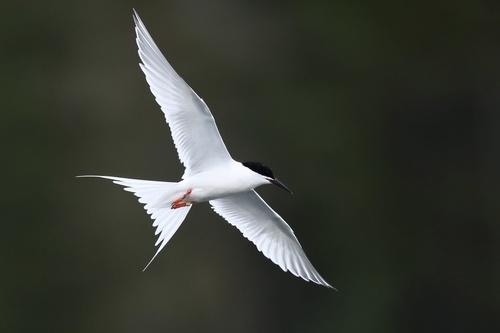 Roseate Tern
In short
The most reliable field mark between Arctic Tern and Roseate Tern is the bill: Arctic Tern adults have a uniformly deep red bill, while Roseate Tern shows a black bill with a red base (except in some southern populations, which are not relevant in the North Atlantic). For juveniles and immatures, focus on the upperwing pattern: Arctic Tern juveniles show a distinct dark carpal bar and 'scaly' upperwing, while Roseate Tern juveniles are paler and lack a strong carpal bar. In flight, Arctic Tern is longer-winged and more buoyant, with a deeply forked tail, while Roseate Tern is shorter-winged and more rapid in wingbeat. Adult Roseate Terns in breeding plumage have a subtle pinkish wash to the underparts, which Arctic Tern never shows. Both species are similar in size and can overlap in colonies, so careful attention to these marks is essential.
Identification tips
- Bill color (adults, breeding): Arctic Tern has a deep red, entirely colored bill. Roseate Tern shows a black bill with a red base (in the North Atlantic); this is the single most reliable mark on perched adults in spring/summer.
- Juvenile/immature upperwing: Arctic Tern juveniles have a strong dark carpal bar and 'scaly' upperparts, with short tail streamers. Roseate juveniles are paler, lack a strong carpal bar, and have a fuller black cap. This is the best mark for separating young birds in flight.
- Tail streamers: Both species have long tail streamers, but Roseate Tern's are especially long and flexible, often extending well beyond the wingtips when perched. Arctic Tern's tail is deeply forked but not as extravagantly long in proportion.
- Underparts (adults, breeding): Roseate Tern shows a subtle pinkish wash to the underparts in breeding plumage, especially on the breast. Arctic Tern is always clean white to pale grey below.
- Leg color: Arctic Tern has short, deep red legs in breeding plumage, turning blackish in winter. Roseate Tern's legs are orange-red and slightly longer, but this is subtle and not always reliable.
- Wing structure and flight: Arctic Tern is longer-winged, with a more buoyant, gliding flight. Roseate Tern is shorter-winged, with faster, more fluttery wingbeats. In direct comparison, Arctic looks more graceful and elongated.
- Upperwing pattern (adults): Arctic Tern's upperwings are pale grey with translucent wingtips and a narrow dark trailing edge. Roseate Tern's wings are even paler, with a white leading edge and less contrast overall, but outer primaries darken in late summer.
- Crown and forehead (non-breeding): Both species develop a white forehead in winter, but Arctic Tern's bill and legs become black, while Roseate's bill is all black and legs remain orange-red.
- Voice: Arctic Tern gives a sharp, nasal rasp; Roseate Tern's call is a softer, distinctive 'chuwit.' Use this in colonies or when birds are calling.
- Habitat and context: Arctic Tern is far more likely in high-latitude, open, or exposed colonies. Roseate Tern is rare, localized, and often found in colonies with nestboxes or dense vegetation, especially in Ireland, the UK, and select US sites.
- Aggression at nest: Arctic Tern is highly defensive and aggressive at the nest, while Roseate Tern is less so and often relies on other terns for protection.
- Seasonal context: In late summer, Roseate Tern's outer primaries may appear darker, but the pinkish underparts and bill pattern remain useful. In winter, both species become harder to separate, but bill and leg color, and upperwing pattern in juveniles, remain helpful.
- Pitfalls: Do not rely on overall paleness alone—both species can appear very pale in bright light. Bill color is key, but beware that Roseate Tern's bill can appear all black early in the season or in non-breeding plumage.
- Direct comparison: When both species are present, look for the combination of bill color, tail streamer length, and underpart color. No single mark is perfect, but the combination is diagnostic.
- When in doubt: Juvenile upperwing pattern (carpal bar in Arctic, absent in Roseate) and adult bill color are the most reliable field marks for these two species.
Size
Both Arctic and Roseate Terns are similar in length (33–36 cm), but Arctic Tern is slightly heavier (average body mass 114 g [avonet/wikidata]). Arctic Tern has a broader wingspan (76–85 cm) compared to Roseate Tern (67–76 cm), giving it a more elongated, graceful look in flight. Roseate Tern appears slightly more slender and delicate, but this is subtle and best judged with direct comparison.
Plumage
- Juvenile/immature birds: Arctic Tern juveniles have a strong dark carpal bar across the upperwing, 'scaly' upperparts with dark-tipped feathers, and short tail streamers. Their bill and legs are black. Roseate Tern juveniles are paler overall, with a less obvious carpal bar and a fuller black cap; their upperparts are also 'scaly' but less contrasting, and they lack the strong wing bar of Arctic.
- Adults (breeding): Arctic Tern has a clean grey mantle, pale grey upperwings with translucent wingtips, a deep red bill, and a black crown/nape. Roseate Tern is paler above, with a white body, pale grey upperwings, and a black bill with a red base. The most distinctive mark is the pinkish tinge to the underparts in Roseate, absent in Arctic. Both have long tail streamers, but Roseate's are especially long and flexible.
- Adults (non-breeding/winter): Both species develop a white forehead and darker bill in winter. Arctic Tern's bill and legs turn black; Roseate's bill becomes all black, legs orange-red. The underparts of Roseate lose the pinkish tinge.
Behaviour
In flight, Arctic Tern is buoyant, with long, narrow wings and a deeply forked tail, often gliding and showing a graceful, floating jizz. Roseate Tern is more rapid and fluttery in wingbeat, with shorter wings and extremely long, flexible tail streamers. When perched, Roseate often appears more delicate and slim, but this is subtle. Roseate Tern is less aggressive at the nest than Arctic Tern, often relying on other terns for defense.
Habitat
Both species breed in colonies on coasts and islands, often together. Arctic Tern favors more northerly, subarctic to Arctic regions, while Roseate Tern is more localized and prefers sheltered, often vegetated or rocky islands, sometimes using nestboxes. Roseate Tern is much rarer and more restricted in range in Europe and North America, with key colonies in Ireland, the UK, and a few US sites. Arctic Tern is far more widespread and abundant in the far north.
Voice
Arctic Tern gives a nasal, rasping call, quite different from Roseate Tern's distinctive 'chuwit' call, which is softer and more reminiscent of a Spotted Redshank. These calls are reliable in the colony or when birds are vocalizing, but can be hard to separate at a distance or in mixed flocks.