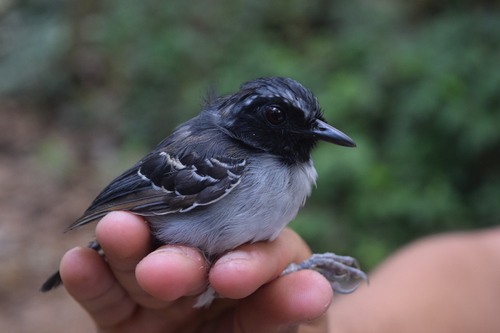
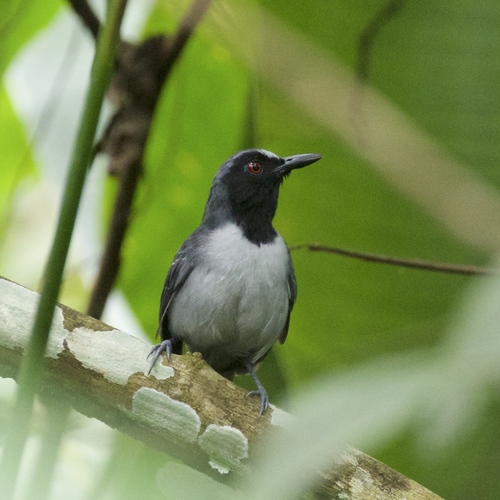
Ash-breasted Antbird vs Black-faced Antbird
Myrmoborus lugubris versus Myrmoborus myotherinus
Play a quiz with Ash-breasted Antbird and Black-faced Antbird
Ash-breasted Antbird
Black-faced Antbird
In short
The Ash-breasted Antbird and Black-faced Antbird are similar in size and structure, but differ in plumage and habitat preferences. Males of both species have a black face, but the Ash-breasted Antbird is primarily gray, while the Black-faced Antbird is darker overall. Females are more distinct, with the Ash-breasted female showing warm buffy-brown tones.
Identification tips
- Look for the gray plumage in male Ash-breasted Antbirds versus the darker overall appearance of male Black-faced Antbirds. 2. Note the warm buffy-brown tones in female Ash-breasted Antbirds. 3. Consider habitat: Ash-breasted Antbirds are often near rivers, while Black-faced Antbirds prefer terra firme forests. 4. Observe behavior: Black-faced Antbirds may join ant swarms, unlike Ash-breasted Antbirds.
Size
Both species are similar in size, typical of small antbirds.
Plumage
Male Ash-breasted Antbirds are gray with a black face and throat, while Black-faced Antbird males are darker overall. Female Ash-breasted Antbirds are warm buffy-brown with pale-spotted wing coverts, whereas female Black-faced Antbirds are generally darker with less contrast.
Behaviour
Both species forage close to the ground, but the Black-faced Antbird occasionally joins mixed-species flocks following army ant swarms.
Habitat
Ash-breasted Antbirds are found in lowland evergreen forests along rivers, especially on river islands and in várzea. Black-faced Antbirds prefer terra firme forests and are more likely to be found away from water.
Voice
Vocalizations are not detailed in the sources, suggesting they may not be the most reliable field marks for differentiation.
Ash-breasted Antbird · Black-faced Antbird · My Tricky Birds