Birdr

Asian Woolly-necked Stork vs Lesser Adjutant

Ciconia episcopus versus Leptoptilos javanicus

Play a quiz with Asian Woolly-necked Stork and Lesser Adjutant
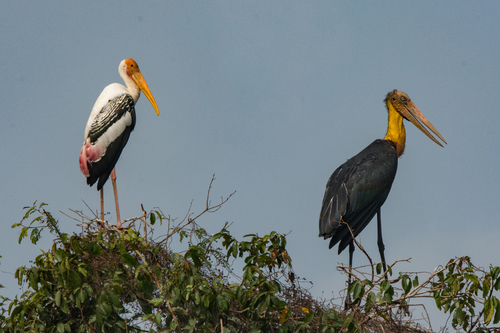
Asian Woolly-necked Stork (Ciconia episcopus) Asian Woolly-necked Stork
Lesser Adjutant (Leptoptilos javanicus) Lesser Adjutant

Media

Loading…

In short

The Asian Woolly-necked Stork and Lesser Adjutant are both large storks, but they differ significantly in appearance and behavior. The Asian Woolly-necked Stork is characterized by its woolly white neck and maroon-purple ruff, while the Lesser Adjutant has a bare, featherless head and neck, giving it a more vulture-like appearance.

Identification tips

1. Neck and Head: Look for the woolly white neck of the Asian Woolly-necked Stork versus the bare, featherless neck of the Lesser Adjutant. 2. Size and Build: Note the larger size and more robust build of the Lesser Adjutant. 3. Habitat Preference: Consider the habitat; Asian Woolly-necked Storks are more likely in forested wetlands, while Lesser Adjutants prefer open wetlands. 4. Behavior: Observe behavior; the Asian Woolly-necked Stork is more likely to be seen slowly walking and hunting, while the Lesser Adjutant may be scavenging.

Size

The Lesser Adjutant is generally larger and more robust than the Asian Woolly-necked Stork.

Plumage

The Asian Woolly-necked Stork has a distinctive woolly white neck, a neat black cap, and red-tinged bill and legs. In contrast, the Lesser Adjutant has a bare, featherless head and neck, with a more somber, dark plumage overall.

Behaviour

The Asian Woolly-necked Stork often hunts alone or in small groups by walking slowly and scanning for prey, while the Lesser Adjutant is known for its solitary behavior and scavenging habits.

Habitat

Asian Woolly-necked Storks are found in a variety of wetland habitats, including agricultural fields and forest openings, whereas Lesser Adjutants prefer more open wetlands and are less associated with forested areas.

Voice

Vocalizations are not a primary distinguishing feature for these species, as both are generally silent.

Submit a better description

Use the same sections as the comparison. Your text is published immediately.

The Asian Woolly-necked Stork and Lesser Adjutant are both large storks, but they differ significantly in appearance and behavior. The Asian Woolly-necked Stork is characterized by its woolly white neck and maroon-purple ruff, while the Lesser Adjutant has a bare, featherless head and neck, giving it a more vulture-like appearance.

1. Neck and Head: Look for the woolly white neck of the Asian Woolly-necked Stork versus the bare, featherless neck of the Lesser Adjutant. 2. Size and Build: Note the larger size and more robust build of the Lesser Adjutant. 3. Habitat Preference: Consider the habitat; Asian Woolly-necked Storks are more likely in forested wetlands, while Lesser Adjutants prefer open wetlands. 4. Behavior: Observe behavior; the Asian Woolly-necked Stork is more likely to be seen slowly walking and hunting, while the Lesser Adjutant may be scavenging.

The Lesser Adjutant is generally larger and more robust than the Asian Woolly-necked Stork.

The Asian Woolly-necked Stork has a distinctive woolly white neck, a neat black cap, and red-tinged bill and legs. In contrast, the Lesser Adjutant has a bare, featherless head and neck, with a more somber, dark plumage overall.

The Asian Woolly-necked Stork often hunts alone or in small groups by walking slowly and scanning for prey, while the Lesser Adjutant is known for its solitary behavior and scavenging habits.

Asian Woolly-necked Storks are found in a variety of wetland habitats, including agricultural fields and forest openings, whereas Lesser Adjutants prefer more open wetlands and are less associated with forested areas.

Vocalizations are not a primary distinguishing feature for these species, as both are generally silent.

Discard your changes?

You have unsaved edits. If you leave now, those changes will be lost.

Asian Woolly-necked Stork · Lesser Adjutant · My Tricky Birds