Birdr

Baikal Teal vs Blue-winged Teal

Sibirionetta formosa versus Spatula discors

Play a quiz with Baikal Teal and Blue-winged Teal
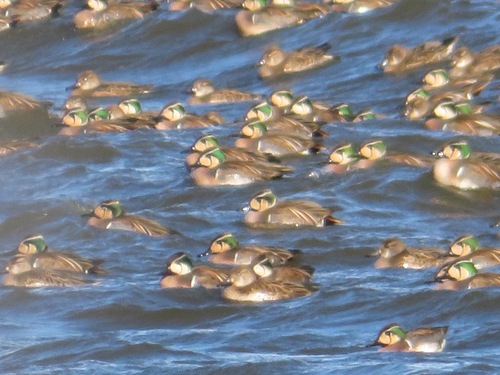
Baikal Teal (Sibirionetta formosa) Baikal Teal
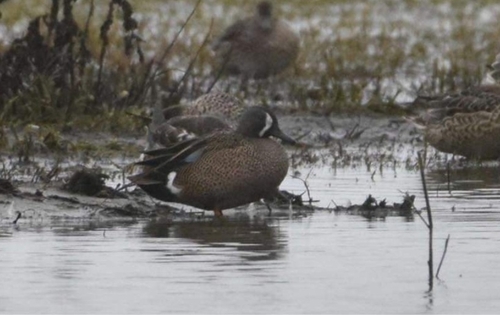
Blue-winged Teal (Spatula discors) Blue-winged Teal

Media

Loading…

In short

The Baikal Teal and Blue-winged Teal can be distinguished by their plumage and behavior. The male Baikal Teal has a strikingly patterned face, while the Blue-winged Teal is more subdued with a distinctive blue patch on the wings. Behaviorally, Baikal Teals form large, dense flocks in winter, unlike the more dispersed Blue-winged Teal.

Identification tips

Size

Both species are small dabbling ducks, but the Baikal Teal is slightly larger and stockier than the Blue-winged Teal.

Plumage

The male Baikal Teal has a bold, variegated face pattern with a green and yellow stripe, while the female is intricately marked with brown. The Blue-winged Teal, in contrast, has a more uniform appearance with a notable blue patch on its wings and a white crescent in front of the eyes in males.

Behaviour

Baikal Teals are known for forming large, dense flocks, especially during the nonbreeding season in South Korea, creating a 'tornado' effect as they take flight. Blue-winged Teals are more solitary or found in small groups, especially during breeding.

Habitat

Baikal Teals primarily winter in rice fields and freshwater ponds in South Korea, while Blue-winged Teals breed in North American wetlands and migrate to Central and South America for winter.

Voice

Vocalizations are not a primary distinguishing feature between these species in the field.

Submit a better description

Use the same sections as the comparison. Your text is published immediately.

The Baikal Teal and Blue-winged Teal can be distinguished by their plumage and behavior. The male Baikal Teal has a strikingly patterned face, while the Blue-winged Teal is more subdued with a distinctive blue patch on the wings. Behaviorally, Baikal Teals form large, dense flocks in winter, unlike the more dispersed Blue-winged Teal.

  • Male Baikal Teal: Look for the bold, multicolored face pattern with green and yellow stripes.
  • Female Baikal Teal: Note the intricately patterned brown face.
  • Blue-winged Teal: Identify by the blue wing patch and white facial crescent in males.
  • Observe flock behavior: large, dense flocks suggest Baikal Teal; smaller groups or solitary birds suggest Blue-winged Teal.
  • Consider habitat: Baikal Teals are likely in rice fields during winter, while Blue-winged Teals are found in North American wetlands during breeding season.

Both species are small dabbling ducks, but the Baikal Teal is slightly larger and stockier than the Blue-winged Teal.

The male Baikal Teal has a bold, variegated face pattern with a green and yellow stripe, while the female is intricately marked with brown. The Blue-winged Teal, in contrast, has a more uniform appearance with a notable blue patch on its wings and a white crescent in front of the eyes in males.

Baikal Teals are known for forming large, dense flocks, especially during the nonbreeding season in South Korea, creating a 'tornado' effect as they take flight. Blue-winged Teals are more solitary or found in small groups, especially during breeding.

Baikal Teals primarily winter in rice fields and freshwater ponds in South Korea, while Blue-winged Teals breed in North American wetlands and migrate to Central and South America for winter.

Vocalizations are not a primary distinguishing feature between these species in the field.

Discard your changes?

You have unsaved edits. If you leave now, those changes will be lost.

Baikal Teal · Blue-winged Teal · My Tricky Birds