Birdr

Baird's Sandpiper vs Least Sandpiper

Calidris bairdii versus Calidris minutilla

Play a quiz with Baird's Sandpiper and Least Sandpiper
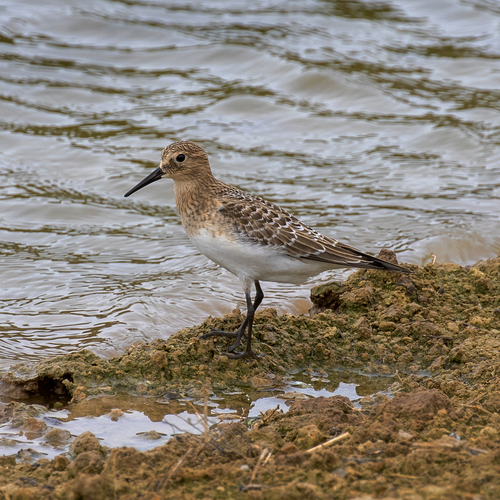
Baird's Sandpiper (Calidris bairdii) Baird's Sandpiper
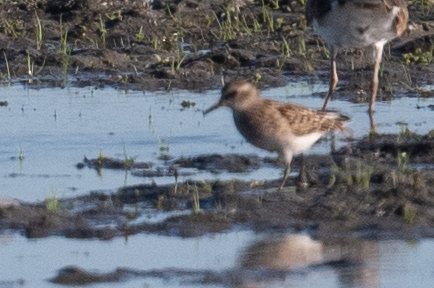
Least Sandpiper (Calidris minutilla) Least Sandpiper

Media

Loading…

In short

Baird's Sandpiper and Least Sandpiper are small shorebirds that can be distinguished by their structural differences and subtle plumage variations. Baird's Sandpiper is slightly larger with longer wings and a more elongated appearance, while Least Sandpiper is smaller and has a more compact build.

Identification tips

Size

Baird's Sandpiper is slightly larger and more elongated, with longer wings and primary projection compared to the smaller, more compact Least Sandpiper.

Plumage

Baird's Sandpiper has a buffy tone with a scaly pattern on the back during breeding season, whereas Least Sandpiper displays a browner tone with a more distinct, crisp pattern. In non-breeding plumage, both species appear more muted, but Baird's tends to retain a slightly buffier hue.

Behaviour

Both species forage by probing in mudflats and shorelines, but Least Sandpiper may be seen using 'surface tension transport' to move prey, a behavior not noted in Baird's Sandpiper.

Habitat

Baird's Sandpiper is often found in more open, drier tundra during breeding, while Least Sandpiper prefers wetter, marshy areas. During migration, both species can be found in similar coastal and inland wetland habitats.

Voice

Vocalizations are not a primary distinguishing feature in the field; both species have similar high-pitched calls, but detailed study may reveal subtle differences.

Submit a better description

Use the same sections as the comparison. Your text is published immediately.

Baird's Sandpiper and Least Sandpiper are small shorebirds that can be distinguished by their structural differences and subtle plumage variations. Baird's Sandpiper is slightly larger with longer wings and a more elongated appearance, while Least Sandpiper is smaller and has a more compact build.

  • Check size and shape: Baird's Sandpiper is larger with longer wings, giving it a more streamlined look.
  • Examine plumage: Look for buffy tones and scaly back in Baird's, versus browner tones and crisp patterns in Least.
  • Observe behavior: Note any 'surface tension transport' feeding in Least Sandpiper.
  • Consider habitat: Baird's prefers drier tundra, Least favors marshy areas during breeding.
  • Listen for calls: While similar, any distinct call differences are subtle and require careful listening.

Baird's Sandpiper is slightly larger and more elongated, with longer wings and primary projection compared to the smaller, more compact Least Sandpiper.

Baird's Sandpiper has a buffy tone with a scaly pattern on the back during breeding season, whereas Least Sandpiper displays a browner tone with a more distinct, crisp pattern. In non-breeding plumage, both species appear more muted, but Baird's tends to retain a slightly buffier hue.

Both species forage by probing in mudflats and shorelines, but Least Sandpiper may be seen using 'surface tension transport' to move prey, a behavior not noted in Baird's Sandpiper.

Baird's Sandpiper is often found in more open, drier tundra during breeding, while Least Sandpiper prefers wetter, marshy areas. During migration, both species can be found in similar coastal and inland wetland habitats.

Vocalizations are not a primary distinguishing feature in the field; both species have similar high-pitched calls, but detailed study may reveal subtle differences.

Discard your changes?

You have unsaved edits. If you leave now, those changes will be lost.

Baird's Sandpiper · Least Sandpiper · My Tricky Birds