Birdr

Baird's Sandpiper vs Pectoral Sandpiper

Calidris bairdii versus Calidris melanotos

Play a quiz with Baird's Sandpiper and Pectoral Sandpiper
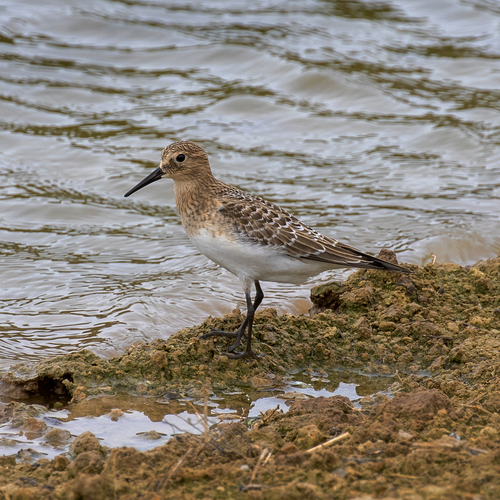
Baird's Sandpiper (Calidris bairdii) Baird's Sandpiper
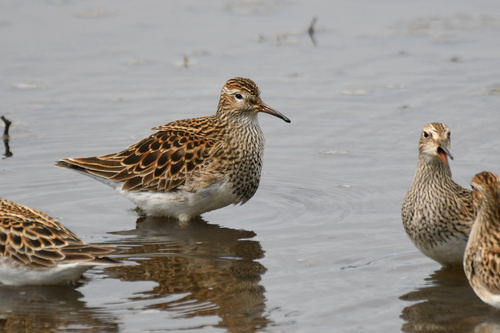
Pectoral Sandpiper (Calidris melanotos) Pectoral Sandpiper

Media

Loading…

In short

Baird's Sandpiper and Pectoral Sandpiper are similar shorebirds, but can be distinguished by their breast markings and structure. Baird's Sandpiper has a more uniform brownish-gray breast, while Pectoral Sandpiper features a sharply demarcated streaked breast with a clear white belly. Structural differences include Baird's longer primary projection and Pectoral's slightly larger size.

Identification tips

Check the breast pattern: Baird's Sandpiper has a uniform breast, while Pectoral Sandpiper has a streaked breast with a sharp boundary. Look at the primary projection: Baird's Sandpiper has a longer primary projection beyond the tail. Observe size and shape: Pectoral Sandpiper is slightly larger and bulkier. Listen for vocalizations: Pectoral Sandpiper's hollow hoots are distinctive during the breeding season.

Size

Pectoral Sandpiper is slightly larger than Baird's Sandpiper, with a bulkier body.

Plumage

Baird's Sandpiper has a more uniform brownish-gray breast and a subtle supercilium, while Pectoral Sandpiper has a distinctively streaked breast that ends abruptly at a clear white belly, and a more pronounced supercilium.

Behaviour

Both species forage in similar habitats, but Pectoral Sandpiper is known for its unique display involving hollow hoots during the breeding season.

Habitat

Both species breed in Arctic tundra and migrate through North America, but Pectoral Sandpiper migrates further south to South America, while Baird's Sandpiper typically winters in South America as well.

Voice

Pectoral Sandpiper's vocalization is notable for its series of hollow hoots, unlike the less distinctive calls of Baird's Sandpiper.

Submit a better description

Use the same sections as the comparison. Your text is published immediately.

Baird's Sandpiper and Pectoral Sandpiper are similar shorebirds, but can be distinguished by their breast markings and structure. Baird's Sandpiper has a more uniform brownish-gray breast, while Pectoral Sandpiper features a sharply demarcated streaked breast with a clear white belly. Structural differences include Baird's longer primary projection and Pectoral's slightly larger size.

Check the breast pattern: Baird's Sandpiper has a uniform breast, while Pectoral Sandpiper has a streaked breast with a sharp boundary. Look at the primary projection: Baird's Sandpiper has a longer primary projection beyond the tail. Observe size and shape: Pectoral Sandpiper is slightly larger and bulkier. Listen for vocalizations: Pectoral Sandpiper's hollow hoots are distinctive during the breeding season.

Pectoral Sandpiper is slightly larger than Baird's Sandpiper, with a bulkier body.

Baird's Sandpiper has a more uniform brownish-gray breast and a subtle supercilium, while Pectoral Sandpiper has a distinctively streaked breast that ends abruptly at a clear white belly, and a more pronounced supercilium.

Both species forage in similar habitats, but Pectoral Sandpiper is known for its unique display involving hollow hoots during the breeding season.

Both species breed in Arctic tundra and migrate through North America, but Pectoral Sandpiper migrates further south to South America, while Baird's Sandpiper typically winters in South America as well.

Pectoral Sandpiper's vocalization is notable for its series of hollow hoots, unlike the less distinctive calls of Baird's Sandpiper.

Discard your changes?

You have unsaved edits. If you leave now, those changes will be lost.

Baird's Sandpiper · Pectoral Sandpiper · My Tricky Birds