
Balearic Shearwater vs Pygmy Cormorant
Puffinus mauretanicus versus Microcarbo pygmaeus
Play a quiz with Balearic Shearwater and Pygmy Cormorant
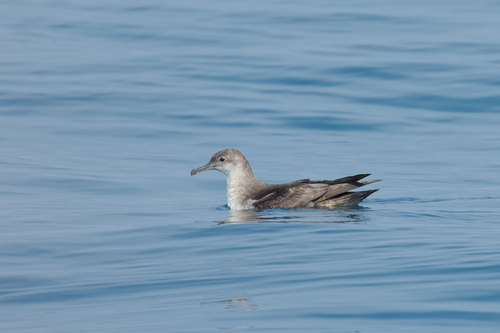
Balearic Shearwater
Pygmy Cormorant
In short
The Balearic Shearwater and Pygmy Cormorant are unlikely to be confused in the field due to their distinct habitats and behaviors. The Balearic Shearwater is a seabird with long wings and a streamlined body, while the Pygmy Cormorant is a freshwater bird with a more compact body and shorter wings.
Identification tips
1. Location: Check the habitat; shearwaters are at sea, cormorants in freshwater. 2. Flight style: Shearwaters glide with stiff wings, cormorants flap more frequently. 3. Plumage: Look for the contrasting underparts of the shearwater versus the uniform dark of the cormorant. 4. Size and shape: Note the larger size and longer wings of the shearwater compared to the smaller, more compact cormorant.
Size
The Balearic Shearwater is larger with a wingspan of about 85–90 cm, whereas the Pygmy Cormorant is smaller, with a wingspan around 55–60 cm.
Plumage
Balearic Shearwaters have a brown upper body and pale underparts, often with a smudgy appearance. Pygmy Cormorants are mostly dark with a glossy sheen, lacking the contrasting underparts of the shearwater.
Behaviour
Balearic Shearwaters are often seen gliding low over the sea in flocks, while Pygmy Cormorants are more solitary or in small groups, frequently diving in freshwater bodies.
Habitat
Balearic Shearwaters are pelagic, found over open seas, especially in the Mediterranean. Pygmy Cormorants prefer freshwater habitats like lakes, rivers, and marshes.
Voice
Balearic Shearwaters are generally silent at sea, while Pygmy Cormorants may produce low grunts or croaks, especially near breeding sites.