
Baltimore Oriole vs Yellow-rumped Warbler
Icterus galbula versus Setophaga coronata
Play a quiz with Baltimore Oriole and Yellow-rumped Warbler
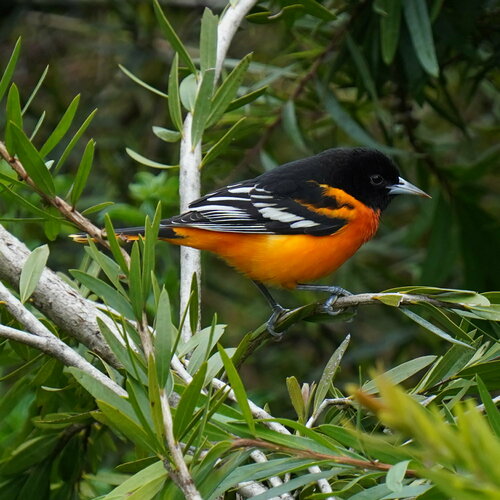 Baltimore Oriole
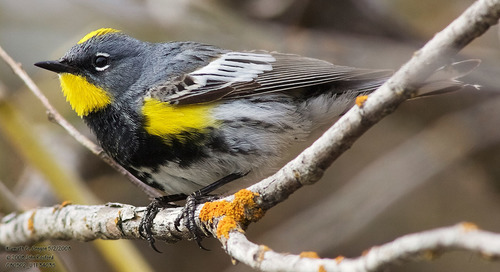 Yellow-rumped Warbler
In short
The most reliable field mark to separate Baltimore Oriole from Yellow-rumped Warbler is the oriole's bold orange (or orange-yellow) underparts and rump, combined with prominent white wing bars on dark wings, versus the warbler's streaked gray or brown plumage with a distinct yellow rump patch and smaller, more delicate structure. Juvenile and female Baltimore Orioles can be confused with warblers due to their duller coloration, but even then, the oriole's larger size, thick pointed bill, and overall orange or yellow tones set it apart from the smaller, streakier warbler with its signature yellow rump. In flight, Baltimore Orioles show a more robust, icterid jizz and always display white wing bars, while Yellow-rumped Warblers are slimmer, with a more fluttery warbler flight and lack the oriole's extensive orange. Both species can be found in overlapping habitats during migration, but their structure and plumage differences remain clear with good views.
Identification tips
- White wing bars vs. white wing patches: Baltimore Orioles of all ages show two bold white wing bars on dark wings, while Yellow-rumped Warblers have white wing patches but not true bars. This is especially useful on perched or flying birds.
- Yellow rump vs. orange rump: Yellow-rumped Warblers always show a bright yellow rump patch, even in dull plumages, while Baltimore Orioles have an orange or yellow-orange rump (matching their underparts) but never a sharply defined yellow patch.
- Bill shape and size: Orioles have a thick, pointed, icterid bill, noticeably stouter than the warbler's slim, pointed bill. This is diagnostic at close range or in photos.
- Overall size and structure: Orioles are much larger and bulkier, with a longer tail and more robust body, while warblers are small, slim, and delicate. Size difference is obvious when both are seen together, but note that a lone oriole can appear smaller at a distance.
- Underpart color: Adult male Baltimore Orioles are vivid orange below; females and juveniles are dull orange-yellow. Yellow-rumped Warblers are always streaked below (gray or brown with streaks), never solid orange or yellow.
- Back and head pattern: Orioles have plain, dark (male) or yellow-brown (female/juvenile) backs, while warblers are streaked above and may show a contrasting cheek patch (black in breeding male myrtle warblers, brown or gray in females).
- Tail pattern in flight: Warblers show white tail spots (especially obvious in flight), while orioles have a plain dark tail with no white spots.
- Behavior: Orioles move more deliberately and may be seen feeding on fruit or nectar, while warblers are restless, often sallying for insects or joining mixed flocks.
- Voice: The oriole's song is a clear, whistled series of notes, while the warbler's is a dry, rapid trill. Calls are also distinct: oriole chatter is harsher and louder than the warbler's soft 'chip.'
- Habitat context: Orioles are more likely in tall deciduous trees and at fruit feeders, while warblers are found in a wider range of habitats, often in conifers or mixed woods, and are more likely to be in flocks.
- Sex and age pitfalls: Female and juvenile orioles can appear yellowish and dull, but still show white wing bars and a larger, thicker bill. Female and immature warblers are streaked, smaller, and always show the yellow rump.
- Seasonal confusion: Orioles are present in the East mainly in spring and summer; warblers can be found year-round in some areas, especially in winter in the South.
- Jizz in flight: Orioles have a strong, direct flight with steady wingbeats, while warblers are more fluttery and erratic.
- Feeding behavior: Orioles may be seen probing fruit or sipping nectar; warblers rarely do this and are more often seen gleaning insects or flycatching.
- Mixed flocks: Warblers often join mixed-species flocks, especially outside the breeding season; orioles are usually solitary or in pairs.
Size
Baltimore Oriole is noticeably larger and bulkier than Yellow-rumped Warbler. Orioles measure 17–22 cm in length with a wingspan of 23–32 cm and average about 34 g in weight, while Yellow-rumped Warblers are smaller at 12–15 cm long, wingspan 19–24 cm, and average only 12.5 g. The oriole has a sturdy body, longish tail, and thick, pointed bill typical of icterids, whereas the warbler is much more delicate, with a slim, pointed bill, shorter tail, and lighter build. Even immature orioles are larger and more robust than adult warblers.
Plumage
For all ages, Baltimore Orioles show white wing bars on dark wings, a feature present in both adults and juveniles. Adult males are strikingly orange below and on the rump, with black head and back, while females and juveniles are yellow-brown above and dull orange-yellow below, but still with white wing bars. Yellow-rumped Warblers, regardless of age or sex, have a streaked gray or brown back, white wing patches (not bars), and a distinctive yellow rump patch. Breeding male warblers have additional yellow on the crown and flanks, and a white or yellow throat depending on subspecies, but never show the solid orange oriole tones. Juvenile and female warblers are duller but always retain the yellow rump and streaked appearance, lacking the oriole's smooth orange or yellow wash and white wing bars. In flight, the oriole's orange or yellow underparts and rump are obvious, while the warbler flashes its yellow rump and white tail spots.
Behaviour
Baltimore Orioles are more likely to be seen perched high in trees, often alone or in pairs, and may visit feeders for fruit or nectar. They move deliberately, sometimes bowing or displaying with fanned tails and lowered wings. Yellow-rumped Warblers are much more active and agile, often seen flitting through foliage, sallying out to catch insects, or foraging in mixed flocks. Their flight is more fluttery and less direct than the oriole's. Orioles rarely join mixed-species flocks, while warblers often do, especially outside the breeding season.
Habitat
Both species can overlap in woodland edges, parks, and suburban areas, especially during migration. However, Baltimore Orioles breed in open deciduous woods and are attracted to tall shade trees and orchards, while Yellow-rumped Warblers are more flexible, breeding in coniferous and mixed forests and wintering in a wide range of habitats, including open woods, shrubby areas, and even beaches. During migration, warblers are more likely to be found in a variety of habitats and in larger numbers.
Voice
Baltimore Oriole males sing a clear, whistled song with a vibrant, fluting quality, often repeated in short bursts. Females also sing but are less musical, and both sexes give harsh chatter calls. Yellow-rumped Warblers have a rapid, dry trill song (tyew-tyew-tyew-tyew, tew-tew-tew) and frequent sharp 'check' or 'chip' calls. The oriole's song is more melodic and less buzzy than the warbler's, and their calls are louder and harsher.