Birdr

Banded Bay Cuckoo vs Lesser Cuckoo

Cacomantis sonneratii versus Cuculus poliocephalus

Play a quiz with Banded Bay Cuckoo and Lesser Cuckoo
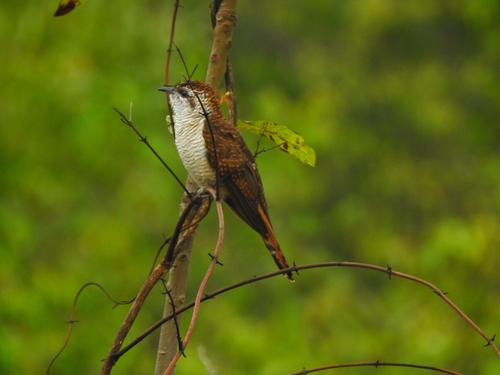
Banded Bay Cuckoo (Cacomantis sonneratii) Banded Bay Cuckoo
Lesser Cuckoo (Cuculus poliocephalus) Lesser Cuckoo

Media

Loading…

In short

The Banded Bay Cuckoo and Lesser Cuckoo are both small, slender cuckoos but differ in plumage and vocalizations. The Banded Bay Cuckoo has distinctive rufous barring on the underparts, while the Lesser Cuckoo is more uniformly colored. Listen for their calls, as they are quite different.

Identification tips

  1. Look for the rufous barring on the underparts of the Banded Bay Cuckoo. 2. Note the uniform plumage of the Lesser Cuckoo. 3. Listen for the distinctive calls: 'piu-piu-piu' for Banded Bay and 'hoo-hoo' for Lesser. 4. Consider habitat: Banded Bay prefers forests, while Lesser can be in more open areas.

Size

Both species are similar in size, with slender bodies typical of cuckoos.

Plumage

The Banded Bay Cuckoo has rufous barring on its underparts and a more uniform rufous-brown upperpart. In contrast, the Lesser Cuckoo lacks this barring and is generally more uniformly colored, often appearing more grayish or brownish.

Behaviour

Both species exhibit typical cuckoo behavior, being elusive and often heard rather than seen. They are both brood parasites.

Habitat

The Banded Bay Cuckoo is typically found in forested areas and edges, while the Lesser Cuckoo can be found in a wider range of habitats including open woodlands and scrub.

Voice

The Banded Bay Cuckoo has a distinctive, repeated 'piu-piu-piu' call, while the Lesser Cuckoo has a more melodious and varied song, often described as a series of 'hoo-hoo' notes.

Submit a better description

Use the same sections as the comparison. Your text is published immediately.

The Banded Bay Cuckoo and Lesser Cuckoo are both small, slender cuckoos but differ in plumage and vocalizations. The Banded Bay Cuckoo has distinctive rufous barring on the underparts, while the Lesser Cuckoo is more uniformly colored. Listen for their calls, as they are quite different.

  1. Look for the rufous barring on the underparts of the Banded Bay Cuckoo. 2. Note the uniform plumage of the Lesser Cuckoo. 3. Listen for the distinctive calls: 'piu-piu-piu' for Banded Bay and 'hoo-hoo' for Lesser. 4. Consider habitat: Banded Bay prefers forests, while Lesser can be in more open areas.

Both species are similar in size, with slender bodies typical of cuckoos.

The Banded Bay Cuckoo has rufous barring on its underparts and a more uniform rufous-brown upperpart. In contrast, the Lesser Cuckoo lacks this barring and is generally more uniformly colored, often appearing more grayish or brownish.

Both species exhibit typical cuckoo behavior, being elusive and often heard rather than seen. They are both brood parasites.

The Banded Bay Cuckoo is typically found in forested areas and edges, while the Lesser Cuckoo can be found in a wider range of habitats including open woodlands and scrub.

The Banded Bay Cuckoo has a distinctive, repeated 'piu-piu-piu' call, while the Lesser Cuckoo has a more melodious and varied song, often described as a series of 'hoo-hoo' notes.

Discard your changes?

You have unsaved edits. If you leave now, those changes will be lost.

Banded Bay Cuckoo · Lesser Cuckoo · My Tricky Birds